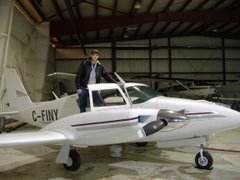
Just got back from a visit back down in London. I was lucky enough to get to go home on a long weekend, when all of my friends were free/home as well, and it was awesome weather.
We took off Friday morning in the Twin Comanche, first bound for North Bay, as I was dropping a friend off there for the weekend so she could visit her friends as well. I've decided that I don't like North Bay. Its such a huge airport (that I'm not really familiar with), and there's no control tower to tell you what to do. There's only a radio service, which means its up to you to find out where you need to go and how to get there to take-off or park after you've landed. Its strange taxi-ing around such a huge airport without the reasurring clearances issued by the controllers. It makes me feel like I'm doing something wrong.
After I dropped my friend off I started back up again and picked my way through the taxi-ways back to the active runway.
I had a great weekend. Went camping for a night, then canoeing, spent a day at the beach playing volleyball, played some tennis with my Dad, and helped out with some farm chores. All in all a pretty full weekend. Good times. Today it was time to head back up and back to work. I was planning to leave around 9:30 in the morning but London was fogged in, and didn't get away until around noon to head back up to North Bay again for the first stop. It was a relaxing flight. I only had about a 5 knot headwind, and it was pretty smooth above the clouds at 7500 ft. I had the airplane cruising on autopilot and managed to read a couple chapters of one of the books I borrowed.
When we got back we gathered all our stuff and parked the airplane and by that time the fuel truck showed up with the Ops Manager and the other pilot - we each had one freight flight up the coast, so off I go to the races.
The flight up the coast was fairly uneventful, the flight on the way back started to get interesting about 20 miles from the field. I was just about to key the mic and call the radio service to advise I was 20 miles and about 9 minutes out when a big Hawker freight plane beat me to it. He also called inbound and although he was still behind me estimated the field about 45 seconds before me. The other pilot in the C-206 was also about 3 miles behind me, so we were all planning on landing within the span of about 2 minutes. Could get interesting. We were all instructed to report 10 miles out, and there were a few minutes until that point where none of us were entirely sure how it was all going to pan out. I watched the mileage to go tick down on the GPS and tried to find the Hawker coming up behind me. He stayed at a higher altitude then me so I wasn't worried of a risk of collision, but more so whether he was going to pass me in time to make his descent and land before I started my approach. We all planned to the use the runway that allowed a straight in approach.
At 10 miles back I called the radio service again and advised my position and also made the suggestion that if the C-206 behind me had me visual I could slow down a bit to give the Hawker more time to get in front of me. So that was the plan. By the time I spotted the Hawker I realized even with me slowed WAY down it still didn't give him enough time to pass me, so I advised that I'd join the circuit on a left base instead of final. I watched as I crept closer and closer to the airport dragging the airplane along at 90 mph while the Hawker rumbled along its approach on final parallel to my flight path. I could slowed down further, but I also didn't want to push my luck with the C-206 following behind me. Even adding a base leg into my circuit left me fairly close behind the Hawker. As I was turning short final he was just starting to clear the runway. The Hawker is a big airplane, bigger then a Dash-8-100, so I was concerned a little bit about the possible wake turbulence. I made a mental note of where the Hawker touched down, and made sure to keep my approach higher and land beyond it. I must have just grazed the wake turbulence area on short final because for a quick second the airplane waggled and shuddered before smoothing out again. I touched down without incident and rolled to the end of the runway to quickly clear for the last of the three of us landing.
Tuesday, September 8, 2009

Wednesday, September 2, 2009
Who wouldn't wanna be me?
Last night I found myself in an empty airplane on the last flight of the day westbound into a beautifully clear sky with the sun setting in front of me. I was in a good mood and was rocking out on my MP3 player to Keith Urban's "Who wouldn't wanna be me" song as I was flying and watching the sun set.
I always like to lock my gaze on the sun and witness the exact moment that the last sliver of the sun disappears below the horizon. I know I shouldn't look directly at the sun, but at least I was still wearing sunglasses. I usually forget to take them off when the evening light starts to fade, and inevitably end up wondering why the cockpit lighting doesn't seem to be as bright as I think it should be. That's when I remember that I'm still wearing sunglasses.
Well just as soon as the sun went down, I remember reading Alan Cockrell's post on his blog http://alancockrell.blogspot.com/ about having the sun and moon on his "yo-yo string" and being able to make the sun or moon come back into the sky after it had already set by climbing. I imagined how that would be cool to see. I assumed you could only see that flying a jet aircraft that has the power to quickly climb into altitudes well above what little piston aircraft can do... or could you? Could my little Cherokee haul the sun back up to this side of the horizon? Nah... there's no way. I almost didn't try it. Then in a split second, now or never decision I pushed the mixture, prop, and power levers in and pulled back into the best climb the little Cherokee could muster. When I had finished converting my kinetic energy into altitude I pushed the nose back down into a more reasonable attitude and looked to where the sun had set. NO WAY! Sure enough, a mere 1000 ft climb had summoned about a quarter of that orange glowing disk back into the atmosphere. I broke out laughing hysterically in disbelief. What a sight!
Fantastic. Who wouldn't wanna be me?
I always like to lock my gaze on the sun and witness the exact moment that the last sliver of the sun disappears below the horizon. I know I shouldn't look directly at the sun, but at least I was still wearing sunglasses. I usually forget to take them off when the evening light starts to fade, and inevitably end up wondering why the cockpit lighting doesn't seem to be as bright as I think it should be. That's when I remember that I'm still wearing sunglasses.
Well just as soon as the sun went down, I remember reading Alan Cockrell's post on his blog http://alancockrell.blogspot.com/ about having the sun and moon on his "yo-yo string" and being able to make the sun or moon come back into the sky after it had already set by climbing. I imagined how that would be cool to see. I assumed you could only see that flying a jet aircraft that has the power to quickly climb into altitudes well above what little piston aircraft can do... or could you? Could my little Cherokee haul the sun back up to this side of the horizon? Nah... there's no way. I almost didn't try it. Then in a split second, now or never decision I pushed the mixture, prop, and power levers in and pulled back into the best climb the little Cherokee could muster. When I had finished converting my kinetic energy into altitude I pushed the nose back down into a more reasonable attitude and looked to where the sun had set. NO WAY! Sure enough, a mere 1000 ft climb had summoned about a quarter of that orange glowing disk back into the atmosphere. I broke out laughing hysterically in disbelief. What a sight!
Fantastic. Who wouldn't wanna be me?
Friday, August 28, 2009
Random Untold Stories
So in the past few months I've had a bunch of other interesting experiences/stories that I haven't yet blogged about mainly due to the reason that they're not big enough events to dedicate an entire blog entry to. They're still fun to mention though, so this blog entry is dedicated to all the short little random stories I have, explained in no particular order, with no particular continuity, nor with any particular point.
I transported a coffin up the coast once, complete with a body inside. The coffin arrived at the airport early however on the back of a pickup truck, and we couldn't take it until later in the morning. So the driver of the pickup ended up cruising around town doing his errands for 3 hrs with a casket and dead person riding around in the back. Yep, we're up north. When we unloaded it from the airplane we muscled it out of the airplane and loaded into the back of another pickup truck, and off they went.
I've also hauled gravestones on a different occasion, earlier in the summer. Those things are HEAVY!
A couple days ago I did another sightseeing flight, which is about 4 for me this summer. I like doing them, because my passengers have all been very appreciative which makes my day. I also haven't done so many that it becomes "just another flight" however. My latest tourists were a couple guys from North Bay, I think a father and middle aged son. They thanked me after we landed and said it was great. I also heard from our dispatcher afterwords (who gave them a ride back from the airport) that they also had lots great things to say about my aviating, how they could tell I was a really good pilot and the landing was very smooth. Complements like that always make my day and give me warm fuzzies. There was another older tourist lady I took up earlier in the summer, just by herself. It was a bumpy day, but she didn't care because she said she was determined to go for a "bush plane ride". She was so thrilled and thankful, and when we landed she told me her life was now complete.
Today during my landing flare the nose cargo compartment door became unlatched and flew open and up. There was nothing in the compartment to fall out, so no harm done, but is awfully distracting when it happens. That's the 3rd time its happened in the last 2 months. The Last time was also during my flare just before touchdown, the other time was during my landing rollout after I touched down. Last inspection the AME's looked at it and ordered a new latch for it, and also in the meantime made an adjustment on the latching mechinism in the hopes that it would help. We're due for inspection in another couple days, so hopefully the new latch is in and it'll get changed out. Its kind of embarrasing when it happens and I have passengers onboard.
I've finally passed the 1000 hr mark. As of my writing this I'm at 1014 hrs total time. Pretty exciting.
I've encounterd some interesting things on the runways up here. One time a pack of some sort of canines crossed the runway just as I was coming in to land, so I just added a bit of power for a second to extend my touchdown point. After I touched down however, there was a large flock of seagulls milling about on the runway in front of me. So after making the effort to lengthen my landing I found myself having to brake quite heavily. All turned out ok. A few weeks ago there was someone on an ATV trucking down the side of the runway. Technically he wasn't on the runway, he was just on the other side of the row of lights, so I didn't see any harm in landing. He was trucking along at probably 40 km/hr in the same direction I was landing, and we bothed looked at each other as I cruised past him on my rollout after landing. It was an odd feeling. It felt exactly like that scene from Indiana Jones and the Last Cruisade where the Nazi pilot flies into the tunnel, rips off his wings, and goes sliding past Indy and his father as they're driving through the tunnel. Except lucky for me I still had my wings and landing gear.
I finally received my spiffy new Canadian Aviation Document pilots license. The new passport style booklets. They look much more professional then a tattered piece of blue paper, but the ratings on my license are no longer spelled out in english, but have been given a acronym code. "SMEL" doesn't sound nearly as impressive as "All single pilot non-high performance single and multi-engine land airplanes". Oh well.
I'm sure there are others that I have since forgotten about, but I'm gonna start making notes now and when I remember/aquire more mini-stories I'll compile another post like this.
I transported a coffin up the coast once, complete with a body inside. The coffin arrived at the airport early however on the back of a pickup truck, and we couldn't take it until later in the morning. So the driver of the pickup ended up cruising around town doing his errands for 3 hrs with a casket and dead person riding around in the back. Yep, we're up north. When we unloaded it from the airplane we muscled it out of the airplane and loaded into the back of another pickup truck, and off they went.
I've also hauled gravestones on a different occasion, earlier in the summer. Those things are HEAVY!
A couple days ago I did another sightseeing flight, which is about 4 for me this summer. I like doing them, because my passengers have all been very appreciative which makes my day. I also haven't done so many that it becomes "just another flight" however. My latest tourists were a couple guys from North Bay, I think a father and middle aged son. They thanked me after we landed and said it was great. I also heard from our dispatcher afterwords (who gave them a ride back from the airport) that they also had lots great things to say about my aviating, how they could tell I was a really good pilot and the landing was very smooth. Complements like that always make my day and give me warm fuzzies. There was another older tourist lady I took up earlier in the summer, just by herself. It was a bumpy day, but she didn't care because she said she was determined to go for a "bush plane ride". She was so thrilled and thankful, and when we landed she told me her life was now complete.
Today during my landing flare the nose cargo compartment door became unlatched and flew open and up. There was nothing in the compartment to fall out, so no harm done, but is awfully distracting when it happens. That's the 3rd time its happened in the last 2 months. The Last time was also during my flare just before touchdown, the other time was during my landing rollout after I touched down. Last inspection the AME's looked at it and ordered a new latch for it, and also in the meantime made an adjustment on the latching mechinism in the hopes that it would help. We're due for inspection in another couple days, so hopefully the new latch is in and it'll get changed out. Its kind of embarrasing when it happens and I have passengers onboard.
I've finally passed the 1000 hr mark. As of my writing this I'm at 1014 hrs total time. Pretty exciting.
I've encounterd some interesting things on the runways up here. One time a pack of some sort of canines crossed the runway just as I was coming in to land, so I just added a bit of power for a second to extend my touchdown point. After I touched down however, there was a large flock of seagulls milling about on the runway in front of me. So after making the effort to lengthen my landing I found myself having to brake quite heavily. All turned out ok. A few weeks ago there was someone on an ATV trucking down the side of the runway. Technically he wasn't on the runway, he was just on the other side of the row of lights, so I didn't see any harm in landing. He was trucking along at probably 40 km/hr in the same direction I was landing, and we bothed looked at each other as I cruised past him on my rollout after landing. It was an odd feeling. It felt exactly like that scene from Indiana Jones and the Last Cruisade where the Nazi pilot flies into the tunnel, rips off his wings, and goes sliding past Indy and his father as they're driving through the tunnel. Except lucky for me I still had my wings and landing gear.
I finally received my spiffy new Canadian Aviation Document pilots license. The new passport style booklets. They look much more professional then a tattered piece of blue paper, but the ratings on my license are no longer spelled out in english, but have been given a acronym code. "SMEL" doesn't sound nearly as impressive as "All single pilot non-high performance single and multi-engine land airplanes". Oh well.
I'm sure there are others that I have since forgotten about, but I'm gonna start making notes now and when I remember/aquire more mini-stories I'll compile another post like this.
Monday, August 24, 2009


 A floatplane that struck a sandbar while landing in the river.
Friday, August 21, 2009
You're in Luck
We had a bunch of freight flights today from off the train that we were supposed to take up, but the train doesn't come in until the afternoon, and we had some thunderstorms roll in.
So this morning I just had the one, a passenger flight to the east. I got my orders to head out to the airport, get the plane ready and my one passenger was going to meet me there. Usually passengers wait for us just on the groundside of the airport gate, which is in line of sight of where we park the Cherokee. After getting out there, fueling up and doing my preflight I still couldn't see anyone there, so I took the truck out and parked it just outside the gate in a conspicuous spot. As I was waiting there a man approached me asking about our rates.
I let him know our prices but told him I was just waiting to go on a flight, and the weather was already starting to look iffy.
Apparently he and his girlfriend had intended to fly on the sched service, but the plane was full and he was stuck waiting around on standby. It was the last flight until monday, and he had to be back to work by then, so the situation was starting to get stressful. Turned out he wanted to go to the same place I was taking the passenger I was waiting for. "Well, I'm actually waiting to take somewhere there right now. If you wanna hang around for a bit until she gets here you might be able to split the flight with her." His face just lit up. When my passenger showed up she was thrilled to split the cost of the charter. She had booked a charter with us for the same reason that the guy and his girlfriend couldn't get on the sched run - a wedding was the cause of the unusual amount of travellers.
It made my day to see the stress melt off of the man's face. He was so relieved and thankful, he was calling me an angel in disguise. Long story short, I made a couple people's day, which made my day.
So this morning I just had the one, a passenger flight to the east. I got my orders to head out to the airport, get the plane ready and my one passenger was going to meet me there. Usually passengers wait for us just on the groundside of the airport gate, which is in line of sight of where we park the Cherokee. After getting out there, fueling up and doing my preflight I still couldn't see anyone there, so I took the truck out and parked it just outside the gate in a conspicuous spot. As I was waiting there a man approached me asking about our rates.
I let him know our prices but told him I was just waiting to go on a flight, and the weather was already starting to look iffy.
Apparently he and his girlfriend had intended to fly on the sched service, but the plane was full and he was stuck waiting around on standby. It was the last flight until monday, and he had to be back to work by then, so the situation was starting to get stressful. Turned out he wanted to go to the same place I was taking the passenger I was waiting for. "Well, I'm actually waiting to take somewhere there right now. If you wanna hang around for a bit until she gets here you might be able to split the flight with her." His face just lit up. When my passenger showed up she was thrilled to split the cost of the charter. She had booked a charter with us for the same reason that the guy and his girlfriend couldn't get on the sched run - a wedding was the cause of the unusual amount of travellers.
It made my day to see the stress melt off of the man's face. He was so relieved and thankful, he was calling me an angel in disguise. Long story short, I made a couple people's day, which made my day.
Thursday, August 13, 2009
Stuff Happens
Not a whole lot of excitment going on around here. Staying fairly busy with the flying however. There was one bit of excitment a couple days ago though. There was a private Cessna 206 floatplane that tried to land on the river, hit a submerged sandbar, and flipped over. I heard about it about a half hour after it happenned, and we all went out to gawk at it. You couldn't see much, it was several hundred metres away out in the middle of the river, resting upside down half in the water, half beached on a small island. There was only the pilot onboard I believe, an older gentleman, and he's ok from what I hear.
The airplane is totalled. They have since dragged it out to our place to keep it until they do something with it. One wing is ripped off, the tail is hanging off the back of the airplane, not much left holding it on, one of the floats is bent upwards, and one blade of the prop has been bent right down right at the route. Its quite the sorry sight. I'll get some pictures up when I decide to stop being lazy.
An interesting twist is that the other pilot was down at the maintenance base for the day with our 206 for its 50 hr inspection, and the crashed pilot's buddy showed up there looking for him. They were both headed north for a fishing trip, and the buddy decided to stop at the maintenance base (which is also a floatplane base, its situated on the edge of a small lake), but the doomed 206 float pilot didn't stop with him but continued on. Interesting to get two perspectives of the same event unfolding. Almost like the movie Vantage Point, or at least what I think that movie would be like, as I haven't seen it.
Apparently a floatplane crashed up here last year as well, or maybe two years ago, I'm not quite sure. Funny to think that stuff like this happens every now and then - its just the nature of the industry (particularly the private sector). No matter how much we try to tame it, stuff happens.
The airplane is totalled. They have since dragged it out to our place to keep it until they do something with it. One wing is ripped off, the tail is hanging off the back of the airplane, not much left holding it on, one of the floats is bent upwards, and one blade of the prop has been bent right down right at the route. Its quite the sorry sight. I'll get some pictures up when I decide to stop being lazy.
An interesting twist is that the other pilot was down at the maintenance base for the day with our 206 for its 50 hr inspection, and the crashed pilot's buddy showed up there looking for him. They were both headed north for a fishing trip, and the buddy decided to stop at the maintenance base (which is also a floatplane base, its situated on the edge of a small lake), but the doomed 206 float pilot didn't stop with him but continued on. Interesting to get two perspectives of the same event unfolding. Almost like the movie Vantage Point, or at least what I think that movie would be like, as I haven't seen it.
Apparently a floatplane crashed up here last year as well, or maybe two years ago, I'm not quite sure. Funny to think that stuff like this happens every now and then - its just the nature of the industry (particularly the private sector). No matter how much we try to tame it, stuff happens.
Sunday, August 2, 2009
The Perfect Storm
Yes, I just watched that movie - for the first time. I never got around to seeing it back in the day, but finally while I was down south for maintenance I picked it up for $2.99. And you guys thought I was going to blog about me flying into a storm.
For those who haven't seen the movie "The Perfect Storm", its a story about a small crew of swordfish fishermen off the coast of Massachusetts who get caught in the hurricane of the century and everybody dies. No really. I thought despite being in a nautical setting, its still a great study on human factors, and what influences our judgement and decision making. It also reminded me of the show on Discovery Channel called "Deadliest Catch", which is a reality show following several different crab fishers off what I believe is the Alaskan coast.
For those who haven't seen the move, and those who haven't seen the movie in the last 10 years, I'll provide a quick summary.
The movie opens with all the swordboats (swordfish boats) returning to port and offloading their catches. Our star crew, and ill-fated subjects of the movie, return with little to show for their season's work - a developing trend apparently. The boat owner threatens the captain of the boat (George Clooney) with being replaced if he can't find a way to do better. The entire crew is dissappointed as well considering their cut of the profits is affected by the poor catch.
Despite it being October, near the end of the fishing season, the Captain decides to head back out for one more trip before winter, to try and salvage his job, reputation, and paycheque. There's some foreshadowing that they're going to run into some trouble (like we didn't already know from the title of the movie).
Out on the water after several days of fishing, once again it appears that they're going to come up short. They decide to head even further out to the known hot spot. Back in Boston, a meteorologist is tracking a developing hurricane thats heading north towards our intrepid fishermen. Back with our fishermen, who at this point have made it to the hot spot, are making the catches they were hoping for. Things are looking up. However they are warned via radio, and also by weather charts faxed directly to the Captain onboard, that they're being cut off from shore by the hurricane. They make the decision that they can stay offshore, hang out for a few days once they're done fishing and wait for the storm to pass before heading back inland. They have all their fish packed in ice, so they won't spoil. So far so good. The trouble begins when their ice machine breaks down. Without the constant production of ice, they can't keep their fish from spoiling. This present this with a critical decision - continue to hang around out at sea, wait for the storm to pass and all their fish to spoil, then head home, broke and failures again... or run the gauntlet straight through the hurricane. This is where the excellent study of human factors comes into play. Obviously the safest course of action is to wait for the storm to pass, however there are several factors that influence their decision otherwise. The first is the paycheque. If they wait out the storm, they'll come back with spoiled fish worth nothing. Secondly they're motivated, the Captain especially, by the fact that this is their last chance to make a successful fishing trip. If its not, the Captain will be fired, his reputation and pride spoiled.
Thirdly their lack of understanding of the magnitude of the storm prevents them from seeing the danger. The Captain never really looks at the weather charts faxed to him, and warnings issued by another fishing boat is ignored. Why? I think certainly a contributing factor is the "I've seen worse" syndrome - the falso belief that he can handle anything, because he has in the past. I also think his first reaction to the warnings is the defensive reaction of refusing help, because of the perception that accepting help would reflect poorly on his alrady fragile reputation.
So the decision has been made - through the storm they go. They endure massive waves and wind, constantly being swamped, and having their windows broken by flailing equipment, yet they continue on. Finally the exhausted crew fighting endlessly with a battered boat, make the decision to turn back around. Fatefully, its too little, too late. They're too far into the storm, and they can't make it out. A huge wave finally capsizes them, sinks the boat, and they all drown.
What influenced their decision to continue for so long? I think most of the factors that influenced their decision to try for it in the first place continued to play a part, but additionally, the fact that making a 180 in rough waters is a dangerous maneuver also contributed to them staying the course for so long. I also think that in general as humans once we make a decision, its difficult for us to re-evaluate our decision and change our mind. We're generally stubborn, and rather then honestly re-evaluating the situation and making a new and different decision based on the newly available data, we'd rather justify the original decision instead. That is until its clear beyond any doubt that we made the wrong one, which was the case of the Captain in the movie. Rather then re-evaluting the decision to plunge through the storm, he stuck to his guns, until it was too late. Finding the line that separates "too-late" and "still enough time to turn around" is an incredibly difficult task. The closer you approach the line, the more difficult it is to see, and the more dangerous the situation becomes. On the other hand there are always influencing factors that motivate us to creep closer and closer to that line.
This can apply with any type of activity with risk involved - aviating, seafaring, driving, even working with power tools or at heights. There are factors that motivate us towards taking the risk, yet the goal is to remain in the safe zone. This movie is such a great example because in seafaring the decisions made and the progression from safety to disaster occur slowly over the course of several days, so it is easier to disect. That progression in aviation can occur in a matter of a couple of hours or less. In driving it can occur in a matter of seconds. Understanding our motivation and the factors that influence us is key in staying on the right side of that line.
For those who haven't seen the movie "The Perfect Storm", its a story about a small crew of swordfish fishermen off the coast of Massachusetts who get caught in the hurricane of the century and everybody dies. No really. I thought despite being in a nautical setting, its still a great study on human factors, and what influences our judgement and decision making. It also reminded me of the show on Discovery Channel called "Deadliest Catch", which is a reality show following several different crab fishers off what I believe is the Alaskan coast.
For those who haven't seen the move, and those who haven't seen the movie in the last 10 years, I'll provide a quick summary.
The movie opens with all the swordboats (swordfish boats) returning to port and offloading their catches. Our star crew, and ill-fated subjects of the movie, return with little to show for their season's work - a developing trend apparently. The boat owner threatens the captain of the boat (George Clooney) with being replaced if he can't find a way to do better. The entire crew is dissappointed as well considering their cut of the profits is affected by the poor catch.
Despite it being October, near the end of the fishing season, the Captain decides to head back out for one more trip before winter, to try and salvage his job, reputation, and paycheque. There's some foreshadowing that they're going to run into some trouble (like we didn't already know from the title of the movie).
Out on the water after several days of fishing, once again it appears that they're going to come up short. They decide to head even further out to the known hot spot. Back in Boston, a meteorologist is tracking a developing hurricane thats heading north towards our intrepid fishermen. Back with our fishermen, who at this point have made it to the hot spot, are making the catches they were hoping for. Things are looking up. However they are warned via radio, and also by weather charts faxed directly to the Captain onboard, that they're being cut off from shore by the hurricane. They make the decision that they can stay offshore, hang out for a few days once they're done fishing and wait for the storm to pass before heading back inland. They have all their fish packed in ice, so they won't spoil. So far so good. The trouble begins when their ice machine breaks down. Without the constant production of ice, they can't keep their fish from spoiling. This present this with a critical decision - continue to hang around out at sea, wait for the storm to pass and all their fish to spoil, then head home, broke and failures again... or run the gauntlet straight through the hurricane. This is where the excellent study of human factors comes into play. Obviously the safest course of action is to wait for the storm to pass, however there are several factors that influence their decision otherwise. The first is the paycheque. If they wait out the storm, they'll come back with spoiled fish worth nothing. Secondly they're motivated, the Captain especially, by the fact that this is their last chance to make a successful fishing trip. If its not, the Captain will be fired, his reputation and pride spoiled.
Thirdly their lack of understanding of the magnitude of the storm prevents them from seeing the danger. The Captain never really looks at the weather charts faxed to him, and warnings issued by another fishing boat is ignored. Why? I think certainly a contributing factor is the "I've seen worse" syndrome - the falso belief that he can handle anything, because he has in the past. I also think his first reaction to the warnings is the defensive reaction of refusing help, because of the perception that accepting help would reflect poorly on his alrady fragile reputation.
So the decision has been made - through the storm they go. They endure massive waves and wind, constantly being swamped, and having their windows broken by flailing equipment, yet they continue on. Finally the exhausted crew fighting endlessly with a battered boat, make the decision to turn back around. Fatefully, its too little, too late. They're too far into the storm, and they can't make it out. A huge wave finally capsizes them, sinks the boat, and they all drown.
What influenced their decision to continue for so long? I think most of the factors that influenced their decision to try for it in the first place continued to play a part, but additionally, the fact that making a 180 in rough waters is a dangerous maneuver also contributed to them staying the course for so long. I also think that in general as humans once we make a decision, its difficult for us to re-evaluate our decision and change our mind. We're generally stubborn, and rather then honestly re-evaluating the situation and making a new and different decision based on the newly available data, we'd rather justify the original decision instead. That is until its clear beyond any doubt that we made the wrong one, which was the case of the Captain in the movie. Rather then re-evaluting the decision to plunge through the storm, he stuck to his guns, until it was too late. Finding the line that separates "too-late" and "still enough time to turn around" is an incredibly difficult task. The closer you approach the line, the more difficult it is to see, and the more dangerous the situation becomes. On the other hand there are always influencing factors that motivate us to creep closer and closer to that line.
This can apply with any type of activity with risk involved - aviating, seafaring, driving, even working with power tools or at heights. There are factors that motivate us towards taking the risk, yet the goal is to remain in the safe zone. This movie is such a great example because in seafaring the decisions made and the progression from safety to disaster occur slowly over the course of several days, so it is easier to disect. That progression in aviation can occur in a matter of a couple of hours or less. In driving it can occur in a matter of seconds. Understanding our motivation and the factors that influence us is key in staying on the right side of that line.
Subscribe to:
Posts (Atom)