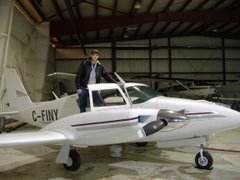
Happy Remembrance Day everyone. I hope you all had time this morning and did better than me to pause for our veterans. I missed my chance at 11:00 AM to give a minute of silence, as I was loading the airplane and pre-flighting for my first flight of the day and 11 AM slipped right past me. As I taxiied out I checked my watch to record the time up and it was 11:11. I guess the 11th minute of the 11th hour of the 11th day of the 11th month will have to do. I sat at the end of the runway lined up and ready to go, the engine idling, as I gave a moment to ponder our veterans of the 2 World Wars. I could only manage 15 seconds before I had to cut it short because there was an Embraer 110 on final behind me closing fast.
It was windy today. Very windy. Gusts on the surface started out strong, and got stronger as the day went on, but I was lucky in that the wind direction was lined up within 10 degrees of the runways on both ends of the flights, so I didn't have much crosswind to wrestle with. But it did mean I had almost a direct crosswind for the cruising portion of the flights. It was quite fun actually, the upper winds were pushing 50-60 knots, which meant my wind drift was almost 30 degrees. You always have at least a few degrees of drift (the angle between the heading of the airplane and the actual path its travelling), but I don't think I've ever had as much as I did today. When flying I find it difficult to wrap my mind around pointing the airplane 30 degrees to one side of where I actually want to end up. Its unintuitive to keep where you want to go that far away from directly in front of you. Once I had the airport in sight I had to resist the urge to steer directly towards it.
Since the winds were so strong I couldn't resist the chance to see if I could slow the airplane down, and turn it into the wind to see if I could stop the airplane in midair altogether. The slowest I managed was 8 knots groundspeed on the GPS, which pretty much looks and feels like a standstill looking out the window. The 206 with its Robinson STOL kit can land and stop in an impressively short distance to begin with, but today with the winds I could have it down and stopped in under 100 ft with full flaps and a nice slow approach speed. What fun!
The high winds picked up as the day went on as a result of a low pressure system moving in from the north. I could see the weather system moving in on on the trip before, the winds were getting quite strong, and we were pretty much out of daylight, so when I taxied in I figured we call it day. Normally we would have called it quits, but the next load included some electrical supplies, which HAD to be there that night. Apparently there was an electrician that had been flown up the coast and he was leaving the next day, so I agreed to brave the winds, rain (which didn't turn out to be that bad), and darkness to get the job done. Technically we're a day only operation, but we can fly the airplane just like a private operator for repositioning flights and such when there isn't any paying passengers or freight onboard. So I had to make it up north with the load before official night-time, and the flight on the way back which would be empty would be legal to make.
It made me think about the idea of managed risk. Its the essence of commercial aviation. In one sense you always want to mitigate the risk as much as possible, but at the same time there is a job to do, and customers that are counting on you. Private pilots have the luxury of just deciding not to go flying if the weather isn't exactly how they like it, but its a bit more of a delicate balance with commercial aviation. In this case NORMALLY we wouldn't have made the flight, cause they can usually wait a day or two for more pop and chips, but today they couldn't wait on the electrical supplies - at least not without incurring a great deal more expense. So I thought about where do we draw the line? By doing the flight both the company and myself were exposing ourselves to a certain amount of MORE risk/danger than usual, but we were still charging the same amount for the trip, and the consequences would still be exactly the same if I bent up the airplane (ie. expensive repairs/possible injury). So why did we make an exception for this flight? At first it seemed like we should decide on an acceptable level of risk and never cross that line under any circumstances, regardless of the urgency. If the immediate rewards were still the same (in the form of X number of dollars paid for completing the trip), why increase the risk?
I came to the conclusion that its not always that simple. Sometimes its just good business sense to increase the acceptable level of risk in certain conditions. Like I said, the essence of commercial aviation is to manage the risk, not to cap it. In that case I was still very sure I could make the flight safely, as was my boss, so that temporary increased risk was worth the reward, intangible as it may be, of proving ourselves able to be counted on by our customers. From a business standpoint that makes the difference. If it was just another usual pop and chips run that could wait, it wouldn't make sense to expose ourselves to the increased risk, because it wouldn't make such a big impression on the customer. But when it mattered to the customer, it mattered that we came through, and as a result will be around for that customer to call on us again to use our service. Safety is always counter balanced by running a viable business. If we cancelled flights too much out of "safety", the company would go under eventually. In the other sense, running a viable business also to some extent contributes to safety. If a company crashed or bent up an airplane every week it wouldn't take long to go bankrupt. Obviously there's a threshold where it just isn't worth the risk, but that threshold can be different for every flight.
I joked once that I was going to start up a competing company to the one I work for now. My fleet would comprise of Cessna 150's cause they're cheap (I'd operate them two-crew, for safety of course). That way in addition to not doing any sort of maintenance whatsoever, and hiring extremely low time pilots at minimum wage, I'd be able to offer much lower prices than my competitors. When an engine seized up or a wing fell off out of lack of maintenance and crashed in the bush I'd just buy another Cessna 150 and hire a couple more pilots. Its the perfect business plan... right? Anyways back to the serious discussion.
Flying freight in higher-risk situations is one thing, but what about exposing passengers to increased risk? That can sometimes be a tricky situation. When I'm flying freight the only one that's exposed to that higher level of risk is me, and I have the ultimate go/no decision, and I'm well aquainted with the level of risk for that particular flight. Not so with passengers. Most passengers would have no idea of the level of risk that they're being exposed to, and generally trust 100% that they're not being put in harms way. Luckily I found however, is that MOST of the time that works itself out, simply by the fact that flying in weather that increases the the level of risk an appreciable amount, is weather that is far beyond the level where most passengers would be scared crapless. Usually when its a passenger trip with questionable weather we cancel the flight out of fear that the passengers would be airsick, or scared crapless, or otherwise be convinced we're crazy to go flying (and choose not to fly with us again) long before we'd cancel the trip out of a genuine risk to safety. So in that sense consideration for our passengers' sanity (so they DO fly with us again) generally prevents the need to asses the actual risk to safety.
I'm essentially separated from the business side of the decisions, so I never have to weigh the safety vs. the business gain. Its a good thing, I've come to realize a long time ago I'm not a very good businessman. My job is JUST being the pilot. Somebody else gets to decide whether or not it would make good business sense to try to attempt the flight. That doesn't mean my fate is left to someone else though, or that I just skip the decision making process altogether. My job IS the pilot. Its still my right and responsibility to consider whether "I" think I can do it safely or not. I don't have to consider the business ramifications however, my decision is based almost entirely on if I'm gonna come back alive or not. In practice however most of this is all just theory, because my employers are ALL pilot's themselves, so they can generally make a pretty good decision all on their own, with the exceptions that sometimes they need input from me on current weather conditions (since they can't see it for themselves from the airplane) and my particular skill-level (although by now they know my skill-level fairly well).
So that was my thought process provoked by the flight today. Writing it down may have been long-winded and far too over-analytical for the actual importance of the event, but I won't apologize. Its my blog.
Showing posts with label aviation. Show all posts
Showing posts with label aviation. Show all posts
Wednesday, November 11, 2009

Thursday, November 5, 2009
Just One of Those Days
We had 4 inches of snow last night. I had some flights I was supposed to do in the morning around 8:30, but the boss said if the weather doesn't look great when I wake up just go back to bed. Sounds good to me. Sure enough as my alarm went off this morning I got up and peaked out the window. I was surprised to see the winter wonderland out the window, but it didn't look to good for flying. Just to be sure I checked the weather reports, and they confirmed the Mark 1 Weather Observation System (aka living room window), so I crawled back under the gloriously warm blankets.
About an hour or so later the boss knocked on my door as per usual and said the weather's looking better, so to be ready in a half hour. We were supposed to have a couple freight trips, but we didn't end up getting all of the freight for one of the trips, so that's been pushed till tomorrow, so I just had the one, and then I had one pax trip after the train arrived in the afternoon.
The Cherokee is down south for maintenance, so I'm flying the C206 in the meantime. I've got almost 50 hrs in it now, and its starting to grow on me, but I think I still like the Cherokee a better. The 206 is just so awkward to climb into. You have to move the seat all the way back, then climb in by vaulting off the tire, and somehow squeeze your feet through the 6" space between the seat and the front of the door openning. Then you have to slide the seat forward, watching that you don't tangle your feet in the dangling headset wires in the process. Before you do that however you have to latch the back cargo door, which can only be done from the inside. Not a big deal if you have a full load of passengers, you can just get them to do it, but if the back of the airplane is all loaded up with freight you have to go in from the front door, somehow reach across the airplane through/over the baggage, feel for the handle, and latch it (you'll have to do that again to unlatch it). Boarding was not a top priority on the engineer's design features for Cessnas.
We got out to the airport, and thankfully it was still well below zero the snow was dry and fluffy so it was just a matter of pulling the wing covers off and then brushing off the rest of the airplane. No scraping ice. We also ended up waiting 15 min or so for the freight to be delivered out to the airplane, so I got a chance to brush the snow off the Twin Comanche as well. Better to do it now than when it warms up a few degrees and turns crusty. The first trip was uneventful. After I came back we still had a couple hours until the train came in so I had a chance to go home and get something to eat before I headed out for my second trip.
The second trip was two adults, both large people, with a baby and a small toddler, and a TON of stuff. It was awkward stuff to pack too. Things like a shovel, a baby basket and a sled as well as the usual boxes and bags. Finally we managed to pack it all in and squeeze the doors shut. The packing job was a work of art. Next came loading the passengers in from the other door. I keep my flight bag in between the two front seats, but that presents a problem for the front seat passenger in boarding since he has to climb over the pilot seat into the front right seat, so I pulled my bag out and put it on the ground beside the airplane. I'll throw it back in after my front passenger has boarded and then I'll be the last to climb in myself. The woman climbed in and got seated in the back, and I waited to host the toddler up onto her lap as she dug around for her seatbelt. She found the one strap, but couldn't locate the other one. I tried to poke my head in and help her dig around to find it, but with no luck. It must have been buried under the bags packed beside the seat. I couldn't get it with her still seated, so she had to extricate herself from the airplane so I could better dig my hands under the bags and pull it out. Still no luck, I couldn't find it. I did however find the rung that it should have been attached to, so that means it wasn't there. Dang. So I wormed my arm through the stacks of cargo to unlatch the back door, and then walked around to the other side of the airplane to see if I could dig up the seatbelt. I tried rustling around with my hand wedged under all the cargo to find it, but still had no luck, so getting quite frusterated, started UNPACKING the back of the airplane again to locate the missing seatbelt strap. I ended up unpacking the entire airplane, because the strap must have somehow come loose during the previous freight trip and been thrown by someone to the very tail end of the cabin.
In a hurried frusteration I started REPACKING the airplane again. It wasn't quite the work of art that it was the first time, but still managed to get it all in there. Time for take two. Once again I closed the door and walked back around to start the boarding process again. Somehow try to latch the back door, load the back passenger, get her belted in, hand her the toddler. Hold the baby while the front passenger climbs in. I've held so many babies this year than I ever thought I would. I used to generally avoid holding babies cause I had never really done it before, but its kind of a requirement of the job here. Apparently I'm doing something right because when the father handed him to me he was crying away, but as soon as I took him in my arms he stopped instantly, lol. Finally everyone was good to go, so I hauled myself up into the airplane. I got seated, and was just about to put my seatbelt on when the passenger in the back piped up, "What about your briefcase?" Aww frig, there it is, still sitting on the ground beside the airplane, out of arms reach. So I extricated myself from the airplane to retrieve my bag, stuffed it between the seats, and climbed back in. I'm glad she said something. I probably would have started up the airplane, then reached for my notebook to record the time, and done the 'ol slap the forehead routine. What a gong show. FINALLY everyone was aboard, the doors were closed, and we were ready to go. Just one of those days.
About an hour or so later the boss knocked on my door as per usual and said the weather's looking better, so to be ready in a half hour. We were supposed to have a couple freight trips, but we didn't end up getting all of the freight for one of the trips, so that's been pushed till tomorrow, so I just had the one, and then I had one pax trip after the train arrived in the afternoon.
The Cherokee is down south for maintenance, so I'm flying the C206 in the meantime. I've got almost 50 hrs in it now, and its starting to grow on me, but I think I still like the Cherokee a better. The 206 is just so awkward to climb into. You have to move the seat all the way back, then climb in by vaulting off the tire, and somehow squeeze your feet through the 6" space between the seat and the front of the door openning. Then you have to slide the seat forward, watching that you don't tangle your feet in the dangling headset wires in the process. Before you do that however you have to latch the back cargo door, which can only be done from the inside. Not a big deal if you have a full load of passengers, you can just get them to do it, but if the back of the airplane is all loaded up with freight you have to go in from the front door, somehow reach across the airplane through/over the baggage, feel for the handle, and latch it (you'll have to do that again to unlatch it). Boarding was not a top priority on the engineer's design features for Cessnas.
We got out to the airport, and thankfully it was still well below zero the snow was dry and fluffy so it was just a matter of pulling the wing covers off and then brushing off the rest of the airplane. No scraping ice. We also ended up waiting 15 min or so for the freight to be delivered out to the airplane, so I got a chance to brush the snow off the Twin Comanche as well. Better to do it now than when it warms up a few degrees and turns crusty. The first trip was uneventful. After I came back we still had a couple hours until the train came in so I had a chance to go home and get something to eat before I headed out for my second trip.
The second trip was two adults, both large people, with a baby and a small toddler, and a TON of stuff. It was awkward stuff to pack too. Things like a shovel, a baby basket and a sled as well as the usual boxes and bags. Finally we managed to pack it all in and squeeze the doors shut. The packing job was a work of art. Next came loading the passengers in from the other door. I keep my flight bag in between the two front seats, but that presents a problem for the front seat passenger in boarding since he has to climb over the pilot seat into the front right seat, so I pulled my bag out and put it on the ground beside the airplane. I'll throw it back in after my front passenger has boarded and then I'll be the last to climb in myself. The woman climbed in and got seated in the back, and I waited to host the toddler up onto her lap as she dug around for her seatbelt. She found the one strap, but couldn't locate the other one. I tried to poke my head in and help her dig around to find it, but with no luck. It must have been buried under the bags packed beside the seat. I couldn't get it with her still seated, so she had to extricate herself from the airplane so I could better dig my hands under the bags and pull it out. Still no luck, I couldn't find it. I did however find the rung that it should have been attached to, so that means it wasn't there. Dang. So I wormed my arm through the stacks of cargo to unlatch the back door, and then walked around to the other side of the airplane to see if I could dig up the seatbelt. I tried rustling around with my hand wedged under all the cargo to find it, but still had no luck, so getting quite frusterated, started UNPACKING the back of the airplane again to locate the missing seatbelt strap. I ended up unpacking the entire airplane, because the strap must have somehow come loose during the previous freight trip and been thrown by someone to the very tail end of the cabin.
In a hurried frusteration I started REPACKING the airplane again. It wasn't quite the work of art that it was the first time, but still managed to get it all in there. Time for take two. Once again I closed the door and walked back around to start the boarding process again. Somehow try to latch the back door, load the back passenger, get her belted in, hand her the toddler. Hold the baby while the front passenger climbs in. I've held so many babies this year than I ever thought I would. I used to generally avoid holding babies cause I had never really done it before, but its kind of a requirement of the job here. Apparently I'm doing something right because when the father handed him to me he was crying away, but as soon as I took him in my arms he stopped instantly, lol. Finally everyone was good to go, so I hauled myself up into the airplane. I got seated, and was just about to put my seatbelt on when the passenger in the back piped up, "What about your briefcase?" Aww frig, there it is, still sitting on the ground beside the airplane, out of arms reach. So I extricated myself from the airplane to retrieve my bag, stuffed it between the seats, and climbed back in. I'm glad she said something. I probably would have started up the airplane, then reached for my notebook to record the time, and done the 'ol slap the forehead routine. What a gong show. FINALLY everyone was aboard, the doors were closed, and we were ready to go. Just one of those days.
Sunday, October 25, 2009
Winter Flying is Here
So winter arrived for real yesterday. We got about 2 inches of snow over the course of yesterday and last night. As the afternoon rolled around my boss came by to tell me the weather looked ok to try some flights. We had a couple trips booked.
When I got out to the airport they had the Cherokee fueled and loaded up and the wing covers off already. I had to take one passenger and a load of the usual freight up to the usual destination. The AWOS was calling 1500 ft ceilings and good visibility before I took off, with the surface temperature just above freezing. I took off into a crisp 13 kt wind directly down the runway. Most of the flight we went through some mist/drizzle, so I stayed at 500 ft, knowing that the temperature up above would probably dip just below freezing, making the drizzle turn into icing conditions. I was sure to be vigilant in checking for carburetor icing. Carburetors have the interesting property of being able to ice up even in atmospheric temperatures well above freezing. Carburetors employ a bernoulli effect to create a lower pressure and draw up the fuel and mix it with the air. A side effect of this air pressure lowering is a cooling effect on the air. So even though outside air temperatures may be above freezing, its quite possible that the air in the carburetor is well below freezing temperatures.
As I left the airport area I passed the local Navajo coming back from where I was going. We gave each other a quick call to make sure we were safely separated, and he also let me know conditions up the coast were about 1500 ft ceilings, good vis underneath, with the winds on a direct crosswind to the runway. The winds weren't too strong, and I touched down lightly on a slushly and soggy gravel runway, with two tiny snow piles plowed alongside the runway.
I dropped off my passenger and unloaded the freight tromping around on the slushy gravel. I bought some winter boots about a week ago when I was down south for the last inspection, and today I was glad I did, my feet stayed warm and dry. They're kind of like a high hiking boot except with a fully rubberized foot section so they're fully waterproof up to about 3 inches, but the lace and toungue section is also fully attached to make them near-waterproof up to the full height of the boot. My summer-weight hiking boots I've been wearing all summer are cracked in the bottom of the rubber sole and no longer waterproof in the least. For the price I paid they didn't hold up to much actually, they started cracking like that 4 months after I bought them, and I haven't really abused them in the least. Don't ever buy Prospector brand boots, waste of $120. Pieces.of.crap. Hopefully my new winter Columbia brand boots hold up better. They were regular $76, but when I took them to the counter to pay for them, surprise! They were on sale for $60. Sweet deal.
Anyways, once again the cops were there to do a quick search. They've really been cracking down. They've been at the airport almost every time I've been there the last few weeks. Its good.
I took off and climbed out to head back south. I knew for the second trip since it was getting late in the day it would cool down a few degrees more, so I decided to do some experimenting and climb up to 1500 hr ft, where it would be cooler, and I could simulate what the misty conditions would do on my second trip back up north in the cooler weather. Sure enough as the temp dropped below 0 the water droplets on the window would start to freeze. That's icing, so I went back down lower where we were still in the positive temps. By the time I had made it back further south and temperature had already dropped a couple of degrees, and even at 500 it was -1. I checked the AWOS and the surface temp was reported as being right on 0.
My windshield had started collecting trace amounts of ice even down at 500 ft. I wasn't going through the drizzle for the entire flight, so the ice would collect on the windshield for a few minutes, and then sublimate off, then collect some more etc, so I never got a build-up any thicker than just a paper-thin layer, but it was icing nonetheless. I landed and my boss pulled up with another passenger with him and asked me how the weather was. I told him about the icing.
"Oh, well thats not too good, I guess we'll try the second trip in the morning."
So that was it for the day, he turned around to take the passengers back while I pushed the airplane back into its parking spot, refueled it and put the engine blanket back on. There was still a thin layer of clear ice covering the leading edges of the wings. It was only maybe the thickness of 2 or 3 pieces of paper - not thick enough to see from the cockpit with no sun to glint off of it, but it was still cool to see it up close. I've picked up a little bit of icing a couple times before in the last month, but its always been above 0 degrees on the ground and so had melted off and disappeared before I had a chance to look at it from outside the cockpit.
When I got out to the airport they had the Cherokee fueled and loaded up and the wing covers off already. I had to take one passenger and a load of the usual freight up to the usual destination. The AWOS was calling 1500 ft ceilings and good visibility before I took off, with the surface temperature just above freezing. I took off into a crisp 13 kt wind directly down the runway. Most of the flight we went through some mist/drizzle, so I stayed at 500 ft, knowing that the temperature up above would probably dip just below freezing, making the drizzle turn into icing conditions. I was sure to be vigilant in checking for carburetor icing. Carburetors have the interesting property of being able to ice up even in atmospheric temperatures well above freezing. Carburetors employ a bernoulli effect to create a lower pressure and draw up the fuel and mix it with the air. A side effect of this air pressure lowering is a cooling effect on the air. So even though outside air temperatures may be above freezing, its quite possible that the air in the carburetor is well below freezing temperatures.
As I left the airport area I passed the local Navajo coming back from where I was going. We gave each other a quick call to make sure we were safely separated, and he also let me know conditions up the coast were about 1500 ft ceilings, good vis underneath, with the winds on a direct crosswind to the runway. The winds weren't too strong, and I touched down lightly on a slushly and soggy gravel runway, with two tiny snow piles plowed alongside the runway.
I dropped off my passenger and unloaded the freight tromping around on the slushy gravel. I bought some winter boots about a week ago when I was down south for the last inspection, and today I was glad I did, my feet stayed warm and dry. They're kind of like a high hiking boot except with a fully rubberized foot section so they're fully waterproof up to about 3 inches, but the lace and toungue section is also fully attached to make them near-waterproof up to the full height of the boot. My summer-weight hiking boots I've been wearing all summer are cracked in the bottom of the rubber sole and no longer waterproof in the least. For the price I paid they didn't hold up to much actually, they started cracking like that 4 months after I bought them, and I haven't really abused them in the least. Don't ever buy Prospector brand boots, waste of $120. Pieces.of.crap. Hopefully my new winter Columbia brand boots hold up better. They were regular $76, but when I took them to the counter to pay for them, surprise! They were on sale for $60. Sweet deal.
Anyways, once again the cops were there to do a quick search. They've really been cracking down. They've been at the airport almost every time I've been there the last few weeks. Its good.
I took off and climbed out to head back south. I knew for the second trip since it was getting late in the day it would cool down a few degrees more, so I decided to do some experimenting and climb up to 1500 hr ft, where it would be cooler, and I could simulate what the misty conditions would do on my second trip back up north in the cooler weather. Sure enough as the temp dropped below 0 the water droplets on the window would start to freeze. That's icing, so I went back down lower where we were still in the positive temps. By the time I had made it back further south and temperature had already dropped a couple of degrees, and even at 500 it was -1. I checked the AWOS and the surface temp was reported as being right on 0.
My windshield had started collecting trace amounts of ice even down at 500 ft. I wasn't going through the drizzle for the entire flight, so the ice would collect on the windshield for a few minutes, and then sublimate off, then collect some more etc, so I never got a build-up any thicker than just a paper-thin layer, but it was icing nonetheless. I landed and my boss pulled up with another passenger with him and asked me how the weather was. I told him about the icing.
"Oh, well thats not too good, I guess we'll try the second trip in the morning."
So that was it for the day, he turned around to take the passengers back while I pushed the airplane back into its parking spot, refueled it and put the engine blanket back on. There was still a thin layer of clear ice covering the leading edges of the wings. It was only maybe the thickness of 2 or 3 pieces of paper - not thick enough to see from the cockpit with no sun to glint off of it, but it was still cool to see it up close. I've picked up a little bit of icing a couple times before in the last month, but its always been above 0 degrees on the ground and so had melted off and disappeared before I had a chance to look at it from outside the cockpit.
Monday, October 12, 2009
Thanksgiving Shakedown
Fall air is definitely here. I can smell that crispness in the air, and I'm starting to have to bundle up as well. I always bring more sweaters/coats then I have to because you never know how cold it might be 150 miles north, and it wouldn't hurt to have an extra layer of clothes handy if I end up on an unplanned night of camping in the middle of nowhere.
A few days ago I took the Twin Comanche up for some circuits. Its been a few weeks now since the engines have been fired up, and I had a bit of a craving for some twin flying. I just went up for 3 circuits, about a half hour flight which satisfied my fix and gave the engines a good workout. At one point there was a Dash-8 inbound and the radio service advised them that there was a "Cherokee 6" in the circuit. I almost felt like correcting them, but it was my last circuit, and in the big picture my airplane type didn't matter a whole lot in that situation. In the past they've also advised other traffic of a "Twin Comanche" when I've been flying the Cherokee. Its obvious they've made the connection that its the same pilot that flies the two different airplanes, and they key on the sound of my voice I suppose.
Today is the Thanksgiving Monday, and I had a couple flights today, so I didn't get a turkey dinner. Not that I would have if I didn't fly. To be honest its getting a little tiresome living up here being away from friends and family, and not having much to do other than rotate between watching TV, reading, and playing on the computer in my days off. I'm still really enjoying the flying, and I'm going to miss it over the winter, but despite that I'm counting the days on when I'll be home for the winter. I will get my fix of flying over the winter though in the form of IFR training. This winter I REALLY have to finish up my Instrument Rating. If I don't, my INRAT exam will expire and I'll be back to square one with that. I also want to have a shot at a twin-ifr job as well. I have almost 1200 hrs total time now, most of that being PIC time, with almost 200 of that being multi-PIC time as well, so I think I've got a pretty good shot at finding something half decent - hopefully. I'm sure how much good another year of single-engine VFR flying will do career-wise for me. I guess we'll see how it all plays out. Hopefully the industry gets a bit more momentum that it got this last spring.
My first flight today was a couple passengers to the usual destination up the coast. The weather was pretty good with only a broken-scattered layer at around 3500 ft, so enroute it was smooth sailing. When we were loading the airplane my boss mentioned with a bit of a wink in his eye that they didn't seem to have much stuff. Usually passengers load the airplane up stuffed to gross weight to get the most out of what they're paying for the charter. If they don't stuff the airplane, its sometimes a hint that the cargo they do have onboard MIGHT just be helping to pay for the trip in the form of contraband liquor. A couple weeks ago I took one passenger up the coast to the community across the river from the one I was going to today, and this one passenger only took with him 4 boxes and 1 50 lb bag of potatoes. Unfortunately for him, his daughter who was supposed to meet him at the airport didn't show up, so he took off to go hunt her down, and in the meantime, the local police showed up and searched the airplane. Turned out ALL of his boxes were nothing bud bottles of hard liquor. By the time they were finished all he had left that wasn't confiscated was his sack of potatoes. It was hilarious. In that case it was ridiculously obvious that he was trying to smuggle liquor. No one legitimately chartering an airplane only brings 5 small pieces of luggage and themselves with them, it just doesn't make financial sense. One of the officers there mentioned that catching that load before it got distributed meant avoiding lots of headaches. He said that 70% of the violence and trouble they have to deal with up there is a direct result of alchohol.
In the case today, there were two people going up, and they didn't have a ton of stuff, but they did have more than a few pieces, so I didn't think anything of it. Apparently my boss picked up on it though, since he made that comment. When we pulled into the ramp after landing sure enough there was a whole convey of vehicles waiting for us. There was a local police truck, an OPP SUV, and my passengers ride waiting for them. This was only the third time since I've been up here that the police in this town have shown up to search a suspected bootlegger flight, usually the local police don't seem to be that hardcore about searches, not in this community at least. The OPP are pretty hardcore though, you know that if they show up something is going down.
So we unloaded the airplane while all the vehicles surrounded the airplane and they all went to work at opening up the bins and boxes and rustling through the stuff. They also searched the passengers themselves, and I looked over laughed and shook my head when I saw one of the passengers with their foot up on the horizontal stab with her pantlegs pulled up and a bottle of vodka taped to her shins. Where am I. Actually they found quite a bit. By the end of it I counted around 14 bottles of vodka, and another 25 or so bottles of some sort of low-alchohol content cooler-type beverage. Quite the load. I figured the street value of all of that would probably be around $2000. So much for the profits they were hoping for, haha. Usually the cops just confiscate the alchohol and drive away, but this time in addition to the liquor, they also apparently found baggies of weed. Now they were in trouble. Long story short in addition to having the contraband confiscated, they also both got arrested. Well, sucks to be them, lol. Good thing this time we got paid for the flight before we took off. Once all the commotion had finished and the vehicles and people were safely away from the airplane, I started up and I was off heading back home for my next flight.
A few days ago I took the Twin Comanche up for some circuits. Its been a few weeks now since the engines have been fired up, and I had a bit of a craving for some twin flying. I just went up for 3 circuits, about a half hour flight which satisfied my fix and gave the engines a good workout. At one point there was a Dash-8 inbound and the radio service advised them that there was a "Cherokee 6" in the circuit. I almost felt like correcting them, but it was my last circuit, and in the big picture my airplane type didn't matter a whole lot in that situation. In the past they've also advised other traffic of a "Twin Comanche" when I've been flying the Cherokee. Its obvious they've made the connection that its the same pilot that flies the two different airplanes, and they key on the sound of my voice I suppose.
Today is the Thanksgiving Monday, and I had a couple flights today, so I didn't get a turkey dinner. Not that I would have if I didn't fly. To be honest its getting a little tiresome living up here being away from friends and family, and not having much to do other than rotate between watching TV, reading, and playing on the computer in my days off. I'm still really enjoying the flying, and I'm going to miss it over the winter, but despite that I'm counting the days on when I'll be home for the winter. I will get my fix of flying over the winter though in the form of IFR training. This winter I REALLY have to finish up my Instrument Rating. If I don't, my INRAT exam will expire and I'll be back to square one with that. I also want to have a shot at a twin-ifr job as well. I have almost 1200 hrs total time now, most of that being PIC time, with almost 200 of that being multi-PIC time as well, so I think I've got a pretty good shot at finding something half decent - hopefully. I'm sure how much good another year of single-engine VFR flying will do career-wise for me. I guess we'll see how it all plays out. Hopefully the industry gets a bit more momentum that it got this last spring.
My first flight today was a couple passengers to the usual destination up the coast. The weather was pretty good with only a broken-scattered layer at around 3500 ft, so enroute it was smooth sailing. When we were loading the airplane my boss mentioned with a bit of a wink in his eye that they didn't seem to have much stuff. Usually passengers load the airplane up stuffed to gross weight to get the most out of what they're paying for the charter. If they don't stuff the airplane, its sometimes a hint that the cargo they do have onboard MIGHT just be helping to pay for the trip in the form of contraband liquor. A couple weeks ago I took one passenger up the coast to the community across the river from the one I was going to today, and this one passenger only took with him 4 boxes and 1 50 lb bag of potatoes. Unfortunately for him, his daughter who was supposed to meet him at the airport didn't show up, so he took off to go hunt her down, and in the meantime, the local police showed up and searched the airplane. Turned out ALL of his boxes were nothing bud bottles of hard liquor. By the time they were finished all he had left that wasn't confiscated was his sack of potatoes. It was hilarious. In that case it was ridiculously obvious that he was trying to smuggle liquor. No one legitimately chartering an airplane only brings 5 small pieces of luggage and themselves with them, it just doesn't make financial sense. One of the officers there mentioned that catching that load before it got distributed meant avoiding lots of headaches. He said that 70% of the violence and trouble they have to deal with up there is a direct result of alchohol.
In the case today, there were two people going up, and they didn't have a ton of stuff, but they did have more than a few pieces, so I didn't think anything of it. Apparently my boss picked up on it though, since he made that comment. When we pulled into the ramp after landing sure enough there was a whole convey of vehicles waiting for us. There was a local police truck, an OPP SUV, and my passengers ride waiting for them. This was only the third time since I've been up here that the police in this town have shown up to search a suspected bootlegger flight, usually the local police don't seem to be that hardcore about searches, not in this community at least. The OPP are pretty hardcore though, you know that if they show up something is going down.
So we unloaded the airplane while all the vehicles surrounded the airplane and they all went to work at opening up the bins and boxes and rustling through the stuff. They also searched the passengers themselves, and I looked over laughed and shook my head when I saw one of the passengers with their foot up on the horizontal stab with her pantlegs pulled up and a bottle of vodka taped to her shins. Where am I. Actually they found quite a bit. By the end of it I counted around 14 bottles of vodka, and another 25 or so bottles of some sort of low-alchohol content cooler-type beverage. Quite the load. I figured the street value of all of that would probably be around $2000. So much for the profits they were hoping for, haha. Usually the cops just confiscate the alchohol and drive away, but this time in addition to the liquor, they also apparently found baggies of weed. Now they were in trouble. Long story short in addition to having the contraband confiscated, they also both got arrested. Well, sucks to be them, lol. Good thing this time we got paid for the flight before we took off. Once all the commotion had finished and the vehicles and people were safely away from the airplane, I started up and I was off heading back home for my next flight.
Saturday, September 19, 2009
Bad Day for Passengers
Things are still going strong coming into the second half of September, which has been totally unexpected. I was under the impression at the beginning of the month that the busy time would be wrapping up, but apparently thats not the case.
Yesterday was cold, wet and miserable however. There was a strange layer of mist blanketing the entire route of flight, giving a vertical visibility of 1000-1500 ft and forward vis of around 3-5 miles. The temperature on the ground stayed between 4-6 degrees C for the better part of the day, but a high pressure system was forecast to move in from the north and push the bad weather away. On my first flight I took off with two passengers onboard and initially climbed to 1000 ft into a headwind. It was pretty turbulent as well as wet and rainy underneath the cloud layer, but I could see the sun and just a tint of blue sky above me, so it looked like this mist/cloud layer was pretty thin. One of my passengers was really not enjoying the ride, she was very nervous, tapping her knee and wringing her hands. The longer we flew the more nervous she got, eventually to the point where she was shivering out of nervousness. I figured for the sake of my passengers I'd pop up another thousand feet or so to get on top of the cloud layer, where we'd see the sun and hopefully the turbulence would taper off a bit as well.
Once at 2000 however I looked up again but it still looked the same, I could still just barely see a bit of blue sky and the sun piercing through the mist, but now I was flying on instruments as the ground had long disappeared. The layer didn't look like it was this thick, but oh well, it can't be more then another few hundred feet before pop out the top. At 3000 ft nothing had changed. We were still in the layer of mist - it was such a strange phenomenon. Here I was 2000 ft higher than I was initially yet looking up still looked exactly the same. It looked like just a thin layer of mist above me. I considered continuing the climb even further, but the temperature was very close to zero degrees as it was, so I didn't want to get any higher and start picking up ice, and we were flying into a headwind, so I didn't want to fight too strong of winds either, so I conceded defeat and started a descent back down to where I could see the ground. Conditions were the same all the way up the coast, so we spent the remainder of the flight bouncing around in the rain and mist at 1000 ft.
Once we landed and unloaded my passengers, I had 5 more waiting ready to come back with me. We got all loaded up and ready to start up when one of the ladies on board said, "No, I can't do it". Can't do it? She was a little larger so I assumed the leg room wasn't enough or something and asked if she wanted to sit in the front where there's a little more leg room. Her friend explained that she was too nervous because of the weather. Oh, not much I could do about that. I could see how it was a bit of an indimidating day to fly - like I said it was cold, rainy, and the winds were quite gusty. In the end we departed with only 3 of the 5 passengers back southbound. The way back was bumpy, but eneventful and quick as we caught a stiff tailwind for the return leg.
My second trip was the same thing. I decided not to experiment with the cloud layer this time however and just stayed at 1000. A Navajo from the other local carrier that departed about the same time I did for the same destination decided to try to get on top however. They advised they were climbing to 3500 ft. I wondered if I missed the cloud tops by a mere couple hundred feet, since I only climbed to 3000. A few minutes later they radioed an advisory that they were now at 4500 ft and level. They had been fooled by the illusion as well, and ended up having to go higher.
The pilots for that carrier are regulars in the area like me, so we're on pretty familiar terms and usually all recognize each other's voices, so I keyed the mic, "Did you manage to find the top of that mist?"
"Ya we popped out at about 4200 ft."
I remarked that I tried that on my last flight but gave up at 3000.
"Hey Chad have you been to **** already today?"
"Yep."
"What are the winds like?"
I tried to remember exactly how the windsock looked. I tend to have a short-term memory and forget entirely what the conditions were at the airport on my last visit, but I managed to pull the mental image of the windsock out of the back of my brain.
"Ahh, gusting about 12-15 knots, pretty much 90 degrees [to the runway direction]."
"Alllll-riiiiighhht."
I smiled to myself. I guess I'm not the only one who likes crosswind landings - they keep life interesting.
By the time I was southbound again for the second time the High Pressure system was starting to work its magic you could see it starting to clear up in the north, but it was still pretty turbulent. About 10 minutes from landing one of my passengers tapped me on the shoulder and asked if I had a tissue. "Sorry no I don't." I turned around to see their young son leaning into a sick bag that his mother was holding for him. Poor guy. Not a good day for my passengers apparently. One terrified flyer, another one that cancelled out of panic, and now a sick kid. I haven't yet had an adult puke in the airplane, but that would make my 3rd child, all probably under 5 that haven't been able to hold it in on the bumpy days. All in a day's work of a pilot I guess.
Yesterday was cold, wet and miserable however. There was a strange layer of mist blanketing the entire route of flight, giving a vertical visibility of 1000-1500 ft and forward vis of around 3-5 miles. The temperature on the ground stayed between 4-6 degrees C for the better part of the day, but a high pressure system was forecast to move in from the north and push the bad weather away. On my first flight I took off with two passengers onboard and initially climbed to 1000 ft into a headwind. It was pretty turbulent as well as wet and rainy underneath the cloud layer, but I could see the sun and just a tint of blue sky above me, so it looked like this mist/cloud layer was pretty thin. One of my passengers was really not enjoying the ride, she was very nervous, tapping her knee and wringing her hands. The longer we flew the more nervous she got, eventually to the point where she was shivering out of nervousness. I figured for the sake of my passengers I'd pop up another thousand feet or so to get on top of the cloud layer, where we'd see the sun and hopefully the turbulence would taper off a bit as well.
Once at 2000 however I looked up again but it still looked the same, I could still just barely see a bit of blue sky and the sun piercing through the mist, but now I was flying on instruments as the ground had long disappeared. The layer didn't look like it was this thick, but oh well, it can't be more then another few hundred feet before pop out the top. At 3000 ft nothing had changed. We were still in the layer of mist - it was such a strange phenomenon. Here I was 2000 ft higher than I was initially yet looking up still looked exactly the same. It looked like just a thin layer of mist above me. I considered continuing the climb even further, but the temperature was very close to zero degrees as it was, so I didn't want to get any higher and start picking up ice, and we were flying into a headwind, so I didn't want to fight too strong of winds either, so I conceded defeat and started a descent back down to where I could see the ground. Conditions were the same all the way up the coast, so we spent the remainder of the flight bouncing around in the rain and mist at 1000 ft.
Once we landed and unloaded my passengers, I had 5 more waiting ready to come back with me. We got all loaded up and ready to start up when one of the ladies on board said, "No, I can't do it". Can't do it? She was a little larger so I assumed the leg room wasn't enough or something and asked if she wanted to sit in the front where there's a little more leg room. Her friend explained that she was too nervous because of the weather. Oh, not much I could do about that. I could see how it was a bit of an indimidating day to fly - like I said it was cold, rainy, and the winds were quite gusty. In the end we departed with only 3 of the 5 passengers back southbound. The way back was bumpy, but eneventful and quick as we caught a stiff tailwind for the return leg.
My second trip was the same thing. I decided not to experiment with the cloud layer this time however and just stayed at 1000. A Navajo from the other local carrier that departed about the same time I did for the same destination decided to try to get on top however. They advised they were climbing to 3500 ft. I wondered if I missed the cloud tops by a mere couple hundred feet, since I only climbed to 3000. A few minutes later they radioed an advisory that they were now at 4500 ft and level. They had been fooled by the illusion as well, and ended up having to go higher.
The pilots for that carrier are regulars in the area like me, so we're on pretty familiar terms and usually all recognize each other's voices, so I keyed the mic, "Did you manage to find the top of that mist?"
"Ya we popped out at about 4200 ft."
I remarked that I tried that on my last flight but gave up at 3000.
"Hey Chad have you been to **** already today?"
"Yep."
"What are the winds like?"
I tried to remember exactly how the windsock looked. I tend to have a short-term memory and forget entirely what the conditions were at the airport on my last visit, but I managed to pull the mental image of the windsock out of the back of my brain.
"Ahh, gusting about 12-15 knots, pretty much 90 degrees [to the runway direction]."
"Alllll-riiiiighhht."
I smiled to myself. I guess I'm not the only one who likes crosswind landings - they keep life interesting.
By the time I was southbound again for the second time the High Pressure system was starting to work its magic you could see it starting to clear up in the north, but it was still pretty turbulent. About 10 minutes from landing one of my passengers tapped me on the shoulder and asked if I had a tissue. "Sorry no I don't." I turned around to see their young son leaning into a sick bag that his mother was holding for him. Poor guy. Not a good day for my passengers apparently. One terrified flyer, another one that cancelled out of panic, and now a sick kid. I haven't yet had an adult puke in the airplane, but that would make my 3rd child, all probably under 5 that haven't been able to hold it in on the bumpy days. All in a day's work of a pilot I guess.
Friday, August 28, 2009
Random Untold Stories
So in the past few months I've had a bunch of other interesting experiences/stories that I haven't yet blogged about mainly due to the reason that they're not big enough events to dedicate an entire blog entry to. They're still fun to mention though, so this blog entry is dedicated to all the short little random stories I have, explained in no particular order, with no particular continuity, nor with any particular point.
I transported a coffin up the coast once, complete with a body inside. The coffin arrived at the airport early however on the back of a pickup truck, and we couldn't take it until later in the morning. So the driver of the pickup ended up cruising around town doing his errands for 3 hrs with a casket and dead person riding around in the back. Yep, we're up north. When we unloaded it from the airplane we muscled it out of the airplane and loaded into the back of another pickup truck, and off they went.
I've also hauled gravestones on a different occasion, earlier in the summer. Those things are HEAVY!
A couple days ago I did another sightseeing flight, which is about 4 for me this summer. I like doing them, because my passengers have all been very appreciative which makes my day. I also haven't done so many that it becomes "just another flight" however. My latest tourists were a couple guys from North Bay, I think a father and middle aged son. They thanked me after we landed and said it was great. I also heard from our dispatcher afterwords (who gave them a ride back from the airport) that they also had lots great things to say about my aviating, how they could tell I was a really good pilot and the landing was very smooth. Complements like that always make my day and give me warm fuzzies. There was another older tourist lady I took up earlier in the summer, just by herself. It was a bumpy day, but she didn't care because she said she was determined to go for a "bush plane ride". She was so thrilled and thankful, and when we landed she told me her life was now complete.
Today during my landing flare the nose cargo compartment door became unlatched and flew open and up. There was nothing in the compartment to fall out, so no harm done, but is awfully distracting when it happens. That's the 3rd time its happened in the last 2 months. The Last time was also during my flare just before touchdown, the other time was during my landing rollout after I touched down. Last inspection the AME's looked at it and ordered a new latch for it, and also in the meantime made an adjustment on the latching mechinism in the hopes that it would help. We're due for inspection in another couple days, so hopefully the new latch is in and it'll get changed out. Its kind of embarrasing when it happens and I have passengers onboard.
I've finally passed the 1000 hr mark. As of my writing this I'm at 1014 hrs total time. Pretty exciting.
I've encounterd some interesting things on the runways up here. One time a pack of some sort of canines crossed the runway just as I was coming in to land, so I just added a bit of power for a second to extend my touchdown point. After I touched down however, there was a large flock of seagulls milling about on the runway in front of me. So after making the effort to lengthen my landing I found myself having to brake quite heavily. All turned out ok. A few weeks ago there was someone on an ATV trucking down the side of the runway. Technically he wasn't on the runway, he was just on the other side of the row of lights, so I didn't see any harm in landing. He was trucking along at probably 40 km/hr in the same direction I was landing, and we bothed looked at each other as I cruised past him on my rollout after landing. It was an odd feeling. It felt exactly like that scene from Indiana Jones and the Last Cruisade where the Nazi pilot flies into the tunnel, rips off his wings, and goes sliding past Indy and his father as they're driving through the tunnel. Except lucky for me I still had my wings and landing gear.
I finally received my spiffy new Canadian Aviation Document pilots license. The new passport style booklets. They look much more professional then a tattered piece of blue paper, but the ratings on my license are no longer spelled out in english, but have been given a acronym code. "SMEL" doesn't sound nearly as impressive as "All single pilot non-high performance single and multi-engine land airplanes". Oh well.
I'm sure there are others that I have since forgotten about, but I'm gonna start making notes now and when I remember/aquire more mini-stories I'll compile another post like this.
I transported a coffin up the coast once, complete with a body inside. The coffin arrived at the airport early however on the back of a pickup truck, and we couldn't take it until later in the morning. So the driver of the pickup ended up cruising around town doing his errands for 3 hrs with a casket and dead person riding around in the back. Yep, we're up north. When we unloaded it from the airplane we muscled it out of the airplane and loaded into the back of another pickup truck, and off they went.
I've also hauled gravestones on a different occasion, earlier in the summer. Those things are HEAVY!
A couple days ago I did another sightseeing flight, which is about 4 for me this summer. I like doing them, because my passengers have all been very appreciative which makes my day. I also haven't done so many that it becomes "just another flight" however. My latest tourists were a couple guys from North Bay, I think a father and middle aged son. They thanked me after we landed and said it was great. I also heard from our dispatcher afterwords (who gave them a ride back from the airport) that they also had lots great things to say about my aviating, how they could tell I was a really good pilot and the landing was very smooth. Complements like that always make my day and give me warm fuzzies. There was another older tourist lady I took up earlier in the summer, just by herself. It was a bumpy day, but she didn't care because she said she was determined to go for a "bush plane ride". She was so thrilled and thankful, and when we landed she told me her life was now complete.
Today during my landing flare the nose cargo compartment door became unlatched and flew open and up. There was nothing in the compartment to fall out, so no harm done, but is awfully distracting when it happens. That's the 3rd time its happened in the last 2 months. The Last time was also during my flare just before touchdown, the other time was during my landing rollout after I touched down. Last inspection the AME's looked at it and ordered a new latch for it, and also in the meantime made an adjustment on the latching mechinism in the hopes that it would help. We're due for inspection in another couple days, so hopefully the new latch is in and it'll get changed out. Its kind of embarrasing when it happens and I have passengers onboard.
I've finally passed the 1000 hr mark. As of my writing this I'm at 1014 hrs total time. Pretty exciting.
I've encounterd some interesting things on the runways up here. One time a pack of some sort of canines crossed the runway just as I was coming in to land, so I just added a bit of power for a second to extend my touchdown point. After I touched down however, there was a large flock of seagulls milling about on the runway in front of me. So after making the effort to lengthen my landing I found myself having to brake quite heavily. All turned out ok. A few weeks ago there was someone on an ATV trucking down the side of the runway. Technically he wasn't on the runway, he was just on the other side of the row of lights, so I didn't see any harm in landing. He was trucking along at probably 40 km/hr in the same direction I was landing, and we bothed looked at each other as I cruised past him on my rollout after landing. It was an odd feeling. It felt exactly like that scene from Indiana Jones and the Last Cruisade where the Nazi pilot flies into the tunnel, rips off his wings, and goes sliding past Indy and his father as they're driving through the tunnel. Except lucky for me I still had my wings and landing gear.
I finally received my spiffy new Canadian Aviation Document pilots license. The new passport style booklets. They look much more professional then a tattered piece of blue paper, but the ratings on my license are no longer spelled out in english, but have been given a acronym code. "SMEL" doesn't sound nearly as impressive as "All single pilot non-high performance single and multi-engine land airplanes". Oh well.
I'm sure there are others that I have since forgotten about, but I'm gonna start making notes now and when I remember/aquire more mini-stories I'll compile another post like this.
Friday, July 17, 2009
Mission: Incomplete
Yesterday was spent wasting my life away sitting at home waiting for the weather to lift. But today was looking a little better, so around 9 AM I got a knock on my door. It was the Chief. He wanted me to check the weather and then come by and let me know what I thought.
Sweet, flying today - maybe. Well I checked the GFA, there was a low pressure system sitting over top of us, but move east, and the METAR reports were calling good vis but marginal ceilings hovering between 500-700 ft. So I had breakfast, got my stuff ready, and just before I headed out the door I checked the METAR one last time. This time it was calling 1600 ft cloud. Whoo hoo! Much better.
Out to the airport, and off we go. I departed and climbed up to 1000. But as we went further north, I had to drop down to 800, then 600, then 400 ft. We cruised along at 400 ft for a bit, and then it started to get even worse. Hmm... to turn around or not to turn around? As long as I could see where I was going we'll be alright. But soon enough I was down to 300 ft agl, the lowest I can legally fly with pax onboard, with the visibility quickly getting worse as well. I peered ahead and couldn't see much in front of me, and if we went much lower it would start to get dangerous. We only made it 30 miles. I nudged in the power and started a climbing left turn to start backtracking. Instantly I was in cloud, but I'd rather be in cloud for a couple minutes at an altitude that I know is safe rather then make a turn close to the ground trying to stay visual in poor conditions. After I made my 180 turn, I started a creeping descent back down out of the clouds. Heading back south the conditions quickly got better.
I called up the radio service again and told them I was coming back. I passed by a helicopter trying to go the same place I was. I wonder if he'll have better luck. I filed a PIREP and landed. Thats the first time I've had to turn around since I started working here. I wonder in the back of my head if a better pilot could have done better. Ahh well. I left a msg for company to pick us back up at the airport, they didn't get it apparently, but after waiting around for about 20 minutes the owner pulled up in the fuel truck with the other pilot. They're heading South to swap airplanes from maintenance. Hopefully he makes it further south then I made it north.
I noticed the helicoper that passed me when I was heading back is also back now. I went over to see if he made it any further, he was certainly gone a fair amount longer then I was. Turns out he ran into the same stuff, but tried to go around it a couple different ways before turning around, and it got even worse then it was when I turned around. I don't feel so bad now. If a chopper can't get through, there's no way an airplane can. We also got chatting, and funny thing, he used to work for us about 20 years ago. It seems like every second pilot I talk to is like, "Ya I used to work for you guys XX years ago!". I should hardly be surprised anymore.
So, now I'm back at the house, waiting for weather to clear up. Dag-nabbit.
Sweet, flying today - maybe. Well I checked the GFA, there was a low pressure system sitting over top of us, but move east, and the METAR reports were calling good vis but marginal ceilings hovering between 500-700 ft. So I had breakfast, got my stuff ready, and just before I headed out the door I checked the METAR one last time. This time it was calling 1600 ft cloud. Whoo hoo! Much better.
Out to the airport, and off we go. I departed and climbed up to 1000. But as we went further north, I had to drop down to 800, then 600, then 400 ft. We cruised along at 400 ft for a bit, and then it started to get even worse. Hmm... to turn around or not to turn around? As long as I could see where I was going we'll be alright. But soon enough I was down to 300 ft agl, the lowest I can legally fly with pax onboard, with the visibility quickly getting worse as well. I peered ahead and couldn't see much in front of me, and if we went much lower it would start to get dangerous. We only made it 30 miles. I nudged in the power and started a climbing left turn to start backtracking. Instantly I was in cloud, but I'd rather be in cloud for a couple minutes at an altitude that I know is safe rather then make a turn close to the ground trying to stay visual in poor conditions. After I made my 180 turn, I started a creeping descent back down out of the clouds. Heading back south the conditions quickly got better.
I called up the radio service again and told them I was coming back. I passed by a helicopter trying to go the same place I was. I wonder if he'll have better luck. I filed a PIREP and landed. Thats the first time I've had to turn around since I started working here. I wonder in the back of my head if a better pilot could have done better. Ahh well. I left a msg for company to pick us back up at the airport, they didn't get it apparently, but after waiting around for about 20 minutes the owner pulled up in the fuel truck with the other pilot. They're heading South to swap airplanes from maintenance. Hopefully he makes it further south then I made it north.
I noticed the helicoper that passed me when I was heading back is also back now. I went over to see if he made it any further, he was certainly gone a fair amount longer then I was. Turns out he ran into the same stuff, but tried to go around it a couple different ways before turning around, and it got even worse then it was when I turned around. I don't feel so bad now. If a chopper can't get through, there's no way an airplane can. We also got chatting, and funny thing, he used to work for us about 20 years ago. It seems like every second pilot I talk to is like, "Ya I used to work for you guys XX years ago!". I should hardly be surprised anymore.
So, now I'm back at the house, waiting for weather to clear up. Dag-nabbit.
Thursday, June 25, 2009
Summer
Its been hot this past week, especially before I figured out that there's air vents at my feet that open.


The smoke was drifting across our route of flight, you could catch a sweet scent of campire if you flew through it. For the most part I tried to climb above though, I'm not entirely sure how much smoke it would take to cause me to starting becoming hypoxic, and while it would be nice to know, I'm not about to try.
Today I retired my first logbook - all the pages are full at 739.5 hrs - whoo hoo! Its a good thing too because the binding threads were starting to all come out. It wouldn't be able to take much more abuse before the whole thing fell apart. The next flight I do will be entered into the larger professional style logbook I bought. With about 50% more pages and more lines to the page, it should be a LONG time before I fill this one up. I liked the size of my old one better, but each page would only take 11 entries, and each time the page is filled you have to do a bunch of totalling and carry it over to the next page, which is time consuming - especially if you're doing up to 12 entries per day. My new logbook can take 23 entries per page. One thing I'm not too sure about, and perhaps any 1000+ hr pilots can let me know, is how you manage to enter 5 digit flight times (0000.0) in those tiny little boxes? I have a hard enough time writing small enough for my current 4 digits to be legible! Hmm, maybe I should hire one of those asians who can write your name on a grain of rice to be my book-keeper.
Ok I'm rambling now, blog over.
A couple days ago even though we had flights we took the afternoon off because it was 32 degrees C. I suppose in addition to cooking the pilots and any passengers, the amount of weight the airplane can take no longer makes sense to do the trips from a business standpoint. Personally I don't mind cooking in the airplane. Once I figured out the vents its actually not too bad anymore, and its either sweating it out in the airplane, or sitting in my house on the ground sweating it out.
Yesterday I got to see something new. There's a small forest fire burning about halfway up the coast on the way to my usual stop. Its not really anywhere near any civilization, so they're just letting it burn. I managed to snap some pictures.


The smoke was drifting across our route of flight, you could catch a sweet scent of campire if you flew through it. For the most part I tried to climb above though, I'm not entirely sure how much smoke it would take to cause me to starting becoming hypoxic, and while it would be nice to know, I'm not about to try.
On one trip the other pilot who flies the other airplane, a Cessna 206, was coming back from a trip at the exact same time as I was, and we managed to move in close enough together to snap some pictures. He got some video of me as well.
Today I couple a couple flights in, but by around 2 pm we called it quits, probably for the day, as there is some low cloud/possibly fog moving in. Much of my last trip coming back from the north was spent at 4-500 ft agl under an overcast cloud layer. I would have probably tried it again, but about 30 miles north of base when coming back I passed an Air Ornge medevac heli heading north, and about five minutes later he turned around because of the cloud, so it must have been getting worse behind me.
On Saturday we go south all the way to Toronto Buttonville to pick up a new Cherokee 6 we just purchased. I'm excited to see the new airplane (well new to us) - its far better equipped then the one I currently fly. It even has an autopilot and a stormscope. I love the stormscopes, its been an awesome tool in my Twin Comanche, even just flying VFR. Hopefully the autopilot works too, those are great fatigue-reducing tools on long flights.
Unfortunately even though we pick in up on Saturday, it won't be ready for a few weeks because the engine is timed out so we have to drop it off at maintenance on the way back up.
Today I retired my first logbook - all the pages are full at 739.5 hrs - whoo hoo! Its a good thing too because the binding threads were starting to all come out. It wouldn't be able to take much more abuse before the whole thing fell apart. The next flight I do will be entered into the larger professional style logbook I bought. With about 50% more pages and more lines to the page, it should be a LONG time before I fill this one up. I liked the size of my old one better, but each page would only take 11 entries, and each time the page is filled you have to do a bunch of totalling and carry it over to the next page, which is time consuming - especially if you're doing up to 12 entries per day. My new logbook can take 23 entries per page. One thing I'm not too sure about, and perhaps any 1000+ hr pilots can let me know, is how you manage to enter 5 digit flight times (0000.0) in those tiny little boxes? I have a hard enough time writing small enough for my current 4 digits to be legible! Hmm, maybe I should hire one of those asians who can write your name on a grain of rice to be my book-keeper.
Ok I'm rambling now, blog over.
Saturday, May 23, 2009
Ahh I Love Computers
My pay structure is based on a base salary pay as well as an additional rate per mile I fly. Even though my employers do the tally at the end of month for my paycheque, I have still been keeping track on my own as well. Up until now I've kept a simple tally on a spreadsheet. I made a list of all my usual trips, with a column for distance to home base beside the routes, and a column for the number of times I've flown each route. At the end of the day I'd update each route tally, and the spreadsheet would sum the numbers for me.
It has worked well enough up until now, with the three main drawbacks to it. The first being the extra time I have each day doing record keeping I hate. Also there's been a couple times where the next day I couldn't remember if I did it or not for the previous day, and have been at the risk of either not recording flights or recording them twice, since the spreadsheet was not a log, just a tally - so it could be prone to error. Lastly my tally spreadsheet was limited in the ability to track mileage that didn't involve flying back to home base.
Well, I had some time tonight, so I've just gone high-tech. For some time now in addition to my paper pilot logbook I've also kept a pilot logbook on spreadsheet in excel so if I ever lose one copy my career is still accounted for. Also keeping a pilot log on spreadsheet makes it easy to keep track of every conceivable combination of hours I need to, such as time on each aircraft type, time in the last 30 days, 90 days, and 12 months, PIC times for single engine, multi-engine, and day and night for both categories, etc since I've programmed all those functions in. Included in that spreadsheet log is also the record of the route of each flight in the form of departure aerodrome and arrival aerodrome, so the information to calculate mileage had the potential to be tracked from this digital logbook... time for some programming!
I created a database on another worksheet of every airport in the area that I visit, which included their 4 letter ident code and the latitude and longitude coordinates, which I easily found from the CFS publication (Canada Flight Supplement - a publication of every aerodrome in canada).
I also already had the formula for calculating distance between points on a spherical surface (aka earth) from a program I wrote a couple years ago, so I didn't even need to do any math research, I already had the code, which just needed to be tweaked. Two hours later, voila, no more manually tracking my mileage. The computer now retrieves the route information for each flight, cross references the airport code with the lat-long database and calculates the distance between the departure and arrival points, which it spits out in a running-total ledger style form, with the monthly total mileage at the top. I love computers.
It has worked well enough up until now, with the three main drawbacks to it. The first being the extra time I have each day doing record keeping I hate. Also there's been a couple times where the next day I couldn't remember if I did it or not for the previous day, and have been at the risk of either not recording flights or recording them twice, since the spreadsheet was not a log, just a tally - so it could be prone to error. Lastly my tally spreadsheet was limited in the ability to track mileage that didn't involve flying back to home base.
Well, I had some time tonight, so I've just gone high-tech. For some time now in addition to my paper pilot logbook I've also kept a pilot logbook on spreadsheet in excel so if I ever lose one copy my career is still accounted for. Also keeping a pilot log on spreadsheet makes it easy to keep track of every conceivable combination of hours I need to, such as time on each aircraft type, time in the last 30 days, 90 days, and 12 months, PIC times for single engine, multi-engine, and day and night for both categories, etc since I've programmed all those functions in. Included in that spreadsheet log is also the record of the route of each flight in the form of departure aerodrome and arrival aerodrome, so the information to calculate mileage had the potential to be tracked from this digital logbook... time for some programming!
I created a database on another worksheet of every airport in the area that I visit, which included their 4 letter ident code and the latitude and longitude coordinates, which I easily found from the CFS publication (Canada Flight Supplement - a publication of every aerodrome in canada).
I also already had the formula for calculating distance between points on a spherical surface (aka earth) from a program I wrote a couple years ago, so I didn't even need to do any math research, I already had the code, which just needed to be tweaked. Two hours later, voila, no more manually tracking my mileage. The computer now retrieves the route information for each flight, cross references the airport code with the lat-long database and calculates the distance between the departure and arrival points, which it spits out in a running-total ledger style form, with the monthly total mileage at the top. I love computers.
Sunday, April 12, 2009
Finally Flying
Written April 11, 2009
So yesterday I finally started flying. The day before I did a quick checkout with the other pilot who flies for the company, and he gave me the thumbs up, so yesterday the chief pilot and I went up for a single checkout before they turned me loose.
While on takeoff however I noted the airspeed indicator was non-functional, however it was too late to abort the takeoff. If the airspeed indicator doesn’t work, this indicates that the pitot tube is clogged. The pitot tube is a little tube hanging off the underside of one wing that measures ram air pressure, and displays it in the form of knots or mph, on our airspeed indicator in the cockpit. If the pitot tube is blocked, our airspeed indicator doesn’t work. Its not uncommon in snowy conditions for the pitot tube to become blocked with snow or ice, so every certified airplane is equipped with the ability to electrically heat up the pitot tube via a switch in the cockpit to melt off any ice in the pitot tube and thus unclog it.
The airspeed indicator is one of the most important instruments in the cockpit because essentially we fly the airplane using it. Our stall speed is in the form indicated airspeed, we also use a specific airspeed to achieve the best climb performance, and to tell us when its structurally safe to lower the flaps and landing gear (if applicable). So its nice to have a working airspeed indicator.
Anyways in this case we were already past the point of no return. I should have caught this on the takeoff roll before it was too late to go airborne, but it was only my second flight in the airplane, and being not too familiar and comfortable in the airplane yet my reaction times were diminished. Not to mention the Cherokee 6 accelerates and climbs like a bat out of hell when its empty. If I was more comfortable in the airplane I am confident I’d be more on the ball. Oh well, so we did the circuit anyways. In any regard the chief pilot was happy with my performance and was content to turn me loose on the cargo runs.
Once we got back on the ground we fiddled a bit with blowing out the pitot tube to unclog it, and I took it for one more test flight circuit and the airspeed indicator seemed to be working well this time.
So finally we loaded up the Cherokee with 1000 lbs of groceries and off I went. I flew up the coast with my cargo, landed, and helped load it into the pickup truck they had waiting for me. When I got back there was another load waiting for me, so we loaded the plane up once again and off I went again, this time I had about 900 lbs of potatoes and a few cases of pop. I had three trips for the day, all the while thinking that this beats the heck out of framing houses! Other then when I’m loading and unloading the airplane, which doesn‘t even really take more then 5-10 minutes, it doesn’t even feel like I’m working. Life is good.
So yesterday I finally started flying. The day before I did a quick checkout with the other pilot who flies for the company, and he gave me the thumbs up, so yesterday the chief pilot and I went up for a single checkout before they turned me loose.
While on takeoff however I noted the airspeed indicator was non-functional, however it was too late to abort the takeoff. If the airspeed indicator doesn’t work, this indicates that the pitot tube is clogged. The pitot tube is a little tube hanging off the underside of one wing that measures ram air pressure, and displays it in the form of knots or mph, on our airspeed indicator in the cockpit. If the pitot tube is blocked, our airspeed indicator doesn’t work. Its not uncommon in snowy conditions for the pitot tube to become blocked with snow or ice, so every certified airplane is equipped with the ability to electrically heat up the pitot tube via a switch in the cockpit to melt off any ice in the pitot tube and thus unclog it.
The airspeed indicator is one of the most important instruments in the cockpit because essentially we fly the airplane using it. Our stall speed is in the form indicated airspeed, we also use a specific airspeed to achieve the best climb performance, and to tell us when its structurally safe to lower the flaps and landing gear (if applicable). So its nice to have a working airspeed indicator.
Anyways in this case we were already past the point of no return. I should have caught this on the takeoff roll before it was too late to go airborne, but it was only my second flight in the airplane, and being not too familiar and comfortable in the airplane yet my reaction times were diminished. Not to mention the Cherokee 6 accelerates and climbs like a bat out of hell when its empty. If I was more comfortable in the airplane I am confident I’d be more on the ball. Oh well, so we did the circuit anyways. In any regard the chief pilot was happy with my performance and was content to turn me loose on the cargo runs.
Once we got back on the ground we fiddled a bit with blowing out the pitot tube to unclog it, and I took it for one more test flight circuit and the airspeed indicator seemed to be working well this time.
So finally we loaded up the Cherokee with 1000 lbs of groceries and off I went. I flew up the coast with my cargo, landed, and helped load it into the pickup truck they had waiting for me. When I got back there was another load waiting for me, so we loaded the plane up once again and off I went again, this time I had about 900 lbs of potatoes and a few cases of pop. I had three trips for the day, all the while thinking that this beats the heck out of framing houses! Other then when I’m loading and unloading the airplane, which doesn‘t even really take more then 5-10 minutes, it doesn’t even feel like I’m working. Life is good.
Sunday, March 29, 2009
Preparations to Leave
So yesterday James (my Aircraft Mechanic friend) and I finished off the Twin Comanche's annual. There were surprisingly few snags, and the one big snag I was expecting turned out to be not so big after all, which is always a pleasant surprise.
The left auxiliary fuel tank was leaking, and I suspected it to be the rubber fuel bladder itself that maybe dried out and cracked, so we started by opening up the top wing panel to inspect the rubber bladder. After inspection however the evidence seemed to point to a leak somewhere from the center of the plane, under the cabin floor, which is where the fuel selectors (to select which fuel tanks to feed from), and the gascolator system is located. A gascolator is a device that extracts water from the fuel system to prevent it from getting into the engine, which could cause an engine failure. It sounds pretty fancy, but in keeping with most aviation technology its actually quite simple. Water is heavier then fuel, so if you mix the two together you'll find the water at the bottom. The gascolator is simply a small bowl at a low point in the fuel system. The fuel line comes in near the top of the bowl, and then leaves near the top. The bowl stays full of fuel, and any water that gets into the system flows through the bowl and then sinks to the bottom, where it can be manually drained.
I didn't fly the Comanche much during the winter, and at some point water accumulated in one of the fuel lines going into the gascolator, and froze, which split it open, and caused the leak. Replacing a fuel line is much easier and cheaper then replacing a rubber fuel bladder, so I was happy.
Another thing was that the landing gear bungies were due to be changed (every 3 yrs or 500 hrs), so we had to change those. These are just bungy cords, about 3/4" in diameter that are rigged to assist the landing gear in coming down and staying down and locked, especially in the event that the pilot has to manually extend the landing gear if he has landing gear problems. Once again a fine example of aviation technology. You can just imagine the engineers discussing that one when designing the airplane:
Lead Engineer: Okay guys, we need to come up with a way to make it easier for the landing gear to come down.
Engineer #2: Rubber bands. Hundreds of them stretched around linkage in the wing to pull the gear down. Simple and effective.
Lead Engineer: Perfect, I'll head down to Business Depot and grab a bag.
So we changed the bungies, completed a bunch of gear swings to make sure it all worked properly, and that was that. Despite all the simple technology in airplanes, it still amazes me how many moving parts, mechanizms, and systems there are in an airplane. While I don't necessarily consider turning wrenches a great way to spend a weekend, its pretty cool to open up and dig into the guts of my airplane every once in a while. Its fascinating to think about how much stuff is going on mechanically when I'm in the cockpit pressing buttons and throwing switches as we're hurtling through the sky. Its really quite impressive how reliable these machines are, taking that into account.
I didn't get a chance to take it on a test flight today since the weather was no good, hopefully tomorrow I can take it for a lap and check everything out ok before I head out over the Ontario wilderness. I finally got the call from my employers, and I'm to head up on Thursday, weather permitting. Stay tuned.
I've also been purchasing some small toys under the guise of "survival gear". I bought a magnesium firestarter, a small handheld compass, a stainless steel waterbottle (for everyday use but the steel also means I can use it to boil water in a survival situation), and this styling mosquito jacket. The jacket is basically a pull over jacket made out of mesh material to prevent insects from getting near my skin and biting. It has a hood/mask that completely encloses my face with a little zipper at the neck to flip it off if I don't want my face enclosed. Its stylin.
So I'm pretty well ready to go, just waiting until the appointed time.
The left auxiliary fuel tank was leaking, and I suspected it to be the rubber fuel bladder itself that maybe dried out and cracked, so we started by opening up the top wing panel to inspect the rubber bladder. After inspection however the evidence seemed to point to a leak somewhere from the center of the plane, under the cabin floor, which is where the fuel selectors (to select which fuel tanks to feed from), and the gascolator system is located. A gascolator is a device that extracts water from the fuel system to prevent it from getting into the engine, which could cause an engine failure. It sounds pretty fancy, but in keeping with most aviation technology its actually quite simple. Water is heavier then fuel, so if you mix the two together you'll find the water at the bottom. The gascolator is simply a small bowl at a low point in the fuel system. The fuel line comes in near the top of the bowl, and then leaves near the top. The bowl stays full of fuel, and any water that gets into the system flows through the bowl and then sinks to the bottom, where it can be manually drained.
I didn't fly the Comanche much during the winter, and at some point water accumulated in one of the fuel lines going into the gascolator, and froze, which split it open, and caused the leak. Replacing a fuel line is much easier and cheaper then replacing a rubber fuel bladder, so I was happy.
Another thing was that the landing gear bungies were due to be changed (every 3 yrs or 500 hrs), so we had to change those. These are just bungy cords, about 3/4" in diameter that are rigged to assist the landing gear in coming down and staying down and locked, especially in the event that the pilot has to manually extend the landing gear if he has landing gear problems. Once again a fine example of aviation technology. You can just imagine the engineers discussing that one when designing the airplane:
Lead Engineer: Okay guys, we need to come up with a way to make it easier for the landing gear to come down.
Engineer #2: Rubber bands. Hundreds of them stretched around linkage in the wing to pull the gear down. Simple and effective.
Lead Engineer: Perfect, I'll head down to Business Depot and grab a bag.
So we changed the bungies, completed a bunch of gear swings to make sure it all worked properly, and that was that. Despite all the simple technology in airplanes, it still amazes me how many moving parts, mechanizms, and systems there are in an airplane. While I don't necessarily consider turning wrenches a great way to spend a weekend, its pretty cool to open up and dig into the guts of my airplane every once in a while. Its fascinating to think about how much stuff is going on mechanically when I'm in the cockpit pressing buttons and throwing switches as we're hurtling through the sky. Its really quite impressive how reliable these machines are, taking that into account.
I didn't get a chance to take it on a test flight today since the weather was no good, hopefully tomorrow I can take it for a lap and check everything out ok before I head out over the Ontario wilderness. I finally got the call from my employers, and I'm to head up on Thursday, weather permitting. Stay tuned.
I've also been purchasing some small toys under the guise of "survival gear". I bought a magnesium firestarter, a small handheld compass, a stainless steel waterbottle (for everyday use but the steel also means I can use it to boil water in a survival situation), and this styling mosquito jacket. The jacket is basically a pull over jacket made out of mesh material to prevent insects from getting near my skin and biting. It has a hood/mask that completely encloses my face with a little zipper at the neck to flip it off if I don't want my face enclosed. Its stylin.
So I'm pretty well ready to go, just waiting until the appointed time.
Monday, September 29, 2008
Want a good education? Get a Pilot's License!
Flying is certainly a very specialized skill. But it is unique in that in that very specialized activity of commanding an aircraft, a very broad area of other skills and education is required. Even more so many of these skills are more then basically covered. Academically a pilot is taught and must understand (for the most part) applied physics which includes aerodynamics, meteorology which could in some cases be described as fluid dynamics. There is also mechanics/engineering, practical mathematics, geography & navigation, communication, and even psychology. Flying is even a study of art. What can show more self expression and skill then massaging an aircraft down for a "picture" perfect landing, or an aerobatic pilot making the sky his canvas?
It has also been long recognized that many valuable life skills can be taken away from inside the airplane. Pilots learn good decision making, hand-eye coordination, critical thinking, safety consciousness and the importance of being prepared. Much of the hands on life skills are easy to understand, but much of what is taught academically to a pilot can be very easily taken for granted. Much of what pilot's are taught is geared towards some sort of practical application, but in many cases the practical application can only make sense after the theory is understood.
Groundschool even for Private Pilots include almost every aerodynamic scenario an aircraft will encounter. Did you know that during a climbing turn an aircraft's inside wing is experiencing different aerodynamics then an aircraft's outside wing? Aerodynamics in a descending turn are different still. The theory behind radio waves is covered as well. In the meteorology side of things, would-be pilots are taught everything from the theory behind cloud formation and predicting what altitude they will form at, to the intimate differences of the weather at a warm front versus a cold front.
Pilot's are also expected to be able to perform on-the-fly (pardon the pun) mental calculations. One excercise, diversions, requires a student to map out a previously unplanned route to a new destination, accurately estimate the distance, calculate the heading to fly, the time it takes to get there, and a halfway point - using only a map and a pencil, while flying the aircraft! That can take some mental gymnastics when the mind is already occupied with flying.
Student pilot's even dabble in human behaviour. They learn the brain's natural decision making process and how our attitudes affect our decision making. They also study how human's communicate and how communication can often breakdown or be misinterpreted. Pilot's who will be working as part of a crew learn all about interpersonal dynamics and behavioural awareness.
Learning the skills of modern aviating is more then just air law, a bit of weather, and learning which buttons to press and how to manipulate the controls of an aircraft. The interesting thing about flying is that it draws from almost every major area of study out there. While a pilot's license won't give you a Phd in any subject, it is certainly an eye opener to the practicality of studying them.
I think sometimes I sell myself short to the skills and knowledge I've learned. The transferable skills gained from learning how to flying are countless. Aviation has taught me more then just how to fly a plane.
It has also been long recognized that many valuable life skills can be taken away from inside the airplane. Pilots learn good decision making, hand-eye coordination, critical thinking, safety consciousness and the importance of being prepared. Much of the hands on life skills are easy to understand, but much of what is taught academically to a pilot can be very easily taken for granted. Much of what pilot's are taught is geared towards some sort of practical application, but in many cases the practical application can only make sense after the theory is understood.
Groundschool even for Private Pilots include almost every aerodynamic scenario an aircraft will encounter. Did you know that during a climbing turn an aircraft's inside wing is experiencing different aerodynamics then an aircraft's outside wing? Aerodynamics in a descending turn are different still. The theory behind radio waves is covered as well. In the meteorology side of things, would-be pilots are taught everything from the theory behind cloud formation and predicting what altitude they will form at, to the intimate differences of the weather at a warm front versus a cold front.
Pilot's are also expected to be able to perform on-the-fly (pardon the pun) mental calculations. One excercise, diversions, requires a student to map out a previously unplanned route to a new destination, accurately estimate the distance, calculate the heading to fly, the time it takes to get there, and a halfway point - using only a map and a pencil, while flying the aircraft! That can take some mental gymnastics when the mind is already occupied with flying.
Student pilot's even dabble in human behaviour. They learn the brain's natural decision making process and how our attitudes affect our decision making. They also study how human's communicate and how communication can often breakdown or be misinterpreted. Pilot's who will be working as part of a crew learn all about interpersonal dynamics and behavioural awareness.
Learning the skills of modern aviating is more then just air law, a bit of weather, and learning which buttons to press and how to manipulate the controls of an aircraft. The interesting thing about flying is that it draws from almost every major area of study out there. While a pilot's license won't give you a Phd in any subject, it is certainly an eye opener to the practicality of studying them.
I think sometimes I sell myself short to the skills and knowledge I've learned. The transferable skills gained from learning how to flying are countless. Aviation has taught me more then just how to fly a plane.
Thursday, March 1, 2007
Gear Up Now or Later?
I went flying for the first time with my new instructor, Frank. I know Frank from the flight school in Sarnia, but he is now working here in London. It just so happens that I need a freelance instructor to train me for my IFR, and it just so happens that Frank has his IFR and is willing to do that.
It was a beautifully clear day, free of any turbulence whatsoever, and we decided just to do some circuits to give me a break from the intensive engine-out training I have been doing, and to give Frank a chance to familiarize himself with the airplane. Everything went well, but he mentioned something about the retraction of the landing gear on take-off that we had learned differently. The take-off procedure I had been following based on the recommended procedures in the POH and according to what I had been taught were roughly as follows: Rotate at 80 mph, accelerate in ground effect until Vy (112 mph), climb out at Vy, retract gear when there is no longer enough runway to land, set climb power. Frank, who learned in the Seminoles at Empire Aviation, mentioned that I should retract the gear to get cleaned up as soon as we verify a positive rate of climb.
These two different techniques have two different underlying philosophies behind them. The technique I have been using, where we retract the gear as soon as we run out of runway, uses the philosophy that if we have an engine failure, and we still have a chance to get back onto the ground and stop, do it, even if we're already airborne. Once we've retracted the gear then we're committed to going flying. The philosophy behind Frank's technique, is that as soon as we start the climbout, we've committed to being airborne, so we want to ger cleaned up as quickly as possible to minimize the chances of an engine failing while we still have junk hanging out under the airplane.
Thinking about these two different ideas I realize there's pros and cons to both techniques. My technique reduces the chances of us having to successfully fly an entire circuit on only one engine, which historically, has proven difficult for many pilots. The con would be that it requires very good judgement on just exactly how much runway we need to sink back down, land, and stop - especially if we've climbed a fair amount above the runway. That can definitely be difficult. Underestimate the airplane's required distance to stop and we end up in the weeds past the runway. The other technique makes the decision making easier: Positive rate of climb, retract the gear, ok we're going flying no matter what. But it makes the assumption that the pilot will be able to maintain control of the airplane and make it climb in the current conditions. Light twins are notoriously bad in the single engine climb performance. The single engine climb performance of the Seminole at gross weight and sea level is listed as 212 fpm. That is not much to work with. The Twin Comanche is only marginally better at 260 fpm (with only two of us onboard during training I've seen up to 600 fpm). That is assuming proper pilot technique - climb at Vyse (aka Blue Line), with gear and flaps retracted. The second technique also just ignores any runway left over, which in reality isn't the safest action. If you have enough runway its safer to land then to try and climbout, fly the circuit, and return for a landing.
I guess the risk-reward is different too, at least if the engine fails at the initial stages of take-off. The technique I have been taught carries a lower risk, lower reward. If I misjudge the distance needed to land and stop, I may end up over-running the runway. The airplane may be wrecked, but chances are I'll be ok, since we're just rolling off the runway. The other technique carries a higher reward, higher risk. If done properly, the airplane as well as everybody onboard will be just fine, but it may require a higher degree of skill to acomplish. Any mistake, and the results could be ugly.
Of course if we're operating from a shorter runway where there's not much left-over after we become airborne, the two techniques essentially become the same, and there's no argument. With long runways like at London however, I like the technique I have been taught and I think I'll stick with it.
It was a beautifully clear day, free of any turbulence whatsoever, and we decided just to do some circuits to give me a break from the intensive engine-out training I have been doing, and to give Frank a chance to familiarize himself with the airplane. Everything went well, but he mentioned something about the retraction of the landing gear on take-off that we had learned differently. The take-off procedure I had been following based on the recommended procedures in the POH and according to what I had been taught were roughly as follows: Rotate at 80 mph, accelerate in ground effect until Vy (112 mph), climb out at Vy, retract gear when there is no longer enough runway to land, set climb power. Frank, who learned in the Seminoles at Empire Aviation, mentioned that I should retract the gear to get cleaned up as soon as we verify a positive rate of climb.
These two different techniques have two different underlying philosophies behind them. The technique I have been using, where we retract the gear as soon as we run out of runway, uses the philosophy that if we have an engine failure, and we still have a chance to get back onto the ground and stop, do it, even if we're already airborne. Once we've retracted the gear then we're committed to going flying. The philosophy behind Frank's technique, is that as soon as we start the climbout, we've committed to being airborne, so we want to ger cleaned up as quickly as possible to minimize the chances of an engine failing while we still have junk hanging out under the airplane.
Thinking about these two different ideas I realize there's pros and cons to both techniques. My technique reduces the chances of us having to successfully fly an entire circuit on only one engine, which historically, has proven difficult for many pilots. The con would be that it requires very good judgement on just exactly how much runway we need to sink back down, land, and stop - especially if we've climbed a fair amount above the runway. That can definitely be difficult. Underestimate the airplane's required distance to stop and we end up in the weeds past the runway. The other technique makes the decision making easier: Positive rate of climb, retract the gear, ok we're going flying no matter what. But it makes the assumption that the pilot will be able to maintain control of the airplane and make it climb in the current conditions. Light twins are notoriously bad in the single engine climb performance. The single engine climb performance of the Seminole at gross weight and sea level is listed as 212 fpm. That is not much to work with. The Twin Comanche is only marginally better at 260 fpm (with only two of us onboard during training I've seen up to 600 fpm). That is assuming proper pilot technique - climb at Vyse (aka Blue Line), with gear and flaps retracted. The second technique also just ignores any runway left over, which in reality isn't the safest action. If you have enough runway its safer to land then to try and climbout, fly the circuit, and return for a landing.
I guess the risk-reward is different too, at least if the engine fails at the initial stages of take-off. The technique I have been taught carries a lower risk, lower reward. If I misjudge the distance needed to land and stop, I may end up over-running the runway. The airplane may be wrecked, but chances are I'll be ok, since we're just rolling off the runway. The other technique carries a higher reward, higher risk. If done properly, the airplane as well as everybody onboard will be just fine, but it may require a higher degree of skill to acomplish. Any mistake, and the results could be ugly.
Of course if we're operating from a shorter runway where there's not much left-over after we become airborne, the two techniques essentially become the same, and there's no argument. With long runways like at London however, I like the technique I have been taught and I think I'll stick with it.
Wednesday, January 10, 2007
How different wing types affect handling
The shape of an airplane's wing can do a whole lot for how an airplane performes, and handles. Aircraft designers take into the account the aircraft's mission: Trainer, cross country machine, aerobatic aircraft, or in many cases some combination between two, or all of those categories.
 The wing camber refers to the shape of the wing if you were looking at it from the end. A high cambered wing is very curved on the top, and thick from top to bottom, whereas a low camber refers to a very flat wing. A common misconception is that a high cambered wing produces more lift. While this is right I suppose in a roundabout way, that specific wording is rather misleading. The thicker camber improves airflow at high angles of attack, therefore a thicker wing will be able to fly at a higher angle of attack without stalling. The higher angle of attack is what actually produces more lift. Camber can also be on the bottom of the wing, which improves airflow when the wing is inverted during aerobatic flight. A camber is NOT required to produce lift. Another flat out wrong concept that is taught is that the air on the top of the wing has to meet up with the air on the bottom. That's not true, in fact, since the air on the top is accelerated, it actually ends up further back then the air on the bottom. This is due to a concept called circulation, which I am not going to take the time to explain. For more information, check out this great website.
So a thicker camber has two effects: It allows the aircraft to fly at higher angles of attack which produces more lift - and it also increases drag. A thinner camber is just the opposite, less lift, less drag. The more lift a wing produces, the slower the stall speed will be.
The wing chord refers the distance between the leading edge and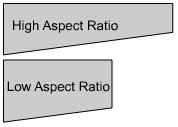 trailing edge of the wing. And the aspect ratio refers to the ratio between the wing chord and wing length. A high aspect ratio, between a long, thin wing (from front to back) actually produces LESS induced drag (drag produced as a side-effect of lift) then a low aspect ratio wing. That's why you always see gliders with incredibly long, thin wings, to produce the most lift possible with the least amount of drag. The shorter wing in a low aspect configuration generally gives greater roll rates, and the shorter wing means stronger construction.
There is one last term we'll go over before we start putting together all these different aspects of wing design together. That is wing washout. A washed out wing has a certain amount of twist built into it. The farther you get to the tip, the more the wing is twisted with its leading edge down. What this serves to do is increase the angle of attack of the wing near its root, and decrease it near the tips. Now if you remember, a wing will stall at a certain angle of attack, usually around 16-18 degrees (depending on the camber). That means that if the wing root has a greater angle of attack, it will stall first, and then the stall will work its way out to the tips. This has two advantages: The ailerons, which are on the outermost portion of the wing, will still have an affect even when the innermost portion of the wing has stalled. This helps to maintain control of the aircraft. Also, it makes for a much gentler stall when part of the wing stalls first, and the stall works its way across the rest of the wing. This is preferable to the entire wing stalling at the same time, and dropping like a rock. Nearly all wings have some sort of washout designed into them, and its disadvantages, as far as practical flight handling goes, are negligable. Therefore this is far as they will be discussed at this point.
Airplanes designed as a high speed cross country machine usually use high-aspect ratio, low camber wings. The long slender, thin airfoil gives lots of lift and very little drag; perfect for efficient cruising, however the sacrifice is made in slow speed handling and can often be tricky to l and. The thin camber generally gives abrupt, unforgiving stalls at higher airspeeds then a thicker camber, and the minimized drag means it takes a long time to slow down. This requires more planning during the landing phase. It also means that if airspeed is not precisely controlled, a too fast approach will cause the airplane to float in the flare, chewing up runway until the airspeed dissipates. The Piper Twin Comanche, and any Mooney aircraft are great examples of high-aspect, low camber wings.
 The wing camber refers to the shape of the wing if you were looking at it from the end. A high cambered wing is very curved on the top, and thick from top to bottom, whereas a low camber refers to a very flat wing. A common misconception is that a high cambered wing produces more lift. While this is right I suppose in a roundabout way, that specific wording is rather misleading. The thicker camber improves airflow at high angles of attack, therefore a thicker wing will be able to fly at a higher angle of attack without stalling. The higher angle of attack is what actually produces more lift. Camber can also be on the bottom of the wing, which improves airflow when the wing is inverted during aerobatic flight. A camber is NOT required to produce lift. Another flat out wrong concept that is taught is that the air on the top of the wing has to meet up with the air on the bottom. That's not true, in fact, since the air on the top is accelerated, it actually ends up further back then the air on the bottom. This is due to a concept called circulation, which I am not going to take the time to explain. For more information, check out this great website.
So a thicker camber has two effects: It allows the aircraft to fly at higher angles of attack which produces more lift - and it also increases drag. A thinner camber is just the opposite, less lift, less drag. The more lift a wing produces, the slower the stall speed will be.
The wing chord refers the distance between the leading edge and
 trailing edge of the wing. And the aspect ratio refers to the ratio between the wing chord and wing length. A high aspect ratio, between a long, thin wing (from front to back) actually produces LESS induced drag (drag produced as a side-effect of lift) then a low aspect ratio wing. That's why you always see gliders with incredibly long, thin wings, to produce the most lift possible with the least amount of drag. The shorter wing in a low aspect configuration generally gives greater roll rates, and the shorter wing means stronger construction.
There is one last term we'll go over before we start putting together all these different aspects of wing design together. That is wing washout. A washed out wing has a certain amount of twist built into it. The farther you get to the tip, the more the wing is twisted with its leading edge down. What this serves to do is increase the angle of attack of the wing near its root, and decrease it near the tips. Now if you remember, a wing will stall at a certain angle of attack, usually around 16-18 degrees (depending on the camber). That means that if the wing root has a greater angle of attack, it will stall first, and then the stall will work its way out to the tips. This has two advantages: The ailerons, which are on the outermost portion of the wing, will still have an affect even when the innermost portion of the wing has stalled. This helps to maintain control of the aircraft. Also, it makes for a much gentler stall when part of the wing stalls first, and the stall works its way across the rest of the wing. This is preferable to the entire wing stalling at the same time, and dropping like a rock. Nearly all wings have some sort of washout designed into them, and its disadvantages, as far as practical flight handling goes, are negligable. Therefore this is far as they will be discussed at this point.
Airplanes designed as a high speed cross country machine usually use high-aspect ratio, low camber wings. The long slender, thin airfoil gives lots of lift and very little drag; perfect for efficient cruising, however the sacrifice is made in slow speed handling and can often be tricky to l
 and. The thin camber generally gives abrupt, unforgiving stalls at higher airspeeds then a thicker camber, and the minimized drag means it takes a long time to slow down. This requires more planning during the landing phase. It also means that if airspeed is not precisely controlled, a too fast approach will cause the airplane to float in the flare, chewing up runway until the airspeed dissipates. The Piper Twin Comanche, and any Mooney aircraft are great examples of high-aspect, low camber wings.
Airplanes designed to have friendlier handling characteristics often sacrifice efficiency and speed during the cruise. Training aircraft like the Piper Tomahawk and many "step-up" aircraft like the Piper Arrow I and II use a low aspect ratio, high camber wing. The thicker camber may limit the cruise speed a little bit more, but these airfoils make for a more docile airplane. Stalls occur at a much slower speed, and are less violent of an event. The drag caused by the thicker profile and 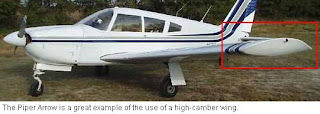 higher induced drag cause the airplane to slow down much quicker, and the short wings will make it sink faster. This makes the landing phase much easier to deal with. Less then perfect airspeed control is not as much of an issue since excess airspeed will be bled off much quicker, giving a greater margin for error.
 higher induced drag cause the airplane to slow down much quicker, and the short wings will make it sink faster. This makes the landing phase much easier to deal with. Less then perfect airspeed control is not as much of an issue since excess airspeed will be bled off much quicker, giving a greater margin for error.
If its load hauling you want the high-camber, high aspect wing ratio is the way to go, like on the Piper Aztec. The high camber allows higher angles of attack translating into more lift, and the high aspect ratio helps maximize lift while minimizing drag.
So designers take into account what mission they believe the aircraft primarily be serving in: Trainer, High Speed Cruiser, Load Hauling, or a step-up airplane somewhere in between. And we as pilots can often tell how the airplane will handle and perform just by looking at the wing and understanding how it works.
Thursday, December 7, 2006
Icing on the Cake
Its snowing out right now, and I can't go flying. Flying in the wintertime has both its pros and cons. Airplanes love cold air. Cold air is more dense, which allows the engine to produce more power. The dense air also provides more substance for the propellers and wings to displace, thus giving more thrust and more lift. In the Cessna 150 these effects are most visibly seen during a climb. On a hot summer day with just me in the airplane I can expect around a 3-400 ft/per min climb, whereas in colder winter weather I've see climbs upward of 600 fpm.
Winter flying also requires more cautious actions to avoid airframe icing. Airframe icing is defined as the buildup of ice on the wings and other surfaces of the aircraft, which can add weight to the airplane as well as reduce lift. In icing conditions, ice most heavily builds up on the leading edges of the wings and other surfaces of the airplane. Ice on the windscreen can impede forward visibility from the cockpit. More importantly, icing on the wings, if appropriate action is not taken, can actually bring an airplane down. The ice changes the shape of the wings, which alters how the air flows over it. This can reduce the amount of lift the wings produce.
All of the larger airliners have equipment to defend against icing, and many smaller aircraft have systems as well. There are 3 different types of ice protection systems, categorized into two different groups: De-icing, which is to remove ice that has already built up, and Anti-icing, which works to prevent ice buildup in the first place. De-icing boots are strips of rubber that are glued onto the leading edges of the wings and other flying surfaces. When ice accumulates on the boots, they can be inflated with air which breaks away the the ice so it falls away. This is by far the most common system employed on smaller business jets and piston planes. Less commonly seen is the weeping leading edge system. Like on the Cirrus line of private aircraft, the leading edge has a grid of tiny holes covering the entire leading edge. When activated, these 'pores' seep anti-icing fluid, which is spread by the airflow over the wing. This fluid prevents water droplets from freezing on the wing. Lastly, and only used on jet aircraft, is the hot-wing anti-icing system. The leading edge is heated from bleed air from the jet engines, which prevents icing from freezing onto the leading edges.
Neither of the airplanes I fly are equipped with de-icing, or anti-icing systems. Additionally, neither aircraft perform particularly well with ice, compared to other airplanes. The Cessna 150 is a very small, underpowered airplane. Do to the lack of power, it would not be able to handle the extra weight and decreased lift as well as more powerful airplanes could. The Twin Comanche, though having lots of power, has what is called a laminar flow wing. Simply speaking, it is critical for this type of wing to have a very smooth surface, free of any contamination. Ice on this wing would change the flow of air very drastically. This means that I have to be very cautious as to the weather conditions I fly into, and as such, I am not going flying today.
Winter flying also requires more cautious actions to avoid airframe icing. Airframe icing is defined as the buildup of ice on the wings and other surfaces of the aircraft, which can add weight to the airplane as well as reduce lift. In icing conditions, ice most heavily builds up on the leading edges of the wings and other surfaces of the airplane. Ice on the windscreen can impede forward visibility from the cockpit. More importantly, icing on the wings, if appropriate action is not taken, can actually bring an airplane down. The ice changes the shape of the wings, which alters how the air flows over it. This can reduce the amount of lift the wings produce.
All of the larger airliners have equipment to defend against icing, and many smaller aircraft have systems as well. There are 3 different types of ice protection systems, categorized into two different groups: De-icing, which is to remove ice that has already built up, and Anti-icing, which works to prevent ice buildup in the first place. De-icing boots are strips of rubber that are glued onto the leading edges of the wings and other flying surfaces. When ice accumulates on the boots, they can be inflated with air which breaks away the the ice so it falls away. This is by far the most common system employed on smaller business jets and piston planes. Less commonly seen is the weeping leading edge system. Like on the Cirrus line of private aircraft, the leading edge has a grid of tiny holes covering the entire leading edge. When activated, these 'pores' seep anti-icing fluid, which is spread by the airflow over the wing. This fluid prevents water droplets from freezing on the wing. Lastly, and only used on jet aircraft, is the hot-wing anti-icing system. The leading edge is heated from bleed air from the jet engines, which prevents icing from freezing onto the leading edges.
Neither of the airplanes I fly are equipped with de-icing, or anti-icing systems. Additionally, neither aircraft perform particularly well with ice, compared to other airplanes. The Cessna 150 is a very small, underpowered airplane. Do to the lack of power, it would not be able to handle the extra weight and decreased lift as well as more powerful airplanes could. The Twin Comanche, though having lots of power, has what is called a laminar flow wing. Simply speaking, it is critical for this type of wing to have a very smooth surface, free of any contamination. Ice on this wing would change the flow of air very drastically. This means that I have to be very cautious as to the weather conditions I fly into, and as such, I am not going flying today.
Wednesday, December 6, 2006
Landing a Twin
Well here is my post on landing the twin as promised. Hopefully I haven't lost too many people to confusion or boredom from the last post. I promise the next one will be less technical.
So here we are, screaming along in our twin. We've been cleared to the downwind, so now we're flying parallel to the runway in the opposite direction, at circuit altitude, which is 1000 ft above the airport. If we haven't already we'll pull the power back to around 17 " of Manifold Pressure, which is about half power, so we can slow down. We'll let our speed bleed off a little. Now we need to get our pre-landing check done. Mixtures go to full rich, fuel selectors should be on main tanks, electric fuel pumps on, and once our airspeed has dropped below 150 mph, we can drop the landing gear, and we'll watch for our green light, indicating the gear is down and locked. The gear will be slowing us down even more, so now once we're below 125 mph, we can lower the flaps.
At this point, we'll be ready to turn onto our base leg, which is 90 degrees to the runway. We slow down to our initial approach speed which will usually be 120 mph, unless we're following in a slower plane and we need to go slower to give them more spacing. Soon enough we'll be ready to turn onto our final leg, lining us up with the runway. I have to remember to not wait too long to turn, otherwise I'm going to turn too late, and have to do an S turn to get ourselves lined up again with the centreline. This isn't a Cessna 150 and it won't turn on a dime as I'm used to. Final approach speed will be 110 mph. Once we're established on final we do our G.U.M.P. check. G.U.M.P. is an acronym for Gas, Undercarriage (landing gear), Mixtures, and Propellers. This means we want to double check that our fuel pumps are on, and fuel selectors on the main tanks, our undercarriage is down and locked (belly landings are quite exciting I hear but not very cost-effective), Mixtures are rich, and Propellers are full forward. All this, with the exception of the landing gear, doesn't really matter a whole lot for landing, but we want to be already set up to climb out if we have to overshoot for whatever reason. So as long as we've been cleared to land we're good to go. All we have to do is fly the airplane down over the threshold, slowly retard the throttle and flare (raise the nose to bleed off our airspeed and touch down on the main wheels).
The flare I find is a much smaller angle in comparison to a Cessna 150 or 172. The airplane is travelling faster and needs more time to slow down and settle onto the runway. I initially had problems flaring too much, and the airplane would zoom up, bleed off its airspeed, and then drop onto the runway - hard on the airplane and it does a number on your back too! All we need is just a very slight nose up attitude and hold it there until our airspeed decreases and the airplane settles onto the runway. Once we've got all three wheels onto the runway its just a matter of applying the brakes and stopping straight ahead. Onto the ground once more safely and uneventfully, just the way we like it!
So here we are, screaming along in our twin. We've been cleared to the downwind, so now we're flying parallel to the runway in the opposite direction, at circuit altitude, which is 1000 ft above the airport. If we haven't already we'll pull the power back to around 17 " of Manifold Pressure, which is about half power, so we can slow down. We'll let our speed bleed off a little. Now we need to get our pre-landing check done. Mixtures go to full rich, fuel selectors should be on main tanks, electric fuel pumps on, and once our airspeed has dropped below 150 mph, we can drop the landing gear, and we'll watch for our green light, indicating the gear is down and locked. The gear will be slowing us down even more, so now once we're below 125 mph, we can lower the flaps.
At this point, we'll be ready to turn onto our base leg, which is 90 degrees to the runway. We slow down to our initial approach speed which will usually be 120 mph, unless we're following in a slower plane and we need to go slower to give them more spacing. Soon enough we'll be ready to turn onto our final leg, lining us up with the runway. I have to remember to not wait too long to turn, otherwise I'm going to turn too late, and have to do an S turn to get ourselves lined up again with the centreline. This isn't a Cessna 150 and it won't turn on a dime as I'm used to. Final approach speed will be 110 mph. Once we're established on final we do our G.U.M.P. check. G.U.M.P. is an acronym for Gas, Undercarriage (landing gear), Mixtures, and Propellers. This means we want to double check that our fuel pumps are on, and fuel selectors on the main tanks, our undercarriage is down and locked (belly landings are quite exciting I hear but not very cost-effective), Mixtures are rich, and Propellers are full forward. All this, with the exception of the landing gear, doesn't really matter a whole lot for landing, but we want to be already set up to climb out if we have to overshoot for whatever reason. So as long as we've been cleared to land we're good to go. All we have to do is fly the airplane down over the threshold, slowly retard the throttle and flare (raise the nose to bleed off our airspeed and touch down on the main wheels).
The flare I find is a much smaller angle in comparison to a Cessna 150 or 172. The airplane is travelling faster and needs more time to slow down and settle onto the runway. I initially had problems flaring too much, and the airplane would zoom up, bleed off its airspeed, and then drop onto the runway - hard on the airplane and it does a number on your back too! All we need is just a very slight nose up attitude and hold it there until our airspeed decreases and the airplane settles onto the runway. Once we've got all three wheels onto the runway its just a matter of applying the brakes and stopping straight ahead. Onto the ground once more safely and uneventfully, just the way we like it!
Tuesday, December 5, 2006
Flying a Twin
Recently I started training for my Multi-Engine Class Rating, in our newly christened 1964 Piper Twin Comanche. My first flight was quite the shock going from the ambling pace of a Cessna 150 straight to the high speed, high demand cockpit of a complex twin. So I am excited to review what I have learned so far.
Just a heads up, this is going to be a fairly technical post, so those not interested in reading procedures and what-not, sorry. Otherwise read on!
For those of you out there who know what a Constant Speed Propeller is, feel free to skip these next two paragraphs, I just feel compelled to give a little background knowledge to those unaquainted with the complex aircraft.
First of all the term "Complex Aircraft" generally refers to an aircraft with retractable landing gear and a constant speed propeller, or in my airplane's case, propellers plural. A constant speed propeller is one where you can control the pitch of the blades. This gives you an advantage similiar to different gears in a car. A fine pitch in the propeller, similiar to a low gear, will give us lots of torque for the take-off and climb, whereas a coarse pitch, like a high gear, will give us a fast cruising speed.
In addition to a power control (controls amount of air aloud into engine) and mixture control (controls amount of fuel aloud into engine) we have a a set of Propeller controls. These don't directly control the pitch of the propeller blades, but actually control a governor that allows the blades to change their pitch in order to hold a constant engine RPM as directed by the prop controls. Hence the name "constant speed propeller". The governor, based on how much power is being delivered to the props by the engine, will adjust the pitch of the blades to either slow down, or speed up the engine as needed to maintain the set RPM. For example. Say we want to set our props to a cruise setting, and right now we have just finished our climb and are in a fine pitch climb setting of 2500 RPM. We will pull back the prop control levers until the Tachometer reads our desired RPM, which we will call 2300. The governor senses that right now the props are spinning at a faster rate then 2300, so it increases the pitch, which in turn loads the engine and slows it down to 2300. If we were to increase the power being delivered to the props by pushing our throttle forward, the props will naturally want to speed up, so the governor will once again increase the pitch of the props in an attempt to keep them spinning at 2300 RPM. So unlike a fixed pitch prop aircraft where power to the engine is measured on the Tachometer, we measure power from the Manifold Pressure Gauge, in Inches of Mercury, and we manage the prop settings using our Tachometer.
Now that we have a little background knowledge, I can talk about the procedures we use for taking off.
For taking off we use a full fine pitch setting for the props, full power to the engines, and no flaps. The Twin Comanche calls for no flaps in take-off, because we don't want to take off while our airspeed is still below Vmc. In a nutshell, the aircraft will be uncontrollable below Vmc if an engine fails. So we want to stay above that at all times. Once we're cleared for take-off, and we've done our crew briefing and are ready to go, we push the power forward, and hold it on the runway centreline as we're sucked back into our seats. Right at about 80 mph, the airplane stops bouncing along the runway and starts flying. Now we'll accelerate in a level attitude just above the runway until we've past Vmc (90 mph) and reached our best rate of climb, which is 112 mph. At this point we'll pitch the nose up and climb out. As soon as we've run out of runway, which is about 5-10 seconds after our wheels left the ground, we transition into the normal climb. Landing gear goes up, we pull the power and props back to our climb setting, and we let our airspeed increase to around 130 to 140 mph for better cooling for the engines. Not long after, we've reached our cruising altitude, so its time for the cruise checklist. Power once again back to cruise power, electric fuel pumps can go off one at a time as we watch our fuel flow gauge for any decrease in fuel flow. If something is wrong with our engine driven fuel pumps we want to be able to identify which one, and if something is wrong with both of them it would also be really nice to not have both engines quit at the same time, cause that would just make for a bad day. The rest of the cruise checklist is pretty standard. Mixtures lean, fuel tank selectors as req'd (also done one at a time), cowl flaps closed, nav instruments set.
I'll post what we do for landing tommorrow maybe, because this is getting a little long and its also getting quite late, and I have to work tommorrow.
Just a heads up, this is going to be a fairly technical post, so those not interested in reading procedures and what-not, sorry. Otherwise read on!
For those of you out there who know what a Constant Speed Propeller is, feel free to skip these next two paragraphs, I just feel compelled to give a little background knowledge to those unaquainted with the complex aircraft.
First of all the term "Complex Aircraft" generally refers to an aircraft with retractable landing gear and a constant speed propeller, or in my airplane's case, propellers plural. A constant speed propeller is one where you can control the pitch of the blades. This gives you an advantage similiar to different gears in a car. A fine pitch in the propeller, similiar to a low gear, will give us lots of torque for the take-off and climb, whereas a coarse pitch, like a high gear, will give us a fast cruising speed.
In addition to a power control (controls amount of air aloud into engine) and mixture control (controls amount of fuel aloud into engine) we have a a set of Propeller controls. These don't directly control the pitch of the propeller blades, but actually control a governor that allows the blades to change their pitch in order to hold a constant engine RPM as directed by the prop controls. Hence the name "constant speed propeller". The governor, based on how much power is being delivered to the props by the engine, will adjust the pitch of the blades to either slow down, or speed up the engine as needed to maintain the set RPM. For example. Say we want to set our props to a cruise setting, and right now we have just finished our climb and are in a fine pitch climb setting of 2500 RPM. We will pull back the prop control levers until the Tachometer reads our desired RPM, which we will call 2300. The governor senses that right now the props are spinning at a faster rate then 2300, so it increases the pitch, which in turn loads the engine and slows it down to 2300. If we were to increase the power being delivered to the props by pushing our throttle forward, the props will naturally want to speed up, so the governor will once again increase the pitch of the props in an attempt to keep them spinning at 2300 RPM. So unlike a fixed pitch prop aircraft where power to the engine is measured on the Tachometer, we measure power from the Manifold Pressure Gauge, in Inches of Mercury, and we manage the prop settings using our Tachometer.
Now that we have a little background knowledge, I can talk about the procedures we use for taking off.
For taking off we use a full fine pitch setting for the props, full power to the engines, and no flaps. The Twin Comanche calls for no flaps in take-off, because we don't want to take off while our airspeed is still below Vmc. In a nutshell, the aircraft will be uncontrollable below Vmc if an engine fails. So we want to stay above that at all times. Once we're cleared for take-off, and we've done our crew briefing and are ready to go, we push the power forward, and hold it on the runway centreline as we're sucked back into our seats. Right at about 80 mph, the airplane stops bouncing along the runway and starts flying. Now we'll accelerate in a level attitude just above the runway until we've past Vmc (90 mph) and reached our best rate of climb, which is 112 mph. At this point we'll pitch the nose up and climb out. As soon as we've run out of runway, which is about 5-10 seconds after our wheels left the ground, we transition into the normal climb. Landing gear goes up, we pull the power and props back to our climb setting, and we let our airspeed increase to around 130 to 140 mph for better cooling for the engines. Not long after, we've reached our cruising altitude, so its time for the cruise checklist. Power once again back to cruise power, electric fuel pumps can go off one at a time as we watch our fuel flow gauge for any decrease in fuel flow. If something is wrong with our engine driven fuel pumps we want to be able to identify which one, and if something is wrong with both of them it would also be really nice to not have both engines quit at the same time, cause that would just make for a bad day. The rest of the cruise checklist is pretty standard. Mixtures lean, fuel tank selectors as req'd (also done one at a time), cowl flaps closed, nav instruments set.
I'll post what we do for landing tommorrow maybe, because this is getting a little long and its also getting quite late, and I have to work tommorrow.
Subscribe to:
Posts (Atom)