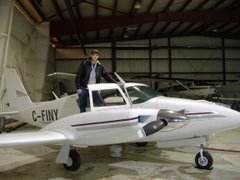
Happy Remembrance Day everyone. I hope you all had time this morning and did better than me to pause for our veterans. I missed my chance at 11:00 AM to give a minute of silence, as I was loading the airplane and pre-flighting for my first flight of the day and 11 AM slipped right past me. As I taxiied out I checked my watch to record the time up and it was 11:11. I guess the 11th minute of the 11th hour of the 11th day of the 11th month will have to do. I sat at the end of the runway lined up and ready to go, the engine idling, as I gave a moment to ponder our veterans of the 2 World Wars. I could only manage 15 seconds before I had to cut it short because there was an Embraer 110 on final behind me closing fast.
It was windy today. Very windy. Gusts on the surface started out strong, and got stronger as the day went on, but I was lucky in that the wind direction was lined up within 10 degrees of the runways on both ends of the flights, so I didn't have much crosswind to wrestle with. But it did mean I had almost a direct crosswind for the cruising portion of the flights. It was quite fun actually, the upper winds were pushing 50-60 knots, which meant my wind drift was almost 30 degrees. You always have at least a few degrees of drift (the angle between the heading of the airplane and the actual path its travelling), but I don't think I've ever had as much as I did today. When flying I find it difficult to wrap my mind around pointing the airplane 30 degrees to one side of where I actually want to end up. Its unintuitive to keep where you want to go that far away from directly in front of you. Once I had the airport in sight I had to resist the urge to steer directly towards it.
Since the winds were so strong I couldn't resist the chance to see if I could slow the airplane down, and turn it into the wind to see if I could stop the airplane in midair altogether. The slowest I managed was 8 knots groundspeed on the GPS, which pretty much looks and feels like a standstill looking out the window. The 206 with its Robinson STOL kit can land and stop in an impressively short distance to begin with, but today with the winds I could have it down and stopped in under 100 ft with full flaps and a nice slow approach speed. What fun!
The high winds picked up as the day went on as a result of a low pressure system moving in from the north. I could see the weather system moving in on on the trip before, the winds were getting quite strong, and we were pretty much out of daylight, so when I taxied in I figured we call it day. Normally we would have called it quits, but the next load included some electrical supplies, which HAD to be there that night. Apparently there was an electrician that had been flown up the coast and he was leaving the next day, so I agreed to brave the winds, rain (which didn't turn out to be that bad), and darkness to get the job done. Technically we're a day only operation, but we can fly the airplane just like a private operator for repositioning flights and such when there isn't any paying passengers or freight onboard. So I had to make it up north with the load before official night-time, and the flight on the way back which would be empty would be legal to make.
It made me think about the idea of managed risk. Its the essence of commercial aviation. In one sense you always want to mitigate the risk as much as possible, but at the same time there is a job to do, and customers that are counting on you. Private pilots have the luxury of just deciding not to go flying if the weather isn't exactly how they like it, but its a bit more of a delicate balance with commercial aviation. In this case NORMALLY we wouldn't have made the flight, cause they can usually wait a day or two for more pop and chips, but today they couldn't wait on the electrical supplies - at least not without incurring a great deal more expense. So I thought about where do we draw the line? By doing the flight both the company and myself were exposing ourselves to a certain amount of MORE risk/danger than usual, but we were still charging the same amount for the trip, and the consequences would still be exactly the same if I bent up the airplane (ie. expensive repairs/possible injury). So why did we make an exception for this flight? At first it seemed like we should decide on an acceptable level of risk and never cross that line under any circumstances, regardless of the urgency. If the immediate rewards were still the same (in the form of X number of dollars paid for completing the trip), why increase the risk?
I came to the conclusion that its not always that simple. Sometimes its just good business sense to increase the acceptable level of risk in certain conditions. Like I said, the essence of commercial aviation is to manage the risk, not to cap it. In that case I was still very sure I could make the flight safely, as was my boss, so that temporary increased risk was worth the reward, intangible as it may be, of proving ourselves able to be counted on by our customers. From a business standpoint that makes the difference. If it was just another usual pop and chips run that could wait, it wouldn't make sense to expose ourselves to the increased risk, because it wouldn't make such a big impression on the customer. But when it mattered to the customer, it mattered that we came through, and as a result will be around for that customer to call on us again to use our service. Safety is always counter balanced by running a viable business. If we cancelled flights too much out of "safety", the company would go under eventually. In the other sense, running a viable business also to some extent contributes to safety. If a company crashed or bent up an airplane every week it wouldn't take long to go bankrupt. Obviously there's a threshold where it just isn't worth the risk, but that threshold can be different for every flight.
I joked once that I was going to start up a competing company to the one I work for now. My fleet would comprise of Cessna 150's cause they're cheap (I'd operate them two-crew, for safety of course). That way in addition to not doing any sort of maintenance whatsoever, and hiring extremely low time pilots at minimum wage, I'd be able to offer much lower prices than my competitors. When an engine seized up or a wing fell off out of lack of maintenance and crashed in the bush I'd just buy another Cessna 150 and hire a couple more pilots. Its the perfect business plan... right? Anyways back to the serious discussion.
Flying freight in higher-risk situations is one thing, but what about exposing passengers to increased risk? That can sometimes be a tricky situation. When I'm flying freight the only one that's exposed to that higher level of risk is me, and I have the ultimate go/no decision, and I'm well aquainted with the level of risk for that particular flight. Not so with passengers. Most passengers would have no idea of the level of risk that they're being exposed to, and generally trust 100% that they're not being put in harms way. Luckily I found however, is that MOST of the time that works itself out, simply by the fact that flying in weather that increases the the level of risk an appreciable amount, is weather that is far beyond the level where most passengers would be scared crapless. Usually when its a passenger trip with questionable weather we cancel the flight out of fear that the passengers would be airsick, or scared crapless, or otherwise be convinced we're crazy to go flying (and choose not to fly with us again) long before we'd cancel the trip out of a genuine risk to safety. So in that sense consideration for our passengers' sanity (so they DO fly with us again) generally prevents the need to asses the actual risk to safety.
I'm essentially separated from the business side of the decisions, so I never have to weigh the safety vs. the business gain. Its a good thing, I've come to realize a long time ago I'm not a very good businessman. My job is JUST being the pilot. Somebody else gets to decide whether or not it would make good business sense to try to attempt the flight. That doesn't mean my fate is left to someone else though, or that I just skip the decision making process altogether. My job IS the pilot. Its still my right and responsibility to consider whether "I" think I can do it safely or not. I don't have to consider the business ramifications however, my decision is based almost entirely on if I'm gonna come back alive or not. In practice however most of this is all just theory, because my employers are ALL pilot's themselves, so they can generally make a pretty good decision all on their own, with the exceptions that sometimes they need input from me on current weather conditions (since they can't see it for themselves from the airplane) and my particular skill-level (although by now they know my skill-level fairly well).
So that was my thought process provoked by the flight today. Writing it down may have been long-winded and far too over-analytical for the actual importance of the event, but I won't apologize. Its my blog.
Showing posts with label pilot. Show all posts
Showing posts with label pilot. Show all posts
Wednesday, November 11, 2009

Saturday, September 19, 2009
Bad Day for Passengers
Things are still going strong coming into the second half of September, which has been totally unexpected. I was under the impression at the beginning of the month that the busy time would be wrapping up, but apparently thats not the case.
Yesterday was cold, wet and miserable however. There was a strange layer of mist blanketing the entire route of flight, giving a vertical visibility of 1000-1500 ft and forward vis of around 3-5 miles. The temperature on the ground stayed between 4-6 degrees C for the better part of the day, but a high pressure system was forecast to move in from the north and push the bad weather away. On my first flight I took off with two passengers onboard and initially climbed to 1000 ft into a headwind. It was pretty turbulent as well as wet and rainy underneath the cloud layer, but I could see the sun and just a tint of blue sky above me, so it looked like this mist/cloud layer was pretty thin. One of my passengers was really not enjoying the ride, she was very nervous, tapping her knee and wringing her hands. The longer we flew the more nervous she got, eventually to the point where she was shivering out of nervousness. I figured for the sake of my passengers I'd pop up another thousand feet or so to get on top of the cloud layer, where we'd see the sun and hopefully the turbulence would taper off a bit as well.
Once at 2000 however I looked up again but it still looked the same, I could still just barely see a bit of blue sky and the sun piercing through the mist, but now I was flying on instruments as the ground had long disappeared. The layer didn't look like it was this thick, but oh well, it can't be more then another few hundred feet before pop out the top. At 3000 ft nothing had changed. We were still in the layer of mist - it was such a strange phenomenon. Here I was 2000 ft higher than I was initially yet looking up still looked exactly the same. It looked like just a thin layer of mist above me. I considered continuing the climb even further, but the temperature was very close to zero degrees as it was, so I didn't want to get any higher and start picking up ice, and we were flying into a headwind, so I didn't want to fight too strong of winds either, so I conceded defeat and started a descent back down to where I could see the ground. Conditions were the same all the way up the coast, so we spent the remainder of the flight bouncing around in the rain and mist at 1000 ft.
Once we landed and unloaded my passengers, I had 5 more waiting ready to come back with me. We got all loaded up and ready to start up when one of the ladies on board said, "No, I can't do it". Can't do it? She was a little larger so I assumed the leg room wasn't enough or something and asked if she wanted to sit in the front where there's a little more leg room. Her friend explained that she was too nervous because of the weather. Oh, not much I could do about that. I could see how it was a bit of an indimidating day to fly - like I said it was cold, rainy, and the winds were quite gusty. In the end we departed with only 3 of the 5 passengers back southbound. The way back was bumpy, but eneventful and quick as we caught a stiff tailwind for the return leg.
My second trip was the same thing. I decided not to experiment with the cloud layer this time however and just stayed at 1000. A Navajo from the other local carrier that departed about the same time I did for the same destination decided to try to get on top however. They advised they were climbing to 3500 ft. I wondered if I missed the cloud tops by a mere couple hundred feet, since I only climbed to 3000. A few minutes later they radioed an advisory that they were now at 4500 ft and level. They had been fooled by the illusion as well, and ended up having to go higher.
The pilots for that carrier are regulars in the area like me, so we're on pretty familiar terms and usually all recognize each other's voices, so I keyed the mic, "Did you manage to find the top of that mist?"
"Ya we popped out at about 4200 ft."
I remarked that I tried that on my last flight but gave up at 3000.
"Hey Chad have you been to **** already today?"
"Yep."
"What are the winds like?"
I tried to remember exactly how the windsock looked. I tend to have a short-term memory and forget entirely what the conditions were at the airport on my last visit, but I managed to pull the mental image of the windsock out of the back of my brain.
"Ahh, gusting about 12-15 knots, pretty much 90 degrees [to the runway direction]."
"Alllll-riiiiighhht."
I smiled to myself. I guess I'm not the only one who likes crosswind landings - they keep life interesting.
By the time I was southbound again for the second time the High Pressure system was starting to work its magic you could see it starting to clear up in the north, but it was still pretty turbulent. About 10 minutes from landing one of my passengers tapped me on the shoulder and asked if I had a tissue. "Sorry no I don't." I turned around to see their young son leaning into a sick bag that his mother was holding for him. Poor guy. Not a good day for my passengers apparently. One terrified flyer, another one that cancelled out of panic, and now a sick kid. I haven't yet had an adult puke in the airplane, but that would make my 3rd child, all probably under 5 that haven't been able to hold it in on the bumpy days. All in a day's work of a pilot I guess.
Yesterday was cold, wet and miserable however. There was a strange layer of mist blanketing the entire route of flight, giving a vertical visibility of 1000-1500 ft and forward vis of around 3-5 miles. The temperature on the ground stayed between 4-6 degrees C for the better part of the day, but a high pressure system was forecast to move in from the north and push the bad weather away. On my first flight I took off with two passengers onboard and initially climbed to 1000 ft into a headwind. It was pretty turbulent as well as wet and rainy underneath the cloud layer, but I could see the sun and just a tint of blue sky above me, so it looked like this mist/cloud layer was pretty thin. One of my passengers was really not enjoying the ride, she was very nervous, tapping her knee and wringing her hands. The longer we flew the more nervous she got, eventually to the point where she was shivering out of nervousness. I figured for the sake of my passengers I'd pop up another thousand feet or so to get on top of the cloud layer, where we'd see the sun and hopefully the turbulence would taper off a bit as well.
Once at 2000 however I looked up again but it still looked the same, I could still just barely see a bit of blue sky and the sun piercing through the mist, but now I was flying on instruments as the ground had long disappeared. The layer didn't look like it was this thick, but oh well, it can't be more then another few hundred feet before pop out the top. At 3000 ft nothing had changed. We were still in the layer of mist - it was such a strange phenomenon. Here I was 2000 ft higher than I was initially yet looking up still looked exactly the same. It looked like just a thin layer of mist above me. I considered continuing the climb even further, but the temperature was very close to zero degrees as it was, so I didn't want to get any higher and start picking up ice, and we were flying into a headwind, so I didn't want to fight too strong of winds either, so I conceded defeat and started a descent back down to where I could see the ground. Conditions were the same all the way up the coast, so we spent the remainder of the flight bouncing around in the rain and mist at 1000 ft.
Once we landed and unloaded my passengers, I had 5 more waiting ready to come back with me. We got all loaded up and ready to start up when one of the ladies on board said, "No, I can't do it". Can't do it? She was a little larger so I assumed the leg room wasn't enough or something and asked if she wanted to sit in the front where there's a little more leg room. Her friend explained that she was too nervous because of the weather. Oh, not much I could do about that. I could see how it was a bit of an indimidating day to fly - like I said it was cold, rainy, and the winds were quite gusty. In the end we departed with only 3 of the 5 passengers back southbound. The way back was bumpy, but eneventful and quick as we caught a stiff tailwind for the return leg.
My second trip was the same thing. I decided not to experiment with the cloud layer this time however and just stayed at 1000. A Navajo from the other local carrier that departed about the same time I did for the same destination decided to try to get on top however. They advised they were climbing to 3500 ft. I wondered if I missed the cloud tops by a mere couple hundred feet, since I only climbed to 3000. A few minutes later they radioed an advisory that they were now at 4500 ft and level. They had been fooled by the illusion as well, and ended up having to go higher.
The pilots for that carrier are regulars in the area like me, so we're on pretty familiar terms and usually all recognize each other's voices, so I keyed the mic, "Did you manage to find the top of that mist?"
"Ya we popped out at about 4200 ft."
I remarked that I tried that on my last flight but gave up at 3000.
"Hey Chad have you been to **** already today?"
"Yep."
"What are the winds like?"
I tried to remember exactly how the windsock looked. I tend to have a short-term memory and forget entirely what the conditions were at the airport on my last visit, but I managed to pull the mental image of the windsock out of the back of my brain.
"Ahh, gusting about 12-15 knots, pretty much 90 degrees [to the runway direction]."
"Alllll-riiiiighhht."
I smiled to myself. I guess I'm not the only one who likes crosswind landings - they keep life interesting.
By the time I was southbound again for the second time the High Pressure system was starting to work its magic you could see it starting to clear up in the north, but it was still pretty turbulent. About 10 minutes from landing one of my passengers tapped me on the shoulder and asked if I had a tissue. "Sorry no I don't." I turned around to see their young son leaning into a sick bag that his mother was holding for him. Poor guy. Not a good day for my passengers apparently. One terrified flyer, another one that cancelled out of panic, and now a sick kid. I haven't yet had an adult puke in the airplane, but that would make my 3rd child, all probably under 5 that haven't been able to hold it in on the bumpy days. All in a day's work of a pilot I guess.
Friday, August 28, 2009
Random Untold Stories
So in the past few months I've had a bunch of other interesting experiences/stories that I haven't yet blogged about mainly due to the reason that they're not big enough events to dedicate an entire blog entry to. They're still fun to mention though, so this blog entry is dedicated to all the short little random stories I have, explained in no particular order, with no particular continuity, nor with any particular point.
I transported a coffin up the coast once, complete with a body inside. The coffin arrived at the airport early however on the back of a pickup truck, and we couldn't take it until later in the morning. So the driver of the pickup ended up cruising around town doing his errands for 3 hrs with a casket and dead person riding around in the back. Yep, we're up north. When we unloaded it from the airplane we muscled it out of the airplane and loaded into the back of another pickup truck, and off they went.
I've also hauled gravestones on a different occasion, earlier in the summer. Those things are HEAVY!
A couple days ago I did another sightseeing flight, which is about 4 for me this summer. I like doing them, because my passengers have all been very appreciative which makes my day. I also haven't done so many that it becomes "just another flight" however. My latest tourists were a couple guys from North Bay, I think a father and middle aged son. They thanked me after we landed and said it was great. I also heard from our dispatcher afterwords (who gave them a ride back from the airport) that they also had lots great things to say about my aviating, how they could tell I was a really good pilot and the landing was very smooth. Complements like that always make my day and give me warm fuzzies. There was another older tourist lady I took up earlier in the summer, just by herself. It was a bumpy day, but she didn't care because she said she was determined to go for a "bush plane ride". She was so thrilled and thankful, and when we landed she told me her life was now complete.
Today during my landing flare the nose cargo compartment door became unlatched and flew open and up. There was nothing in the compartment to fall out, so no harm done, but is awfully distracting when it happens. That's the 3rd time its happened in the last 2 months. The Last time was also during my flare just before touchdown, the other time was during my landing rollout after I touched down. Last inspection the AME's looked at it and ordered a new latch for it, and also in the meantime made an adjustment on the latching mechinism in the hopes that it would help. We're due for inspection in another couple days, so hopefully the new latch is in and it'll get changed out. Its kind of embarrasing when it happens and I have passengers onboard.
I've finally passed the 1000 hr mark. As of my writing this I'm at 1014 hrs total time. Pretty exciting.
I've encounterd some interesting things on the runways up here. One time a pack of some sort of canines crossed the runway just as I was coming in to land, so I just added a bit of power for a second to extend my touchdown point. After I touched down however, there was a large flock of seagulls milling about on the runway in front of me. So after making the effort to lengthen my landing I found myself having to brake quite heavily. All turned out ok. A few weeks ago there was someone on an ATV trucking down the side of the runway. Technically he wasn't on the runway, he was just on the other side of the row of lights, so I didn't see any harm in landing. He was trucking along at probably 40 km/hr in the same direction I was landing, and we bothed looked at each other as I cruised past him on my rollout after landing. It was an odd feeling. It felt exactly like that scene from Indiana Jones and the Last Cruisade where the Nazi pilot flies into the tunnel, rips off his wings, and goes sliding past Indy and his father as they're driving through the tunnel. Except lucky for me I still had my wings and landing gear.
I finally received my spiffy new Canadian Aviation Document pilots license. The new passport style booklets. They look much more professional then a tattered piece of blue paper, but the ratings on my license are no longer spelled out in english, but have been given a acronym code. "SMEL" doesn't sound nearly as impressive as "All single pilot non-high performance single and multi-engine land airplanes". Oh well.
I'm sure there are others that I have since forgotten about, but I'm gonna start making notes now and when I remember/aquire more mini-stories I'll compile another post like this.
I transported a coffin up the coast once, complete with a body inside. The coffin arrived at the airport early however on the back of a pickup truck, and we couldn't take it until later in the morning. So the driver of the pickup ended up cruising around town doing his errands for 3 hrs with a casket and dead person riding around in the back. Yep, we're up north. When we unloaded it from the airplane we muscled it out of the airplane and loaded into the back of another pickup truck, and off they went.
I've also hauled gravestones on a different occasion, earlier in the summer. Those things are HEAVY!
A couple days ago I did another sightseeing flight, which is about 4 for me this summer. I like doing them, because my passengers have all been very appreciative which makes my day. I also haven't done so many that it becomes "just another flight" however. My latest tourists were a couple guys from North Bay, I think a father and middle aged son. They thanked me after we landed and said it was great. I also heard from our dispatcher afterwords (who gave them a ride back from the airport) that they also had lots great things to say about my aviating, how they could tell I was a really good pilot and the landing was very smooth. Complements like that always make my day and give me warm fuzzies. There was another older tourist lady I took up earlier in the summer, just by herself. It was a bumpy day, but she didn't care because she said she was determined to go for a "bush plane ride". She was so thrilled and thankful, and when we landed she told me her life was now complete.
Today during my landing flare the nose cargo compartment door became unlatched and flew open and up. There was nothing in the compartment to fall out, so no harm done, but is awfully distracting when it happens. That's the 3rd time its happened in the last 2 months. The Last time was also during my flare just before touchdown, the other time was during my landing rollout after I touched down. Last inspection the AME's looked at it and ordered a new latch for it, and also in the meantime made an adjustment on the latching mechinism in the hopes that it would help. We're due for inspection in another couple days, so hopefully the new latch is in and it'll get changed out. Its kind of embarrasing when it happens and I have passengers onboard.
I've finally passed the 1000 hr mark. As of my writing this I'm at 1014 hrs total time. Pretty exciting.
I've encounterd some interesting things on the runways up here. One time a pack of some sort of canines crossed the runway just as I was coming in to land, so I just added a bit of power for a second to extend my touchdown point. After I touched down however, there was a large flock of seagulls milling about on the runway in front of me. So after making the effort to lengthen my landing I found myself having to brake quite heavily. All turned out ok. A few weeks ago there was someone on an ATV trucking down the side of the runway. Technically he wasn't on the runway, he was just on the other side of the row of lights, so I didn't see any harm in landing. He was trucking along at probably 40 km/hr in the same direction I was landing, and we bothed looked at each other as I cruised past him on my rollout after landing. It was an odd feeling. It felt exactly like that scene from Indiana Jones and the Last Cruisade where the Nazi pilot flies into the tunnel, rips off his wings, and goes sliding past Indy and his father as they're driving through the tunnel. Except lucky for me I still had my wings and landing gear.
I finally received my spiffy new Canadian Aviation Document pilots license. The new passport style booklets. They look much more professional then a tattered piece of blue paper, but the ratings on my license are no longer spelled out in english, but have been given a acronym code. "SMEL" doesn't sound nearly as impressive as "All single pilot non-high performance single and multi-engine land airplanes". Oh well.
I'm sure there are others that I have since forgotten about, but I'm gonna start making notes now and when I remember/aquire more mini-stories I'll compile another post like this.
Thursday, June 25, 2009
Summer
Its been hot this past week, especially before I figured out that there's air vents at my feet that open.


The smoke was drifting across our route of flight, you could catch a sweet scent of campire if you flew through it. For the most part I tried to climb above though, I'm not entirely sure how much smoke it would take to cause me to starting becoming hypoxic, and while it would be nice to know, I'm not about to try.
Today I retired my first logbook - all the pages are full at 739.5 hrs - whoo hoo! Its a good thing too because the binding threads were starting to all come out. It wouldn't be able to take much more abuse before the whole thing fell apart. The next flight I do will be entered into the larger professional style logbook I bought. With about 50% more pages and more lines to the page, it should be a LONG time before I fill this one up. I liked the size of my old one better, but each page would only take 11 entries, and each time the page is filled you have to do a bunch of totalling and carry it over to the next page, which is time consuming - especially if you're doing up to 12 entries per day. My new logbook can take 23 entries per page. One thing I'm not too sure about, and perhaps any 1000+ hr pilots can let me know, is how you manage to enter 5 digit flight times (0000.0) in those tiny little boxes? I have a hard enough time writing small enough for my current 4 digits to be legible! Hmm, maybe I should hire one of those asians who can write your name on a grain of rice to be my book-keeper.
Ok I'm rambling now, blog over.
A couple days ago even though we had flights we took the afternoon off because it was 32 degrees C. I suppose in addition to cooking the pilots and any passengers, the amount of weight the airplane can take no longer makes sense to do the trips from a business standpoint. Personally I don't mind cooking in the airplane. Once I figured out the vents its actually not too bad anymore, and its either sweating it out in the airplane, or sitting in my house on the ground sweating it out.
Yesterday I got to see something new. There's a small forest fire burning about halfway up the coast on the way to my usual stop. Its not really anywhere near any civilization, so they're just letting it burn. I managed to snap some pictures.


The smoke was drifting across our route of flight, you could catch a sweet scent of campire if you flew through it. For the most part I tried to climb above though, I'm not entirely sure how much smoke it would take to cause me to starting becoming hypoxic, and while it would be nice to know, I'm not about to try.
On one trip the other pilot who flies the other airplane, a Cessna 206, was coming back from a trip at the exact same time as I was, and we managed to move in close enough together to snap some pictures. He got some video of me as well.
Today I couple a couple flights in, but by around 2 pm we called it quits, probably for the day, as there is some low cloud/possibly fog moving in. Much of my last trip coming back from the north was spent at 4-500 ft agl under an overcast cloud layer. I would have probably tried it again, but about 30 miles north of base when coming back I passed an Air Ornge medevac heli heading north, and about five minutes later he turned around because of the cloud, so it must have been getting worse behind me.
On Saturday we go south all the way to Toronto Buttonville to pick up a new Cherokee 6 we just purchased. I'm excited to see the new airplane (well new to us) - its far better equipped then the one I currently fly. It even has an autopilot and a stormscope. I love the stormscopes, its been an awesome tool in my Twin Comanche, even just flying VFR. Hopefully the autopilot works too, those are great fatigue-reducing tools on long flights.
Unfortunately even though we pick in up on Saturday, it won't be ready for a few weeks because the engine is timed out so we have to drop it off at maintenance on the way back up.
Today I retired my first logbook - all the pages are full at 739.5 hrs - whoo hoo! Its a good thing too because the binding threads were starting to all come out. It wouldn't be able to take much more abuse before the whole thing fell apart. The next flight I do will be entered into the larger professional style logbook I bought. With about 50% more pages and more lines to the page, it should be a LONG time before I fill this one up. I liked the size of my old one better, but each page would only take 11 entries, and each time the page is filled you have to do a bunch of totalling and carry it over to the next page, which is time consuming - especially if you're doing up to 12 entries per day. My new logbook can take 23 entries per page. One thing I'm not too sure about, and perhaps any 1000+ hr pilots can let me know, is how you manage to enter 5 digit flight times (0000.0) in those tiny little boxes? I have a hard enough time writing small enough for my current 4 digits to be legible! Hmm, maybe I should hire one of those asians who can write your name on a grain of rice to be my book-keeper.
Ok I'm rambling now, blog over.
Sunday, April 12, 2009
Finally Flying
Written April 11, 2009
So yesterday I finally started flying. The day before I did a quick checkout with the other pilot who flies for the company, and he gave me the thumbs up, so yesterday the chief pilot and I went up for a single checkout before they turned me loose.
While on takeoff however I noted the airspeed indicator was non-functional, however it was too late to abort the takeoff. If the airspeed indicator doesn’t work, this indicates that the pitot tube is clogged. The pitot tube is a little tube hanging off the underside of one wing that measures ram air pressure, and displays it in the form of knots or mph, on our airspeed indicator in the cockpit. If the pitot tube is blocked, our airspeed indicator doesn’t work. Its not uncommon in snowy conditions for the pitot tube to become blocked with snow or ice, so every certified airplane is equipped with the ability to electrically heat up the pitot tube via a switch in the cockpit to melt off any ice in the pitot tube and thus unclog it.
The airspeed indicator is one of the most important instruments in the cockpit because essentially we fly the airplane using it. Our stall speed is in the form indicated airspeed, we also use a specific airspeed to achieve the best climb performance, and to tell us when its structurally safe to lower the flaps and landing gear (if applicable). So its nice to have a working airspeed indicator.
Anyways in this case we were already past the point of no return. I should have caught this on the takeoff roll before it was too late to go airborne, but it was only my second flight in the airplane, and being not too familiar and comfortable in the airplane yet my reaction times were diminished. Not to mention the Cherokee 6 accelerates and climbs like a bat out of hell when its empty. If I was more comfortable in the airplane I am confident I’d be more on the ball. Oh well, so we did the circuit anyways. In any regard the chief pilot was happy with my performance and was content to turn me loose on the cargo runs.
Once we got back on the ground we fiddled a bit with blowing out the pitot tube to unclog it, and I took it for one more test flight circuit and the airspeed indicator seemed to be working well this time.
So finally we loaded up the Cherokee with 1000 lbs of groceries and off I went. I flew up the coast with my cargo, landed, and helped load it into the pickup truck they had waiting for me. When I got back there was another load waiting for me, so we loaded the plane up once again and off I went again, this time I had about 900 lbs of potatoes and a few cases of pop. I had three trips for the day, all the while thinking that this beats the heck out of framing houses! Other then when I’m loading and unloading the airplane, which doesn‘t even really take more then 5-10 minutes, it doesn’t even feel like I’m working. Life is good.
So yesterday I finally started flying. The day before I did a quick checkout with the other pilot who flies for the company, and he gave me the thumbs up, so yesterday the chief pilot and I went up for a single checkout before they turned me loose.
While on takeoff however I noted the airspeed indicator was non-functional, however it was too late to abort the takeoff. If the airspeed indicator doesn’t work, this indicates that the pitot tube is clogged. The pitot tube is a little tube hanging off the underside of one wing that measures ram air pressure, and displays it in the form of knots or mph, on our airspeed indicator in the cockpit. If the pitot tube is blocked, our airspeed indicator doesn’t work. Its not uncommon in snowy conditions for the pitot tube to become blocked with snow or ice, so every certified airplane is equipped with the ability to electrically heat up the pitot tube via a switch in the cockpit to melt off any ice in the pitot tube and thus unclog it.
The airspeed indicator is one of the most important instruments in the cockpit because essentially we fly the airplane using it. Our stall speed is in the form indicated airspeed, we also use a specific airspeed to achieve the best climb performance, and to tell us when its structurally safe to lower the flaps and landing gear (if applicable). So its nice to have a working airspeed indicator.
Anyways in this case we were already past the point of no return. I should have caught this on the takeoff roll before it was too late to go airborne, but it was only my second flight in the airplane, and being not too familiar and comfortable in the airplane yet my reaction times were diminished. Not to mention the Cherokee 6 accelerates and climbs like a bat out of hell when its empty. If I was more comfortable in the airplane I am confident I’d be more on the ball. Oh well, so we did the circuit anyways. In any regard the chief pilot was happy with my performance and was content to turn me loose on the cargo runs.
Once we got back on the ground we fiddled a bit with blowing out the pitot tube to unclog it, and I took it for one more test flight circuit and the airspeed indicator seemed to be working well this time.
So finally we loaded up the Cherokee with 1000 lbs of groceries and off I went. I flew up the coast with my cargo, landed, and helped load it into the pickup truck they had waiting for me. When I got back there was another load waiting for me, so we loaded the plane up once again and off I went again, this time I had about 900 lbs of potatoes and a few cases of pop. I had three trips for the day, all the while thinking that this beats the heck out of framing houses! Other then when I’m loading and unloading the airplane, which doesn‘t even really take more then 5-10 minutes, it doesn’t even feel like I’m working. Life is good.
Wednesday, January 10, 2007
How different wing types affect handling
The shape of an airplane's wing can do a whole lot for how an airplane performes, and handles. Aircraft designers take into the account the aircraft's mission: Trainer, cross country machine, aerobatic aircraft, or in many cases some combination between two, or all of those categories.
 The wing camber refers to the shape of the wing if you were looking at it from the end. A high cambered wing is very curved on the top, and thick from top to bottom, whereas a low camber refers to a very flat wing. A common misconception is that a high cambered wing produces more lift. While this is right I suppose in a roundabout way, that specific wording is rather misleading. The thicker camber improves airflow at high angles of attack, therefore a thicker wing will be able to fly at a higher angle of attack without stalling. The higher angle of attack is what actually produces more lift. Camber can also be on the bottom of the wing, which improves airflow when the wing is inverted during aerobatic flight. A camber is NOT required to produce lift. Another flat out wrong concept that is taught is that the air on the top of the wing has to meet up with the air on the bottom. That's not true, in fact, since the air on the top is accelerated, it actually ends up further back then the air on the bottom. This is due to a concept called circulation, which I am not going to take the time to explain. For more information, check out this great website.
So a thicker camber has two effects: It allows the aircraft to fly at higher angles of attack which produces more lift - and it also increases drag. A thinner camber is just the opposite, less lift, less drag. The more lift a wing produces, the slower the stall speed will be.
The wing chord refers the distance between the leading edge and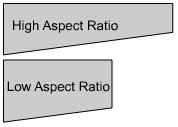 trailing edge of the wing. And the aspect ratio refers to the ratio between the wing chord and wing length. A high aspect ratio, between a long, thin wing (from front to back) actually produces LESS induced drag (drag produced as a side-effect of lift) then a low aspect ratio wing. That's why you always see gliders with incredibly long, thin wings, to produce the most lift possible with the least amount of drag. The shorter wing in a low aspect configuration generally gives greater roll rates, and the shorter wing means stronger construction.
There is one last term we'll go over before we start putting together all these different aspects of wing design together. That is wing washout. A washed out wing has a certain amount of twist built into it. The farther you get to the tip, the more the wing is twisted with its leading edge down. What this serves to do is increase the angle of attack of the wing near its root, and decrease it near the tips. Now if you remember, a wing will stall at a certain angle of attack, usually around 16-18 degrees (depending on the camber). That means that if the wing root has a greater angle of attack, it will stall first, and then the stall will work its way out to the tips. This has two advantages: The ailerons, which are on the outermost portion of the wing, will still have an affect even when the innermost portion of the wing has stalled. This helps to maintain control of the aircraft. Also, it makes for a much gentler stall when part of the wing stalls first, and the stall works its way across the rest of the wing. This is preferable to the entire wing stalling at the same time, and dropping like a rock. Nearly all wings have some sort of washout designed into them, and its disadvantages, as far as practical flight handling goes, are negligable. Therefore this is far as they will be discussed at this point.
Airplanes designed as a high speed cross country machine usually use high-aspect ratio, low camber wings. The long slender, thin airfoil gives lots of lift and very little drag; perfect for efficient cruising, however the sacrifice is made in slow speed handling and can often be tricky to l and. The thin camber generally gives abrupt, unforgiving stalls at higher airspeeds then a thicker camber, and the minimized drag means it takes a long time to slow down. This requires more planning during the landing phase. It also means that if airspeed is not precisely controlled, a too fast approach will cause the airplane to float in the flare, chewing up runway until the airspeed dissipates. The Piper Twin Comanche, and any Mooney aircraft are great examples of high-aspect, low camber wings.
 The wing camber refers to the shape of the wing if you were looking at it from the end. A high cambered wing is very curved on the top, and thick from top to bottom, whereas a low camber refers to a very flat wing. A common misconception is that a high cambered wing produces more lift. While this is right I suppose in a roundabout way, that specific wording is rather misleading. The thicker camber improves airflow at high angles of attack, therefore a thicker wing will be able to fly at a higher angle of attack without stalling. The higher angle of attack is what actually produces more lift. Camber can also be on the bottom of the wing, which improves airflow when the wing is inverted during aerobatic flight. A camber is NOT required to produce lift. Another flat out wrong concept that is taught is that the air on the top of the wing has to meet up with the air on the bottom. That's not true, in fact, since the air on the top is accelerated, it actually ends up further back then the air on the bottom. This is due to a concept called circulation, which I am not going to take the time to explain. For more information, check out this great website.
So a thicker camber has two effects: It allows the aircraft to fly at higher angles of attack which produces more lift - and it also increases drag. A thinner camber is just the opposite, less lift, less drag. The more lift a wing produces, the slower the stall speed will be.
The wing chord refers the distance between the leading edge and
 trailing edge of the wing. And the aspect ratio refers to the ratio between the wing chord and wing length. A high aspect ratio, between a long, thin wing (from front to back) actually produces LESS induced drag (drag produced as a side-effect of lift) then a low aspect ratio wing. That's why you always see gliders with incredibly long, thin wings, to produce the most lift possible with the least amount of drag. The shorter wing in a low aspect configuration generally gives greater roll rates, and the shorter wing means stronger construction.
There is one last term we'll go over before we start putting together all these different aspects of wing design together. That is wing washout. A washed out wing has a certain amount of twist built into it. The farther you get to the tip, the more the wing is twisted with its leading edge down. What this serves to do is increase the angle of attack of the wing near its root, and decrease it near the tips. Now if you remember, a wing will stall at a certain angle of attack, usually around 16-18 degrees (depending on the camber). That means that if the wing root has a greater angle of attack, it will stall first, and then the stall will work its way out to the tips. This has two advantages: The ailerons, which are on the outermost portion of the wing, will still have an affect even when the innermost portion of the wing has stalled. This helps to maintain control of the aircraft. Also, it makes for a much gentler stall when part of the wing stalls first, and the stall works its way across the rest of the wing. This is preferable to the entire wing stalling at the same time, and dropping like a rock. Nearly all wings have some sort of washout designed into them, and its disadvantages, as far as practical flight handling goes, are negligable. Therefore this is far as they will be discussed at this point.
Airplanes designed as a high speed cross country machine usually use high-aspect ratio, low camber wings. The long slender, thin airfoil gives lots of lift and very little drag; perfect for efficient cruising, however the sacrifice is made in slow speed handling and can often be tricky to l
 and. The thin camber generally gives abrupt, unforgiving stalls at higher airspeeds then a thicker camber, and the minimized drag means it takes a long time to slow down. This requires more planning during the landing phase. It also means that if airspeed is not precisely controlled, a too fast approach will cause the airplane to float in the flare, chewing up runway until the airspeed dissipates. The Piper Twin Comanche, and any Mooney aircraft are great examples of high-aspect, low camber wings.
Airplanes designed to have friendlier handling characteristics often sacrifice efficiency and speed during the cruise. Training aircraft like the Piper Tomahawk and many "step-up" aircraft like the Piper Arrow I and II use a low aspect ratio, high camber wing. The thicker camber may limit the cruise speed a little bit more, but these airfoils make for a more docile airplane. Stalls occur at a much slower speed, and are less violent of an event. The drag caused by the thicker profile and 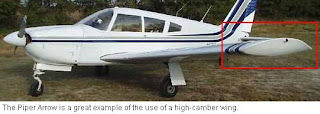 higher induced drag cause the airplane to slow down much quicker, and the short wings will make it sink faster. This makes the landing phase much easier to deal with. Less then perfect airspeed control is not as much of an issue since excess airspeed will be bled off much quicker, giving a greater margin for error.
 higher induced drag cause the airplane to slow down much quicker, and the short wings will make it sink faster. This makes the landing phase much easier to deal with. Less then perfect airspeed control is not as much of an issue since excess airspeed will be bled off much quicker, giving a greater margin for error.
If its load hauling you want the high-camber, high aspect wing ratio is the way to go, like on the Piper Aztec. The high camber allows higher angles of attack translating into more lift, and the high aspect ratio helps maximize lift while minimizing drag.
So designers take into account what mission they believe the aircraft primarily be serving in: Trainer, High Speed Cruiser, Load Hauling, or a step-up airplane somewhere in between. And we as pilots can often tell how the airplane will handle and perform just by looking at the wing and understanding how it works.
Subscribe to:
Posts (Atom)