The wing camber refers to the shape of the wing if you were looking at it from the end. A high cambered wing is very curved on the top, and thick from top to bottom, whereas a low camber refers to a very flat wing. A common misconception is that a high cambered wing produces more lift. While this is right I suppose in a roundabout way, that specific wording is rather misleading. The thicker camber improves airflow at high angles of attack, therefore a thicker wing will be able to fly at a higher angle of attack without stalling. The higher angle of attack is what actually produces more lift. Camber can also be on the bottom of the wing, which improves airflow when the wing is inverted during aerobatic flight. A camber is NOT required to produce lift. Another flat out wrong concept that is taught is that the air on the top of the wing has to meet up with the air on the bottom. That's not true, in fact, since the air on the top is accelerated, it actually ends up further back then the air on the bottom. This is due to a concept called circulation, which I am not going to take the time to explain. For more information, check out this great website.
So a thicker camber has two effects: It allows the aircraft to fly at higher angles of attack which produces more lift - and it also increases drag. A thinner camber is just the opposite, less lift, less drag. The more lift a wing produces, the slower the stall speed will be.
The wing chord refers the distance between the leading edge and
 trailing edge of the wing. And the aspect ratio refers to the ratio between the wing chord and wing length. A high aspect ratio, between a long, thin wing (from front to back) actually produces LESS induced drag (drag produced as a side-effect of lift) then a low aspect ratio wing. That's why you always see gliders with incredibly long, thin wings, to produce the most lift possible with the least amount of drag. The shorter wing in a low aspect configuration generally gives greater roll rates, and the shorter wing means stronger construction.
There is one last term we'll go over before we start putting together all these different aspects of wing design together. That is wing washout. A washed out wing has a certain amount of twist built into it. The farther you get to the tip, the more the wing is twisted with its leading edge down. What this serves to do is increase the angle of attack of the wing near its root, and decrease it near the tips. Now if you remember, a wing will stall at a certain angle of attack, usually around 16-18 degrees (depending on the camber). That means that if the wing root has a greater angle of attack, it will stall first, and then the stall will work its way out to the tips. This has two advantages: The ailerons, which are on the outermost portion of the wing, will still have an affect even when the innermost portion of the wing has stalled. This helps to maintain control of the aircraft. Also, it makes for a much gentler stall when part of the wing stalls first, and the stall works its way across the rest of the wing. This is preferable to the entire wing stalling at the same time, and dropping like a rock. Nearly all wings have some sort of washout designed into them, and its disadvantages, as far as practical flight handling goes, are negligable. Therefore this is far as they will be discussed at this point.
Airplanes designed as a high speed cross country machine usually use high-aspect ratio, low camber wings. The long slender, thin airfoil gives lots of lift and very little drag; perfect for efficient cruising, however the sacrifice is made in slow speed handling and can often be tricky to l
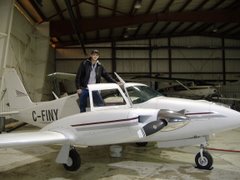
 and. The thin camber generally gives abrupt, unforgiving stalls at higher airspeeds then a thicker camber, and the minimized drag means it takes a long time to slow down. This requires more planning during the landing phase. It also means that if airspeed is not precisely controlled, a too fast approach will cause the airplane to float in the flare, chewing up runway until the airspeed dissipates. The Piper Twin Comanche, and any Mooney aircraft are great examples of high-aspect, low camber wings.
Airplanes designed to have friendlier handling characteristics often sacrifice efficiency and speed during the cruise. Training aircraft like the Piper Tomahawk and many "step-up" aircraft like the Piper Arrow I and II use a low aspect ratio, high camber wing. The thicker camber may limit the cruise speed a little bit more, but these airfoils make for a more docile airplane. Stalls occur at a much slower speed, and are less violent of an event. The drag caused by the thicker profile and 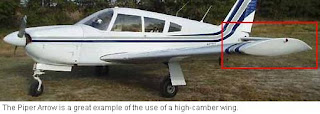 higher induced drag cause the airplane to slow down much quicker, and the short wings will make it sink faster. This makes the landing phase much easier to deal with. Less then perfect airspeed control is not as much of an issue since excess airspeed will be bled off much quicker, giving a greater margin for error.
 higher induced drag cause the airplane to slow down much quicker, and the short wings will make it sink faster. This makes the landing phase much easier to deal with. Less then perfect airspeed control is not as much of an issue since excess airspeed will be bled off much quicker, giving a greater margin for error.
If its load hauling you want the high-camber, high aspect wing ratio is the way to go, like on the Piper Aztec. The high camber allows higher angles of attack translating into more lift, and the high aspect ratio helps maximize lift while minimizing drag.
So designers take into account what mission they believe the aircraft primarily be serving in: Trainer, High Speed Cruiser, Load Hauling, or a step-up airplane somewhere in between. And we as pilots can often tell how the airplane will handle and perform just by looking at the wing and understanding how it works.