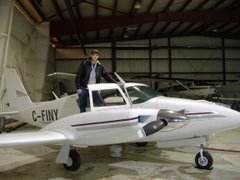
I went flying for the first time with my new instructor, Frank. I know Frank from the flight school in Sarnia, but he is now working here in London. It just so happens that I need a freelance instructor to train me for my IFR, and it just so happens that Frank has his IFR and is willing to do that.
It was a beautifully clear day, free of any turbulence whatsoever, and we decided just to do some circuits to give me a break from the intensive engine-out training I have been doing, and to give Frank a chance to familiarize himself with the airplane. Everything went well, but he mentioned something about the retraction of the landing gear on take-off that we had learned differently. The take-off procedure I had been following based on the recommended procedures in the POH and according to what I had been taught were roughly as follows: Rotate at 80 mph, accelerate in ground effect until Vy (112 mph), climb out at Vy, retract gear when there is no longer enough runway to land, set climb power. Frank, who learned in the Seminoles at Empire Aviation, mentioned that I should retract the gear to get cleaned up as soon as we verify a positive rate of climb.
These two different techniques have two different underlying philosophies behind them. The technique I have been using, where we retract the gear as soon as we run out of runway, uses the philosophy that if we have an engine failure, and we still have a chance to get back onto the ground and stop, do it, even if we're already airborne. Once we've retracted the gear then we're committed to going flying. The philosophy behind Frank's technique, is that as soon as we start the climbout, we've committed to being airborne, so we want to ger cleaned up as quickly as possible to minimize the chances of an engine failing while we still have junk hanging out under the airplane.
Thinking about these two different ideas I realize there's pros and cons to both techniques. My technique reduces the chances of us having to successfully fly an entire circuit on only one engine, which historically, has proven difficult for many pilots. The con would be that it requires very good judgement on just exactly how much runway we need to sink back down, land, and stop - especially if we've climbed a fair amount above the runway. That can definitely be difficult. Underestimate the airplane's required distance to stop and we end up in the weeds past the runway. The other technique makes the decision making easier: Positive rate of climb, retract the gear, ok we're going flying no matter what. But it makes the assumption that the pilot will be able to maintain control of the airplane and make it climb in the current conditions. Light twins are notoriously bad in the single engine climb performance. The single engine climb performance of the Seminole at gross weight and sea level is listed as 212 fpm. That is not much to work with. The Twin Comanche is only marginally better at 260 fpm (with only two of us onboard during training I've seen up to 600 fpm). That is assuming proper pilot technique - climb at Vyse (aka Blue Line), with gear and flaps retracted. The second technique also just ignores any runway left over, which in reality isn't the safest action. If you have enough runway its safer to land then to try and climbout, fly the circuit, and return for a landing.
I guess the risk-reward is different too, at least if the engine fails at the initial stages of take-off. The technique I have been taught carries a lower risk, lower reward. If I misjudge the distance needed to land and stop, I may end up over-running the runway. The airplane may be wrecked, but chances are I'll be ok, since we're just rolling off the runway. The other technique carries a higher reward, higher risk. If done properly, the airplane as well as everybody onboard will be just fine, but it may require a higher degree of skill to acomplish. Any mistake, and the results could be ugly.
Of course if we're operating from a shorter runway where there's not much left-over after we become airborne, the two techniques essentially become the same, and there's no argument. With long runways like at London however, I like the technique I have been taught and I think I'll stick with it.
Showing posts with label light twins. Show all posts
Showing posts with label light twins. Show all posts
Thursday, March 1, 2007

Wednesday, December 6, 2006
Landing a Twin
Well here is my post on landing the twin as promised. Hopefully I haven't lost too many people to confusion or boredom from the last post. I promise the next one will be less technical.
So here we are, screaming along in our twin. We've been cleared to the downwind, so now we're flying parallel to the runway in the opposite direction, at circuit altitude, which is 1000 ft above the airport. If we haven't already we'll pull the power back to around 17 " of Manifold Pressure, which is about half power, so we can slow down. We'll let our speed bleed off a little. Now we need to get our pre-landing check done. Mixtures go to full rich, fuel selectors should be on main tanks, electric fuel pumps on, and once our airspeed has dropped below 150 mph, we can drop the landing gear, and we'll watch for our green light, indicating the gear is down and locked. The gear will be slowing us down even more, so now once we're below 125 mph, we can lower the flaps.
At this point, we'll be ready to turn onto our base leg, which is 90 degrees to the runway. We slow down to our initial approach speed which will usually be 120 mph, unless we're following in a slower plane and we need to go slower to give them more spacing. Soon enough we'll be ready to turn onto our final leg, lining us up with the runway. I have to remember to not wait too long to turn, otherwise I'm going to turn too late, and have to do an S turn to get ourselves lined up again with the centreline. This isn't a Cessna 150 and it won't turn on a dime as I'm used to. Final approach speed will be 110 mph. Once we're established on final we do our G.U.M.P. check. G.U.M.P. is an acronym for Gas, Undercarriage (landing gear), Mixtures, and Propellers. This means we want to double check that our fuel pumps are on, and fuel selectors on the main tanks, our undercarriage is down and locked (belly landings are quite exciting I hear but not very cost-effective), Mixtures are rich, and Propellers are full forward. All this, with the exception of the landing gear, doesn't really matter a whole lot for landing, but we want to be already set up to climb out if we have to overshoot for whatever reason. So as long as we've been cleared to land we're good to go. All we have to do is fly the airplane down over the threshold, slowly retard the throttle and flare (raise the nose to bleed off our airspeed and touch down on the main wheels).
The flare I find is a much smaller angle in comparison to a Cessna 150 or 172. The airplane is travelling faster and needs more time to slow down and settle onto the runway. I initially had problems flaring too much, and the airplane would zoom up, bleed off its airspeed, and then drop onto the runway - hard on the airplane and it does a number on your back too! All we need is just a very slight nose up attitude and hold it there until our airspeed decreases and the airplane settles onto the runway. Once we've got all three wheels onto the runway its just a matter of applying the brakes and stopping straight ahead. Onto the ground once more safely and uneventfully, just the way we like it!
So here we are, screaming along in our twin. We've been cleared to the downwind, so now we're flying parallel to the runway in the opposite direction, at circuit altitude, which is 1000 ft above the airport. If we haven't already we'll pull the power back to around 17 " of Manifold Pressure, which is about half power, so we can slow down. We'll let our speed bleed off a little. Now we need to get our pre-landing check done. Mixtures go to full rich, fuel selectors should be on main tanks, electric fuel pumps on, and once our airspeed has dropped below 150 mph, we can drop the landing gear, and we'll watch for our green light, indicating the gear is down and locked. The gear will be slowing us down even more, so now once we're below 125 mph, we can lower the flaps.
At this point, we'll be ready to turn onto our base leg, which is 90 degrees to the runway. We slow down to our initial approach speed which will usually be 120 mph, unless we're following in a slower plane and we need to go slower to give them more spacing. Soon enough we'll be ready to turn onto our final leg, lining us up with the runway. I have to remember to not wait too long to turn, otherwise I'm going to turn too late, and have to do an S turn to get ourselves lined up again with the centreline. This isn't a Cessna 150 and it won't turn on a dime as I'm used to. Final approach speed will be 110 mph. Once we're established on final we do our G.U.M.P. check. G.U.M.P. is an acronym for Gas, Undercarriage (landing gear), Mixtures, and Propellers. This means we want to double check that our fuel pumps are on, and fuel selectors on the main tanks, our undercarriage is down and locked (belly landings are quite exciting I hear but not very cost-effective), Mixtures are rich, and Propellers are full forward. All this, with the exception of the landing gear, doesn't really matter a whole lot for landing, but we want to be already set up to climb out if we have to overshoot for whatever reason. So as long as we've been cleared to land we're good to go. All we have to do is fly the airplane down over the threshold, slowly retard the throttle and flare (raise the nose to bleed off our airspeed and touch down on the main wheels).
The flare I find is a much smaller angle in comparison to a Cessna 150 or 172. The airplane is travelling faster and needs more time to slow down and settle onto the runway. I initially had problems flaring too much, and the airplane would zoom up, bleed off its airspeed, and then drop onto the runway - hard on the airplane and it does a number on your back too! All we need is just a very slight nose up attitude and hold it there until our airspeed decreases and the airplane settles onto the runway. Once we've got all three wheels onto the runway its just a matter of applying the brakes and stopping straight ahead. Onto the ground once more safely and uneventfully, just the way we like it!
Tuesday, December 5, 2006
Flying a Twin
Recently I started training for my Multi-Engine Class Rating, in our newly christened 1964 Piper Twin Comanche. My first flight was quite the shock going from the ambling pace of a Cessna 150 straight to the high speed, high demand cockpit of a complex twin. So I am excited to review what I have learned so far.
Just a heads up, this is going to be a fairly technical post, so those not interested in reading procedures and what-not, sorry. Otherwise read on!
For those of you out there who know what a Constant Speed Propeller is, feel free to skip these next two paragraphs, I just feel compelled to give a little background knowledge to those unaquainted with the complex aircraft.
First of all the term "Complex Aircraft" generally refers to an aircraft with retractable landing gear and a constant speed propeller, or in my airplane's case, propellers plural. A constant speed propeller is one where you can control the pitch of the blades. This gives you an advantage similiar to different gears in a car. A fine pitch in the propeller, similiar to a low gear, will give us lots of torque for the take-off and climb, whereas a coarse pitch, like a high gear, will give us a fast cruising speed.
In addition to a power control (controls amount of air aloud into engine) and mixture control (controls amount of fuel aloud into engine) we have a a set of Propeller controls. These don't directly control the pitch of the propeller blades, but actually control a governor that allows the blades to change their pitch in order to hold a constant engine RPM as directed by the prop controls. Hence the name "constant speed propeller". The governor, based on how much power is being delivered to the props by the engine, will adjust the pitch of the blades to either slow down, or speed up the engine as needed to maintain the set RPM. For example. Say we want to set our props to a cruise setting, and right now we have just finished our climb and are in a fine pitch climb setting of 2500 RPM. We will pull back the prop control levers until the Tachometer reads our desired RPM, which we will call 2300. The governor senses that right now the props are spinning at a faster rate then 2300, so it increases the pitch, which in turn loads the engine and slows it down to 2300. If we were to increase the power being delivered to the props by pushing our throttle forward, the props will naturally want to speed up, so the governor will once again increase the pitch of the props in an attempt to keep them spinning at 2300 RPM. So unlike a fixed pitch prop aircraft where power to the engine is measured on the Tachometer, we measure power from the Manifold Pressure Gauge, in Inches of Mercury, and we manage the prop settings using our Tachometer.
Now that we have a little background knowledge, I can talk about the procedures we use for taking off.
For taking off we use a full fine pitch setting for the props, full power to the engines, and no flaps. The Twin Comanche calls for no flaps in take-off, because we don't want to take off while our airspeed is still below Vmc. In a nutshell, the aircraft will be uncontrollable below Vmc if an engine fails. So we want to stay above that at all times. Once we're cleared for take-off, and we've done our crew briefing and are ready to go, we push the power forward, and hold it on the runway centreline as we're sucked back into our seats. Right at about 80 mph, the airplane stops bouncing along the runway and starts flying. Now we'll accelerate in a level attitude just above the runway until we've past Vmc (90 mph) and reached our best rate of climb, which is 112 mph. At this point we'll pitch the nose up and climb out. As soon as we've run out of runway, which is about 5-10 seconds after our wheels left the ground, we transition into the normal climb. Landing gear goes up, we pull the power and props back to our climb setting, and we let our airspeed increase to around 130 to 140 mph for better cooling for the engines. Not long after, we've reached our cruising altitude, so its time for the cruise checklist. Power once again back to cruise power, electric fuel pumps can go off one at a time as we watch our fuel flow gauge for any decrease in fuel flow. If something is wrong with our engine driven fuel pumps we want to be able to identify which one, and if something is wrong with both of them it would also be really nice to not have both engines quit at the same time, cause that would just make for a bad day. The rest of the cruise checklist is pretty standard. Mixtures lean, fuel tank selectors as req'd (also done one at a time), cowl flaps closed, nav instruments set.
I'll post what we do for landing tommorrow maybe, because this is getting a little long and its also getting quite late, and I have to work tommorrow.
Just a heads up, this is going to be a fairly technical post, so those not interested in reading procedures and what-not, sorry. Otherwise read on!
For those of you out there who know what a Constant Speed Propeller is, feel free to skip these next two paragraphs, I just feel compelled to give a little background knowledge to those unaquainted with the complex aircraft.
First of all the term "Complex Aircraft" generally refers to an aircraft with retractable landing gear and a constant speed propeller, or in my airplane's case, propellers plural. A constant speed propeller is one where you can control the pitch of the blades. This gives you an advantage similiar to different gears in a car. A fine pitch in the propeller, similiar to a low gear, will give us lots of torque for the take-off and climb, whereas a coarse pitch, like a high gear, will give us a fast cruising speed.
In addition to a power control (controls amount of air aloud into engine) and mixture control (controls amount of fuel aloud into engine) we have a a set of Propeller controls. These don't directly control the pitch of the propeller blades, but actually control a governor that allows the blades to change their pitch in order to hold a constant engine RPM as directed by the prop controls. Hence the name "constant speed propeller". The governor, based on how much power is being delivered to the props by the engine, will adjust the pitch of the blades to either slow down, or speed up the engine as needed to maintain the set RPM. For example. Say we want to set our props to a cruise setting, and right now we have just finished our climb and are in a fine pitch climb setting of 2500 RPM. We will pull back the prop control levers until the Tachometer reads our desired RPM, which we will call 2300. The governor senses that right now the props are spinning at a faster rate then 2300, so it increases the pitch, which in turn loads the engine and slows it down to 2300. If we were to increase the power being delivered to the props by pushing our throttle forward, the props will naturally want to speed up, so the governor will once again increase the pitch of the props in an attempt to keep them spinning at 2300 RPM. So unlike a fixed pitch prop aircraft where power to the engine is measured on the Tachometer, we measure power from the Manifold Pressure Gauge, in Inches of Mercury, and we manage the prop settings using our Tachometer.
Now that we have a little background knowledge, I can talk about the procedures we use for taking off.
For taking off we use a full fine pitch setting for the props, full power to the engines, and no flaps. The Twin Comanche calls for no flaps in take-off, because we don't want to take off while our airspeed is still below Vmc. In a nutshell, the aircraft will be uncontrollable below Vmc if an engine fails. So we want to stay above that at all times. Once we're cleared for take-off, and we've done our crew briefing and are ready to go, we push the power forward, and hold it on the runway centreline as we're sucked back into our seats. Right at about 80 mph, the airplane stops bouncing along the runway and starts flying. Now we'll accelerate in a level attitude just above the runway until we've past Vmc (90 mph) and reached our best rate of climb, which is 112 mph. At this point we'll pitch the nose up and climb out. As soon as we've run out of runway, which is about 5-10 seconds after our wheels left the ground, we transition into the normal climb. Landing gear goes up, we pull the power and props back to our climb setting, and we let our airspeed increase to around 130 to 140 mph for better cooling for the engines. Not long after, we've reached our cruising altitude, so its time for the cruise checklist. Power once again back to cruise power, electric fuel pumps can go off one at a time as we watch our fuel flow gauge for any decrease in fuel flow. If something is wrong with our engine driven fuel pumps we want to be able to identify which one, and if something is wrong with both of them it would also be really nice to not have both engines quit at the same time, cause that would just make for a bad day. The rest of the cruise checklist is pretty standard. Mixtures lean, fuel tank selectors as req'd (also done one at a time), cowl flaps closed, nav instruments set.
I'll post what we do for landing tommorrow maybe, because this is getting a little long and its also getting quite late, and I have to work tommorrow.
Subscribe to:
Posts (Atom)