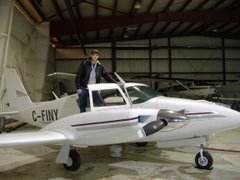
I went flying for the first time with my new instructor, Frank. I know Frank from the flight school in Sarnia, but he is now working here in London. It just so happens that I need a freelance instructor to train me for my IFR, and it just so happens that Frank has his IFR and is willing to do that.
It was a beautifully clear day, free of any turbulence whatsoever, and we decided just to do some circuits to give me a break from the intensive engine-out training I have been doing, and to give Frank a chance to familiarize himself with the airplane. Everything went well, but he mentioned something about the retraction of the landing gear on take-off that we had learned differently. The take-off procedure I had been following based on the recommended procedures in the POH and according to what I had been taught were roughly as follows: Rotate at 80 mph, accelerate in ground effect until Vy (112 mph), climb out at Vy, retract gear when there is no longer enough runway to land, set climb power. Frank, who learned in the Seminoles at Empire Aviation, mentioned that I should retract the gear to get cleaned up as soon as we verify a positive rate of climb.
These two different techniques have two different underlying philosophies behind them. The technique I have been using, where we retract the gear as soon as we run out of runway, uses the philosophy that if we have an engine failure, and we still have a chance to get back onto the ground and stop, do it, even if we're already airborne. Once we've retracted the gear then we're committed to going flying. The philosophy behind Frank's technique, is that as soon as we start the climbout, we've committed to being airborne, so we want to ger cleaned up as quickly as possible to minimize the chances of an engine failing while we still have junk hanging out under the airplane.
Thinking about these two different ideas I realize there's pros and cons to both techniques. My technique reduces the chances of us having to successfully fly an entire circuit on only one engine, which historically, has proven difficult for many pilots. The con would be that it requires very good judgement on just exactly how much runway we need to sink back down, land, and stop - especially if we've climbed a fair amount above the runway. That can definitely be difficult. Underestimate the airplane's required distance to stop and we end up in the weeds past the runway. The other technique makes the decision making easier: Positive rate of climb, retract the gear, ok we're going flying no matter what. But it makes the assumption that the pilot will be able to maintain control of the airplane and make it climb in the current conditions. Light twins are notoriously bad in the single engine climb performance. The single engine climb performance of the Seminole at gross weight and sea level is listed as 212 fpm. That is not much to work with. The Twin Comanche is only marginally better at 260 fpm (with only two of us onboard during training I've seen up to 600 fpm). That is assuming proper pilot technique - climb at Vyse (aka Blue Line), with gear and flaps retracted. The second technique also just ignores any runway left over, which in reality isn't the safest action. If you have enough runway its safer to land then to try and climbout, fly the circuit, and return for a landing.
I guess the risk-reward is different too, at least if the engine fails at the initial stages of take-off. The technique I have been taught carries a lower risk, lower reward. If I misjudge the distance needed to land and stop, I may end up over-running the runway. The airplane may be wrecked, but chances are I'll be ok, since we're just rolling off the runway. The other technique carries a higher reward, higher risk. If done properly, the airplane as well as everybody onboard will be just fine, but it may require a higher degree of skill to acomplish. Any mistake, and the results could be ugly.
Of course if we're operating from a shorter runway where there's not much left-over after we become airborne, the two techniques essentially become the same, and there's no argument. With long runways like at London however, I like the technique I have been taught and I think I'll stick with it.
Showing posts with label engine failure. Show all posts
Showing posts with label engine failure. Show all posts
Thursday, March 1, 2007

Monday, January 8, 2007
Mixture Pitch Power, Gear and Flaps Up, Identify, Verify, Feather.
If you read the title then you've just learned the procedure for dealing with an engine failure in a light twin. I went flying on Sunday and we did a couple circuits, then practiced our emergency procedures. My landings are coming along quite well I must say. Out of the four we did I can honestly say I greased two of them, and the other two weren't perfect, but still well within acceptable parameters. Now I need to start working on touching down within the landing zone I shoot for.
My emergency procedures still need some work. The little rhythmic mantra of "mixtures, pitch, power, gear and flaps up, identify, verify, feather" refers to the memory checklist we need to carry out immediately following an engine failure. 'Mixtures' means we push the mixture controls full forward to the full rich setting. 'Pitch' means we set the pitch of the props forward to full fine, and 'Power' means we immediately go to full power. Basically all the levers on the throttle quadrant go forward. After that we want to clean the airplane up aerodynamically, meaning we raise the landing gear and flaps, if they're down. Now we check to make sure there's no engine fire, and 'Identify' the failed engine. To identify we use the phrase "Dead foot, dead engine". That means that since we are now in an asymetrical thrust situation, we're going have to be using a substantial amount of rudder to counter-act the off-balance thrust and keep us heading in a straight line. This means that the foot that is NOT pushing agains the rudder pedals, means that is the side that has the failed engine. Dead foot, dead engine. Now we need to 'Verify' that conclusion with the engine guages. What is the Manifold Pressure and Tach saying? Now that we have verified the failed engine, we need to "Feather" it. Feathering refers to setting the pitch of the props to full coarse, so they're aligned into the airflow to give us the least amount of drag possible. Mixture, pitch, power - gear and flaps up - identify, verify, feather.
At this point in the process we need to do a cause check to try and find the problem. Make sure our fuel selectors are selected on a tank that has fuel in it, electric fuel pumps get switched on in case an engine driven fuel pump has failed, and we'll open the alternate engine intake air just in case the engine has been choked out with some ice. We'll now attempt a restart. If that doesn't work and we're resigned to the the fact that we are now flying on only one engine, we'll secure the dead engine. That means shutting off the fuel pumps, pulling the mixture control and throttle to idle-cutoff, and shutting off the magnetos and any accessories like generators/alternators on the dead engine. We also need to think about selecting the fuel tank on the side of the dead engine to crossfeed into the good engine. This will over time lighten up that wing and help to counter-act the tendancy to turn towards that side due to the asymetric thrust we're dealing with.
And that's it. I still need work on burning that procedure into my brain and into my muscle memory. I need to be able to go through that whole thing quickly and smoothly without the need to think about it. Any time lost during that procedure may mean altitude and control of the aircraft lost. This is especially critical during the take-off phase where I'm still flying low to the ground, and relatively slow. The lives of myself and my passengers may very well depend on how quickly and efficiently I can carry out that procedure - so it needs to be perfect, and taken very seriously.
Onto a different topic. Pilots who don't follow proper circuit procedures, really drive me crazy, so beware, I'm about to start a rant. We were doing circuits in the Twin Comanche at Huron Airpark in Centralia, and we in our left downwind. We heard a garbled, unreadable radio call, which I disregarded because I couldn't understand a word of it. Shortly after, I looked back to just catch the flash of a yellow piper cub pass directly over top of us from right to left, with what must have been less then 200 ft of clearance. He must not have seen us. Now I admit it can sometimes be difficult to spot other airplanes, especially relatively fast ones. He then proceeded to descend down to our height, circuit altitude, and from about mid-downwind, turned right and joined the downwind... from the downwind side! For those unfamiliar with traffic pattern procedures, that is a HUGE NoNo! Its also unsafe. Let me explain why: You don't do that because there could be an airplane in the downwind already and you might not see him thus causing a risk of collision! Hey wait a second... there WAS an airplane in the downwind! US!!! What a retard, pilots like that should not be licensed if they want to disregard the safety of themselves and others out of pure laziness. If I remembered his registration I would have reported him. This maneuver slipped himself to the inside and essentially ahead of us, who were technically first in line to land. Despite the fact that he managed to land and clear the runway in enough time that it did n't affect us, that is still VERY poor airmanship, and also very rude. Ok I'm calm now. The proper way one should enter the circuit from the downwind side of the airport (in a left hand circuit) is to angle your approach a ways to the left of the airport, then join the downwind leg straight in. Note the green arrows in the diagram. The red arrow is the path the menacing HACK took. This is a good example of why we always have to keep our eyes outside the cockpit and looking around. Sometimes the only person you can trust to maintain a level of safety is yourself.
My emergency procedures still need some work. The little rhythmic mantra of "mixtures, pitch, power, gear and flaps up, identify, verify, feather" refers to the memory checklist we need to carry out immediately following an engine failure. 'Mixtures' means we push the mixture controls full forward to the full rich setting. 'Pitch' means we set the pitch of the props forward to full fine, and 'Power' means we immediately go to full power. Basically all the levers on the throttle quadrant go forward. After that we want to clean the airplane up aerodynamically, meaning we raise the landing gear and flaps, if they're down. Now we check to make sure there's no engine fire, and 'Identify' the failed engine. To identify we use the phrase "Dead foot, dead engine". That means that since we are now in an asymetrical thrust situation, we're going have to be using a substantial amount of rudder to counter-act the off-balance thrust and keep us heading in a straight line. This means that the foot that is NOT pushing agains the rudder pedals, means that is the side that has the failed engine. Dead foot, dead engine. Now we need to 'Verify' that conclusion with the engine guages. What is the Manifold Pressure and Tach saying? Now that we have verified the failed engine, we need to "Feather" it. Feathering refers to setting the pitch of the props to full coarse, so they're aligned into the airflow to give us the least amount of drag possible. Mixture, pitch, power - gear and flaps up - identify, verify, feather.
At this point in the process we need to do a cause check to try and find the problem. Make sure our fuel selectors are selected on a tank that has fuel in it, electric fuel pumps get switched on in case an engine driven fuel pump has failed, and we'll open the alternate engine intake air just in case the engine has been choked out with some ice. We'll now attempt a restart. If that doesn't work and we're resigned to the the fact that we are now flying on only one engine, we'll secure the dead engine. That means shutting off the fuel pumps, pulling the mixture control and throttle to idle-cutoff, and shutting off the magnetos and any accessories like generators/alternators on the dead engine. We also need to think about selecting the fuel tank on the side of the dead engine to crossfeed into the good engine. This will over time lighten up that wing and help to counter-act the tendancy to turn towards that side due to the asymetric thrust we're dealing with.
And that's it. I still need work on burning that procedure into my brain and into my muscle memory. I need to be able to go through that whole thing quickly and smoothly without the need to think about it. Any time lost during that procedure may mean altitude and control of the aircraft lost. This is especially critical during the take-off phase where I'm still flying low to the ground, and relatively slow. The lives of myself and my passengers may very well depend on how quickly and efficiently I can carry out that procedure - so it needs to be perfect, and taken very seriously.
Onto a different topic. Pilots who don't follow proper circuit procedures, really drive me crazy, so beware, I'm about to start a rant. We were doing circuits in the Twin Comanche at Huron Airpark in Centralia, and we in our left downwind. We heard a garbled, unreadable radio call, which I disregarded because I couldn't understand a word of it. Shortly after, I looked back to just catch the flash of a yellow piper cub pass directly over top of us from right to left, with what must have been less then 200 ft of clearance. He must not have seen us. Now I admit it can sometimes be difficult to spot other airplanes, especially relatively fast ones. He then proceeded to descend down to our height, circuit altitude, and from about mid-downwind, turned right and joined the downwind... from the downwind side! For those unfamiliar with traffic pattern procedures, that is a HUGE NoNo! Its also unsafe. Let me explain why: You don't do that because there could be an airplane in the downwind already and you might not see him thus causing a risk of collision! Hey wait a second... there WAS an airplane in the downwind! US!!! What a retard, pilots like that should not be licensed if they want to disregard the safety of themselves and others out of pure laziness. If I remembered his registration I would have reported him. This maneuver slipped himself to the inside and essentially ahead of us, who were technically first in line to land. Despite the fact that he managed to land and clear the runway in enough time that it did
 n't affect us, that is still VERY poor airmanship, and also very rude. Ok I'm calm now. The proper way one should enter the circuit from the downwind side of the airport (in a left hand circuit) is to angle your approach a ways to the left of the airport, then join the downwind leg straight in. Note the green arrows in the diagram. The red arrow is the path the menacing HACK took. This is a good example of why we always have to keep our eyes outside the cockpit and looking around. Sometimes the only person you can trust to maintain a level of safety is yourself.
Subscribe to:
Posts (Atom)