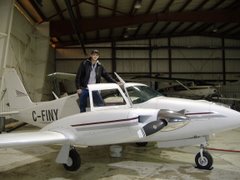
We have just been finishing up the annual for the Twin Comanche. The only major snag was a cracked exhaust pipe on the right engine, and a completely broken pipe, the same pipe actually on the left engine. We had to replace both of them, as neither the crack nor the broken pipe were weldable.
I took two days off work to do most of the work myself, with James, my licensed mechanic coworker did the actually inspections and provided me with the guidance I needed.
The new exhause pipes finally came today and so I spent what only amounted to be an hour and a half installing them. It was easier then I expected. I already had the old pipes removed, so I spent my lunch time drilling a hole for the clamp pin and clamping the old tips onto the new pipes. After work it was just a matter of sliding (more like wrestling, they didn't slide in very well) the pipes into their slot, bolting them onto the exhaust port with a new gasket, and then re-attaching the tip sling. Once the pipes were properly installed I just had to drill new holes for the EGT (Exhaust Gas Temperature) probes and clamp them into place. That was that. Maybe I'll take some pictures of the engine tomorrow and then post them.
Its nice to actually accomplish something. Sometimes the frusterating thing about maintenance in aviation is there are so many inspections and not a whole lot of anything else. You spend an an hour ripping panels off and removing parts to look at what you wanted to see and say, "Yep, looks good". Then you turn around and have to put everything back together again. You almost feel better about the whole thing when you open something up to find it broken (money aside of course, when its your own airplane this is not so much the case), and then you can at least feel your efforts aren't in vain, and you can have the satisfaction of fixing it.
Friday, April 20, 2007

Wednesday, April 18, 2007
Near Miss
Saturday I was down in Sarnia flying my Cessna 150 getting ready to take my CPL flight test, when I witnessed a near mid-air collision. I had just joined the downwind circuit for runway 32, and there were 2 other airplanes in the circuit. One was a rental pilot out flying the school's 172, the other one, also a 172 was from somewhere else, as I didn't recognize the callsign.
The rental pilot was flying ahead of me in the downwind (parallel to final approach leg, but flying opposite direction), with the other pilot on his base leg (90° to final approach leg). The rental pilot made a radio call indicating he was doing a gliding 180 maneuver, which is a commercial level maneuver that involves pulling all the power off in the downwind, and gliding down in a 180° turn to land. The rental pilot's first ignorant mistake was to practice things like that with other aircraft in the circuit. His second mistake was his complete and total disregard to where those other aircraft were. During his manuever, I watched the airplanes come easily within 2 wingspans of each other as the rental pilot cut off the other pilot as he turned to the inside of the other airplane. He was just not paying attention. He ended up landing to do a touch and go, and the other pilot decided at that point to overshoot.
Talking to the rental pilot afterwards I learned that he never even saw the other airplane until he was down and rolling on the runway as the other aircraft flew over top of him in the overshoot. I've never seen airplanes so untintentionally close to each other in flight. The rental pilot has a passenger onboard, his wife, who was completely oblivious to the whole incident until we mentioned it to the pilot on the ground. The worst part about it was the rental pilot thought it was funny when we mentioned it to him, and he never admitted any wrongdoing or took any responsibility for his actions at all. Apparently he has a reputation among the flight instructors for being ignorantly reckless. Even thinking about it now, 4 days after the event, it gives me a knot in my stomach. I almost saw people die - a pilot who had done nothing wrong, and a completely innocent passenger. All from a ignorant pilot's actions.
When I mentioned it back at the flight school after we were both on the ground, I asked him very gently if he had seen the other airplane, and didn't really comment on anything other then what I saw. I regret being so kind. The more I think about it, seeing how he reacted with no remorse, and with no intentions on making sure the event doesn't repeat itself, the more I wish I had chewed him out in front of his passenger and everyone else in the room. It very well could have been me he nearly smacked into. Ignorant, self-righteous pilots like that with no respect for the responsibility they carry should not be aloud to hold a license, and the flight school should not be renting airplanes to him. At least it ended safely, if only by sheer dumb luck. It makes me sick just to think that I could have witnessed the collision of two airplanes from a birds-eye-view, I'm not sure how I would have handled it had it actually happened.
Monday, April 9, 2007
Ignorance is Bliss
As soon as you earn your license and start taking non-pilot passengers up with you, you learn pretty quickly that your behaviour in the cockpit greatly influences their perception of the flight, particularily their safety. If pilots in a commercial airliner run into a problem, even if its a moderately serious one, they are able to work through and deal with without being under the scrutinous eyes of nervous passengers. Something could go wrong, and if they're able to either ignore it or fix it, nobody will be the wiser. In private airplanes however, the passengers can see everything that goes on in the cockpit, so we don't have that luxury. However we still have the responsibility and desire to maintain the confidence of our passengers, and demonstrate to them that flying is indeed as safe as we say it is. Especially if we want those passenger to fly with us again.
This presents a little bit of dilema for small airplane pilots, and can require a certain amount of good judgement to maintain the confidence of your passengers without comprimising their safety. It does become a little easier if you're operating single pilot however, which, fortunately, the vast majority of the time we are. The exception being if a fellow pilot is riding along left seat and you use him as a sort of simulated copilot (two sets of hands and heads are always better then one). In this case its always better to openly point out and discuss everything going on, so both persons have full situational awareness, and two knowledgeable brains can help work through the problem. Operating single pilot if you notice a small problem you can note it mentally and take the necessary actions or just monitor it silently as needed. The truth is small problems happen fairly often, but they usually don't cause reason to panic. Radios can act up, spark plugs can foul, carburetors can start to ice up. Usually its just a matter of taking the proper steps to fix or side-step the problem so it doesn't become a factor or monitoring it as needed to make sure things don't get worse. If they do we want to already be on top of them. But many passengers, especially nervous ones, if they notice that something isn't quite right, even if its a little something, can become far more concerned then need be. In those situations its difficult if not impossible to set them at ease simply by explaining the situation, (providing we can spare the time and attention at the moment do so) so I find for the most part its best to just try and not let them in on the problem, as long as their safety isn't jepardized by their ignorance. In this case its important to keep a confident appearance and at least appear that everything is fine and you're under control. If things worsen and the passengers have a need to know what's going on so they can react accordingly, that is an entirely different situation. But 99% of the time it never comes to that, so why worry them?
We'll use carburetor icing as an example. While fairly rare, it can and has happened to me. While not serious in the least if the correct actions are taken, it is not a normal part of the flight. I was taking a passenger up in the Cessna 150 once, and I could tell she was a little nervous. It was a little bit of a moist hazy day, and I pulled the carb heat out to check for icing. Sure enough, the engine started running just a little rough. Unfortunately I couldn't hide the change in engine sound from her and she visible jumped. I was a little concerned about the icing, at least until the carb heat could clear it out, but I didn't show it, and simply confidently explained that I pulled the carb heat out, which would cause the engine to lose a little bit of power do to the hot air. I neglected the part about possibly having an engine failure if I let the ice build up any more. She didn't need to know about that. In a couple minutes the ice cleared up, and everything went along as if nothing happened.
I guess its a matter of the cliche's "Knowledge is power" and "Ignorance is bliss". Non-pilot passengers often don't have the knowledge or experience to to fully understand whats going on, so as harsh as it sounds its best they don't know at all. Of course there are always exceptions. There are the passengers who have confidence in your abilities and the airplane and understand that minor glitches happen, and even if they don't fully understand everything, they do understand that most the time its no big deal because we always leave ourselves alternative options to take. In those cases providing you are able to take the time and give a commentary on whats going on, it can serve as an interesting learning experience, and can serve to boost their confidence even more. The trick is its important to know who those people are.
Tuesday, March 27, 2007
Little green dots
We went flying on Monday. From the heat of the day there were scattered spots of convective activity popping up all over southwestern Ontario. When you hear convective activity think potential thunderstorms. There was a line of activity north of London running from Stratford all the way to the Hamilton area, and there was also a line developing south down near Chatham as well. When I talked to the weather briefer he mentioned that London and Sarnia were ok for now but thunderstorms could easily start to pop up there as well.
We did our usual flight to Sarnia to fly some ILS approaches, and the weather turned out to be a non-event for us, as there was a wide corridor of clear skies running from Sarnia to London. But we did get to fire up our fancy stormscope which I haven't had a chance to see working yet. For those unfamiliar with such a device, a stormscope measures electrical discharges within a cloud and displays them on a little round display in the form of a green dot relative to the position of the aircraft. How it does this, the best explanation I can give is its magic, but it works. The dots once they've appeared stay on the screen in the same place until the CLEAR button is pushed. They don't move around the display if we make a turn so we have to be sure to push CLEAR everytime we make a heading change, and let the Stormscope start picking up fresh discharges again based on the new relative direction. So if there is convective activity (which produces electrical discharges) within range of our stormscope (25-200 miles depending on the setting) the little green dots on the screen will accumulate enough after a couple minutes that we can make out rather clearly where the good weather is and where the bad weather is in relation to our position. Its really quite fascinating to watch the little green dots start to pile up and clutter the display screen. We could make out very well on the stormscope the squall line over kitchener, and the stormscope also picked up the cell of thunderclouds south near Chatham quite nicely as well. Since it was a clear day we could see the Cumulonimbus clouds building in the distance over Chatham, so we really didn't need a Stormscope to tell us to stay away from there, but the beauty of this instrument is if we were flying in IMC (or even just marginal VFR) and weren't able to see a great distance in front of us, we'd be able to detect any embedded thunderclouds in real time and effectively navigate around the bad spots.
There are two other types of weather detection equipment in common usage. There is the onboard weather radar, which usually has a dome mounted in the nose of an aircraft. This dome picks up the echo's of the radar signal off of any precipitation ahead of the aircraft, and can thus show you where the heavy spots of rain are, thus indicating thunderstorms. These units however are rather large, and expensive, and for the most part are only used on larger aircraft. The other type is also weather radar, but it draws its information from ground based radar stations and relayed to the aircraft by satellite. This is known as XM WX Nexrad Weather. Or just XM Weather. Or just Nexrad Weather. This type for the most part only requires a GPS unit capable of receiving it (with a small current paid subscription), and is thus relatively affordable compared to onboard weather radar, while achieving similiar results. It does have a few minor drawbacks however. Weather information on Nexrad weather is limited to the geographical regions that are covered by a working ground radar station. It is also dependant on a solid GPS signal. It also must be noted that the information given is not in real time. New radar images are transmitted to the GPS units every 15 minutes or so. This means with this system if the weather changes quickly, you'll no longer have an accurate picture, and weather can change very rapidly, especially when we're talking about thunderstorms.
The pros to weather radar of any type is that it is more useful all year round, and it will pick up precipitation of any kind - rain, snow, freezing rain. That is something our Stormscope cannot do. Save from installing a $30,000 onboard weather radar system in our little Twin Comanche - impractical if no impossible - it gives us some pretty good capability. It shows us a clear picture of up-to-the-second dangerous weather in real time, without being dependant on technology outside of the cockpit. Pretty dang cool if you ask me.
Saturday, March 17, 2007
May I Never See the Day...
I was browsing through the photos of Twin Comanche's on Airliners.net. My airplane has made it into the photo gallery. Look up C-FINY to find it. But I also came across this photo:
That is a Twin Comanche that seen better days. Every airport has airplines like this sitting around. Airplanes that at one point have had some reason for its owners to abandon it and leave it to rot. In Sarnia there is an old V-tail Bonanza sitting behind one of the buildings in a pile of junk. I've always wondered about it - its history, and what happened to it that made it no longer worth maintaining. Its been sitting there for as long as I can remember, which goes back for at least 15 years. Airplanes like these always seem to be permanent fixtures of the airports. They've sat there for as long as anyone can remember and will most likely continue to sit there and decay for many more years. This one in the picture is missing the nose cowl, as well as the tail cone fairing at the back. Also judging by the way that its sitting on its tail in the grass I would imagine the engines have been stripped off it too. There are also very obvious signs of corrosion. This airplane has been dead for a very long time, and all I can say is may I never see the day my Twin Comanche looks like the one in the picture.
Tuesday, March 13, 2007
Ahh the Springtime
Ahh the springtime! Warmer days, sun shining, everybody out flying in the clear skies. The sweet smell of avgas, the thrum of aero engines running, nosewheels collapsing... Yes, you read that correctly.
It was gorgeous out today. Warm and Sunny enought that for most the day we just left the hangar door open to enjoy the fresh air and sunlight. Around mid-afternoon I was working away and looked up to see James and Brian (my coworker and my boss) pushing a Cessna 172 into the hangar. Nothing too out of the ordinary, we have lots of planes coming in and out of our hangar all the time. Except something was wrong with the picture I was seeing. The airplane was tilted forward at a very unusual angle. That was because it had some slight nosewheel problems. Ok not so slight. The airplane as it turned out is pretty much a write off. Some student pilot and instructor somehow managed to impact the ground hard enough to push the nosestrut all the way up into the engine compartment. Only about 3/4 of the wheel was left exposed out the bottom of the airplane. The outer 4" of the props were folded back nicely. When we took the top cowl off to look inside, you could see the bottom bracket that braces the nose strut to the belly of the airplane had been ripped off its anchor points and folded up, and part of the firewall was crumpled along with it. The firewall is essentially the core of an airplane. That's what the engine mount is bolted to, and basically the rest of the airplane is run into or back from that point as well. It's pretty much the strongest part of an airplane. The bolts that mount the top part of the nosestrut to the firewall were also all sheared off as the strut was pushed up further into the nose.
Needless to say it was not something you see everyday. I wish I could post some pictures, but I probably shouldn't, as a certain amount of annonymity is probably good at this point. The plane doesn't belong to anybody I know, apparently its from a flight school in the Toronto area. Both student and pilot are ok. I feel bad for the instructor. It will probably be bad news for him, but for all we know there may have been little he could have done. If a student lacks the finess to land properly, and things start to go bad close to the ground, sometimes there's precious little time for the instructor to intervene and regain control of the situation. Then again it could be all the instructor's fault. I didn't see it happen, and I wasn't there, so I can't really comment. It was certainly interesting to see an airplane in that kind of shape coming into our hangar however.
Monday, March 12, 2007
More Hard Work
More instrument practice today. We started off flying a little practice pattern that involved a bunch of instrument procedures, like a procedure turn, deardrop entry, and hold pattern, just to get the hang of flying in that manner. For the most part I had it down fairly easily. Its just a matter of flying a series of timed straight legs and turns as precisely as possible, so Frank decided that he would let me try an NDB approach on for size.
We tuned into the Goderich NDB and made our way north, with me flying heads down on instruments the entire way. We were flying through some light rain showers but for the most part it was relatively clear. I wasn't wearing a hood or foggles or anything, but I wasn't aloud to look outside. Typically you're supposed to wear something that obstructs your vision to everything except the instruments to simulate instrument meteorlogical conditions (IMC), but its really not that hard to resist looking outside as long as you concentrate on the panel.
Actually its so easy to focus on the instruments that I can entirely forget about everything else - that is until Frank makes some off-handed comment about the weather outside or some landmark on the ground, which then I reflexively look up. Doh! As long as Frank keeps quiet though I quickly become lost in my instrument scan: Attitude, heading, altitude, ADF. Attitude, heading, altitude, ADF.
This all comes fairly naturally, its just about reading the instruments and making the necessary corections. The NDB approaches we did today were a different story however. I won't go into the gory details of how its supposed to work and proper procedures, but it is DIFFICULT. Its not nearly as straightforward and intuitive as flying an ILS, but requires a certain amount of spatial thinking - picturing where you are based on the position of the ADF needle versus the aircraft's heading. We flew three approaches and each time I becames so entangled in trying to wrap my mind around what was supposed to happen, and what was actually happening, that I completely forgot that I actually had to fly an airplane at the same time. One attempt I neglected my pre-landing checks, and another time I forgot about descending down to the next step down altitude until it was too late. At that point I was trying to rapidly descend and slow down at the same time before I missed the airport altogether. Descents and reductions in airspeed don't go well together at all. While doing that my attention was diverted from the navigational part of the approach, and I forgot about my final turn after I passed the NDB. I was marginally improving though. By the third one I had the concept of the NDB approach down in my head better. I'm sure when we go up again and get a couple more attempts in I'll have it more solidified in my head. Once I understand completely how its supposed to work, I'll have a fighting chance at actually getting the airplane to do it. I managed to prove today however that if you become too focused on getting one thing to happen right and forget about all the other things you have to worry about things can quickly spiral out of hand.
Today's flight again took so much work to learn and perform what I was being taught, but that is so much fun. I haven't had this kind of fun in an airplane in a long time, its so refreshing.
On a side note, on the way back to london we had a substantial tailwind, and the GPS was showing a groundspeed of 185 kts, or 213 mph. "200 mph club" baby.
Subscribe to:
Posts (Atom)