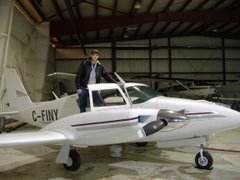
Things are still going strong coming into the second half of September, which has been totally unexpected. I was under the impression at the beginning of the month that the busy time would be wrapping up, but apparently thats not the case.
Yesterday was cold, wet and miserable however. There was a strange layer of mist blanketing the entire route of flight, giving a vertical visibility of 1000-1500 ft and forward vis of around 3-5 miles. The temperature on the ground stayed between 4-6 degrees C for the better part of the day, but a high pressure system was forecast to move in from the north and push the bad weather away. On my first flight I took off with two passengers onboard and initially climbed to 1000 ft into a headwind. It was pretty turbulent as well as wet and rainy underneath the cloud layer, but I could see the sun and just a tint of blue sky above me, so it looked like this mist/cloud layer was pretty thin. One of my passengers was really not enjoying the ride, she was very nervous, tapping her knee and wringing her hands. The longer we flew the more nervous she got, eventually to the point where she was shivering out of nervousness. I figured for the sake of my passengers I'd pop up another thousand feet or so to get on top of the cloud layer, where we'd see the sun and hopefully the turbulence would taper off a bit as well.
Once at 2000 however I looked up again but it still looked the same, I could still just barely see a bit of blue sky and the sun piercing through the mist, but now I was flying on instruments as the ground had long disappeared. The layer didn't look like it was this thick, but oh well, it can't be more then another few hundred feet before pop out the top. At 3000 ft nothing had changed. We were still in the layer of mist - it was such a strange phenomenon. Here I was 2000 ft higher than I was initially yet looking up still looked exactly the same. It looked like just a thin layer of mist above me. I considered continuing the climb even further, but the temperature was very close to zero degrees as it was, so I didn't want to get any higher and start picking up ice, and we were flying into a headwind, so I didn't want to fight too strong of winds either, so I conceded defeat and started a descent back down to where I could see the ground. Conditions were the same all the way up the coast, so we spent the remainder of the flight bouncing around in the rain and mist at 1000 ft.
Once we landed and unloaded my passengers, I had 5 more waiting ready to come back with me. We got all loaded up and ready to start up when one of the ladies on board said, "No, I can't do it". Can't do it? She was a little larger so I assumed the leg room wasn't enough or something and asked if she wanted to sit in the front where there's a little more leg room. Her friend explained that she was too nervous because of the weather. Oh, not much I could do about that. I could see how it was a bit of an indimidating day to fly - like I said it was cold, rainy, and the winds were quite gusty. In the end we departed with only 3 of the 5 passengers back southbound. The way back was bumpy, but eneventful and quick as we caught a stiff tailwind for the return leg.
My second trip was the same thing. I decided not to experiment with the cloud layer this time however and just stayed at 1000. A Navajo from the other local carrier that departed about the same time I did for the same destination decided to try to get on top however. They advised they were climbing to 3500 ft. I wondered if I missed the cloud tops by a mere couple hundred feet, since I only climbed to 3000. A few minutes later they radioed an advisory that they were now at 4500 ft and level. They had been fooled by the illusion as well, and ended up having to go higher.
The pilots for that carrier are regulars in the area like me, so we're on pretty familiar terms and usually all recognize each other's voices, so I keyed the mic, "Did you manage to find the top of that mist?"
"Ya we popped out at about 4200 ft."
I remarked that I tried that on my last flight but gave up at 3000.
"Hey Chad have you been to **** already today?"
"Yep."
"What are the winds like?"
I tried to remember exactly how the windsock looked. I tend to have a short-term memory and forget entirely what the conditions were at the airport on my last visit, but I managed to pull the mental image of the windsock out of the back of my brain.
"Ahh, gusting about 12-15 knots, pretty much 90 degrees [to the runway direction]."
"Alllll-riiiiighhht."
I smiled to myself. I guess I'm not the only one who likes crosswind landings - they keep life interesting.
By the time I was southbound again for the second time the High Pressure system was starting to work its magic you could see it starting to clear up in the north, but it was still pretty turbulent. About 10 minutes from landing one of my passengers tapped me on the shoulder and asked if I had a tissue. "Sorry no I don't." I turned around to see their young son leaning into a sick bag that his mother was holding for him. Poor guy. Not a good day for my passengers apparently. One terrified flyer, another one that cancelled out of panic, and now a sick kid. I haven't yet had an adult puke in the airplane, but that would make my 3rd child, all probably under 5 that haven't been able to hold it in on the bumpy days. All in a day's work of a pilot I guess.
Showing posts with label icing. Show all posts
Showing posts with label icing. Show all posts
Saturday, September 19, 2009

Thursday, December 7, 2006
Icing on the Cake
Its snowing out right now, and I can't go flying. Flying in the wintertime has both its pros and cons. Airplanes love cold air. Cold air is more dense, which allows the engine to produce more power. The dense air also provides more substance for the propellers and wings to displace, thus giving more thrust and more lift. In the Cessna 150 these effects are most visibly seen during a climb. On a hot summer day with just me in the airplane I can expect around a 3-400 ft/per min climb, whereas in colder winter weather I've see climbs upward of 600 fpm.
Winter flying also requires more cautious actions to avoid airframe icing. Airframe icing is defined as the buildup of ice on the wings and other surfaces of the aircraft, which can add weight to the airplane as well as reduce lift. In icing conditions, ice most heavily builds up on the leading edges of the wings and other surfaces of the airplane. Ice on the windscreen can impede forward visibility from the cockpit. More importantly, icing on the wings, if appropriate action is not taken, can actually bring an airplane down. The ice changes the shape of the wings, which alters how the air flows over it. This can reduce the amount of lift the wings produce.
All of the larger airliners have equipment to defend against icing, and many smaller aircraft have systems as well. There are 3 different types of ice protection systems, categorized into two different groups: De-icing, which is to remove ice that has already built up, and Anti-icing, which works to prevent ice buildup in the first place. De-icing boots are strips of rubber that are glued onto the leading edges of the wings and other flying surfaces. When ice accumulates on the boots, they can be inflated with air which breaks away the the ice so it falls away. This is by far the most common system employed on smaller business jets and piston planes. Less commonly seen is the weeping leading edge system. Like on the Cirrus line of private aircraft, the leading edge has a grid of tiny holes covering the entire leading edge. When activated, these 'pores' seep anti-icing fluid, which is spread by the airflow over the wing. This fluid prevents water droplets from freezing on the wing. Lastly, and only used on jet aircraft, is the hot-wing anti-icing system. The leading edge is heated from bleed air from the jet engines, which prevents icing from freezing onto the leading edges.
Neither of the airplanes I fly are equipped with de-icing, or anti-icing systems. Additionally, neither aircraft perform particularly well with ice, compared to other airplanes. The Cessna 150 is a very small, underpowered airplane. Do to the lack of power, it would not be able to handle the extra weight and decreased lift as well as more powerful airplanes could. The Twin Comanche, though having lots of power, has what is called a laminar flow wing. Simply speaking, it is critical for this type of wing to have a very smooth surface, free of any contamination. Ice on this wing would change the flow of air very drastically. This means that I have to be very cautious as to the weather conditions I fly into, and as such, I am not going flying today.
Winter flying also requires more cautious actions to avoid airframe icing. Airframe icing is defined as the buildup of ice on the wings and other surfaces of the aircraft, which can add weight to the airplane as well as reduce lift. In icing conditions, ice most heavily builds up on the leading edges of the wings and other surfaces of the airplane. Ice on the windscreen can impede forward visibility from the cockpit. More importantly, icing on the wings, if appropriate action is not taken, can actually bring an airplane down. The ice changes the shape of the wings, which alters how the air flows over it. This can reduce the amount of lift the wings produce.
All of the larger airliners have equipment to defend against icing, and many smaller aircraft have systems as well. There are 3 different types of ice protection systems, categorized into two different groups: De-icing, which is to remove ice that has already built up, and Anti-icing, which works to prevent ice buildup in the first place. De-icing boots are strips of rubber that are glued onto the leading edges of the wings and other flying surfaces. When ice accumulates on the boots, they can be inflated with air which breaks away the the ice so it falls away. This is by far the most common system employed on smaller business jets and piston planes. Less commonly seen is the weeping leading edge system. Like on the Cirrus line of private aircraft, the leading edge has a grid of tiny holes covering the entire leading edge. When activated, these 'pores' seep anti-icing fluid, which is spread by the airflow over the wing. This fluid prevents water droplets from freezing on the wing. Lastly, and only used on jet aircraft, is the hot-wing anti-icing system. The leading edge is heated from bleed air from the jet engines, which prevents icing from freezing onto the leading edges.
Neither of the airplanes I fly are equipped with de-icing, or anti-icing systems. Additionally, neither aircraft perform particularly well with ice, compared to other airplanes. The Cessna 150 is a very small, underpowered airplane. Do to the lack of power, it would not be able to handle the extra weight and decreased lift as well as more powerful airplanes could. The Twin Comanche, though having lots of power, has what is called a laminar flow wing. Simply speaking, it is critical for this type of wing to have a very smooth surface, free of any contamination. Ice on this wing would change the flow of air very drastically. This means that I have to be very cautious as to the weather conditions I fly into, and as such, I am not going flying today.
Subscribe to:
Posts (Atom)