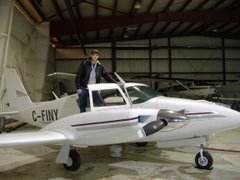
So I finally got checked out on the Cessna 206 yesterday. Its been a while since I've flown a high-wing... 3 years now I think. We went up intending to do a few circuits dual before some solo practice, but after the first one he told me to go drop him off on the ramp and sent me back up for a few more by myself.
The 206 is much more responsive in the roll axis then both the Cherokee (which is lethargic by any comparison) as well as my Twinkie. Due to the large rudder it also has lots of yaw authority. Conversely it seems to have a much heavier elevator pull/push.
I think of the comparison like this: The Cherokee is more airplane-like, whereas the 206 feels more like a flying-machine contraption with the wing struts, wheels visibly hanging down, and taxi characteristics. I forgot how wobbly Cessna's are on the ground - there's lots of spring in those steel leaf landing gear compared to the rock solid taxi-ing characteristics of the low-wing Pipers. Every bump causes a side-to-side rocking motion during taxi.
Our 206 is equipped with the Robinson STOL kit, which includes wing fences and drooping ailerons to assist the main flaps. Takeoff performance is incredible; by the time you've finished advancing the throttle the airplane is almost ready to come off the ground when its empty. Climbout happens in a strange almost nose-down attitude until the flaps are retracted.
There's something about the construction of the 206 compared to the Cherokee that says it was meant to be a workhorse. Its solid. The Cherokee feels more like it was built to be a private plane that has been pressed into Commerical service. I can't provide any real evidence, its just the vibe that I get. There's also no argument when it comes to which is a better bush plane.
All in all the 206 is an interesting bird to fly, but I think I prefer the Cherokee for my day-to-day flights. Its about 5-10 knots faster, easier to load, easier to enter and exit, easier to fuel, and much more stable on the ground.
Tuesday, July 28, 2009

Friday, July 17, 2009
Mission: Incomplete
Yesterday was spent wasting my life away sitting at home waiting for the weather to lift. But today was looking a little better, so around 9 AM I got a knock on my door. It was the Chief. He wanted me to check the weather and then come by and let me know what I thought.
Sweet, flying today - maybe. Well I checked the GFA, there was a low pressure system sitting over top of us, but move east, and the METAR reports were calling good vis but marginal ceilings hovering between 500-700 ft. So I had breakfast, got my stuff ready, and just before I headed out the door I checked the METAR one last time. This time it was calling 1600 ft cloud. Whoo hoo! Much better.
Out to the airport, and off we go. I departed and climbed up to 1000. But as we went further north, I had to drop down to 800, then 600, then 400 ft. We cruised along at 400 ft for a bit, and then it started to get even worse. Hmm... to turn around or not to turn around? As long as I could see where I was going we'll be alright. But soon enough I was down to 300 ft agl, the lowest I can legally fly with pax onboard, with the visibility quickly getting worse as well. I peered ahead and couldn't see much in front of me, and if we went much lower it would start to get dangerous. We only made it 30 miles. I nudged in the power and started a climbing left turn to start backtracking. Instantly I was in cloud, but I'd rather be in cloud for a couple minutes at an altitude that I know is safe rather then make a turn close to the ground trying to stay visual in poor conditions. After I made my 180 turn, I started a creeping descent back down out of the clouds. Heading back south the conditions quickly got better.
I called up the radio service again and told them I was coming back. I passed by a helicopter trying to go the same place I was. I wonder if he'll have better luck. I filed a PIREP and landed. Thats the first time I've had to turn around since I started working here. I wonder in the back of my head if a better pilot could have done better. Ahh well. I left a msg for company to pick us back up at the airport, they didn't get it apparently, but after waiting around for about 20 minutes the owner pulled up in the fuel truck with the other pilot. They're heading South to swap airplanes from maintenance. Hopefully he makes it further south then I made it north.
I noticed the helicoper that passed me when I was heading back is also back now. I went over to see if he made it any further, he was certainly gone a fair amount longer then I was. Turns out he ran into the same stuff, but tried to go around it a couple different ways before turning around, and it got even worse then it was when I turned around. I don't feel so bad now. If a chopper can't get through, there's no way an airplane can. We also got chatting, and funny thing, he used to work for us about 20 years ago. It seems like every second pilot I talk to is like, "Ya I used to work for you guys XX years ago!". I should hardly be surprised anymore.
So, now I'm back at the house, waiting for weather to clear up. Dag-nabbit.
Sweet, flying today - maybe. Well I checked the GFA, there was a low pressure system sitting over top of us, but move east, and the METAR reports were calling good vis but marginal ceilings hovering between 500-700 ft. So I had breakfast, got my stuff ready, and just before I headed out the door I checked the METAR one last time. This time it was calling 1600 ft cloud. Whoo hoo! Much better.
Out to the airport, and off we go. I departed and climbed up to 1000. But as we went further north, I had to drop down to 800, then 600, then 400 ft. We cruised along at 400 ft for a bit, and then it started to get even worse. Hmm... to turn around or not to turn around? As long as I could see where I was going we'll be alright. But soon enough I was down to 300 ft agl, the lowest I can legally fly with pax onboard, with the visibility quickly getting worse as well. I peered ahead and couldn't see much in front of me, and if we went much lower it would start to get dangerous. We only made it 30 miles. I nudged in the power and started a climbing left turn to start backtracking. Instantly I was in cloud, but I'd rather be in cloud for a couple minutes at an altitude that I know is safe rather then make a turn close to the ground trying to stay visual in poor conditions. After I made my 180 turn, I started a creeping descent back down out of the clouds. Heading back south the conditions quickly got better.
I called up the radio service again and told them I was coming back. I passed by a helicopter trying to go the same place I was. I wonder if he'll have better luck. I filed a PIREP and landed. Thats the first time I've had to turn around since I started working here. I wonder in the back of my head if a better pilot could have done better. Ahh well. I left a msg for company to pick us back up at the airport, they didn't get it apparently, but after waiting around for about 20 minutes the owner pulled up in the fuel truck with the other pilot. They're heading South to swap airplanes from maintenance. Hopefully he makes it further south then I made it north.
I noticed the helicoper that passed me when I was heading back is also back now. I went over to see if he made it any further, he was certainly gone a fair amount longer then I was. Turns out he ran into the same stuff, but tried to go around it a couple different ways before turning around, and it got even worse then it was when I turned around. I don't feel so bad now. If a chopper can't get through, there's no way an airplane can. We also got chatting, and funny thing, he used to work for us about 20 years ago. It seems like every second pilot I talk to is like, "Ya I used to work for you guys XX years ago!". I should hardly be surprised anymore.
So, now I'm back at the house, waiting for weather to clear up. Dag-nabbit.
Friday, July 10, 2009
How High
There are a lot of factors in play when it comes to choosing our altitude. I often get asked how high we’ll be flying, and I always have to hold back the "well it depends on..." and launch into all the different factors that come into play when choosing how high we're going to fly. I don't think my passengers usually want the answer in the amount of detail I'd like to give. That's what a blog is for. So here we go.
Every airplane has a favourite altitude – the altitude where it performs most efficiently. The higher we get the thinner the air gets, which carries with it both a pro and a con. The pro is that since there’s less air, there’s also less resistance, meaning it takes less power to move through the air then it would at a lower altitude. Less air also unfortunately means the engines can’t produce as much power, which is where the trade-off is. An airplane's most efficient altitude is where we burn the least amount of fuel and go the fastest. This is accomplished by finding that trade-off of drag vs power produced. We can go even further to say that this depends on the power setting we want to cruise at. If we want to fly for maximum range, then we'll have to cruise at a lower power setting. In that case since we’re not asking a whole lot of the engine, it makes sense to climb up high to the thin air where both power and drag are reduced. The higher power setting we want to cruise at, generally the lower we have to fly. Lets say we want to fly at max cruise, which is usually 75% of the maximum rated horsepower. Our most efficient altitude will be somewhere near to the height at which we have the throttles fire-walled with the engine only producing that 75% power of its full power horsepower at sea level. Usually for most normally aspirated (non-turbocharged) airplanes that’s around 6000-8000 ft. In the Twin Comanche (which I happen to be flying in while I write this) it is 8000 ft. Any higher than that and the engine power stands a good chance of falling off below 75%. Any lower however and the thicker air will be holding us back in the form of extra drag. So engine power vs drag is our first consideration when choosing the best cruising altitude.
For this reason turbocharged airplanes have the ability to fly both faster and much higher. A turbocharger compresses the air before it enters the engine, which eliminates (to a point) the disadvantage of a power decrease at higher altitudes. This allows an aircraft to fly in the higher altitudes where the air is thinner, resulting in a higher cruise speed while still be able to produce the same level of power as it would much lower. How high exactly depends on how much boost the turbocharger has, or how much it is able to compress the air. For a turbocharged airplane the most efficient altitude occurs at the highest altitude where the turbocharger is able to produce the desired power setting. Below that altitude and the turbocharged engine can produce more power then is required, but above that the turbocharger’s ability starts to decline and engine power decreases.
Our second biggest consideration is what are the winds doing? Wind strength usually increases with altitude. So if we’re fighting a headwind, we have to decide if the stronger winds aloft are going to cancel out any advantage we’re gaining by flying high. If we’re in a tailwind, the winds aloft may very well give us a bigger push then we’d achieve by flying at our airplanes most efficient altitude. Considering that it’s usually a good practice to fly higher in a tailwind, and lower in a headwind.
Weather is also a factor, especially if we’re flying VFR. VFR airplanes aren’t supposed to fly through clouds, some sometimes that can limit us to flying lower underneath, or in some cases overtop. Weather considerations for IFR airplanes can include icing, which may mean that airplane has to stay lower in the warmer air where airframe icing is not occurring.
Other factors include obeying the Cruising Altitude Order, which is a rule that governs certain altitudes airplanes flying in certain directions cruise at. VFR aircraft flying westbound should always cruise at even thousands plus five hundred feet. For example 4500, 6500, 8500, etc. VFR aircraft flying eastbound should cruise at odd thousands plus five hundred feet – 5500, 7500, 9500, etc. For IFR traffic it’s the same except without the “plus 500 ft”. This in theory is supposed to reduce the risk of a mid-air collision. I think it works fairly well.
Turbulence also comes into play sometimes as well, especially when carrying passengers. Usually convective turbulence caused by the sun heating the earth on sunny days is stronger at the lower altitudes. So sometimes for your passengers’ sakes, it may be worth it to cruise a little higher in the smooth air, even if it means catching a stronger headwind or giving up some engine power. A smooth flight that’s slightly longer is usually more enjoyable then a short flight bouncing around. Especially if it means you don’t have to clean up puke afterwards.
How far the destination is can also be a factor, especially when flying at aircraft with marginal performance. Sometimes staying lower then the altitude where you’ll fly the fastest can be better in the long run if its just a short hop. Spending 20-30 minutes climbing at a slow airspeed and burning obscene amounts of fuel may not make much sense when it’s only a 40-minute flight. That being said, during the descent it is possible to convert much of that altitude back into airspeed, but its never possible to gain back all of the spent time and energy.
Finally, and this generally only applies to single engine airplanes, safety in the form of gliding distance should also be considered. If we’re flying over bodies of water or unfriendly terrain its wise to consider choosing an altitude high enough to leave us with options should an engine fail and we become a glider.
This all being said, all this may be great theory, and though it may be possible to sit down, check the weather reports and aircraft performance charts and compute the absolute best altitude to fly at, it rarely makes sense or is practical to spend the time doing that. Usually after having flown an airplane for a reasonable amount of time, one gets to know the airplane enough to form a pretty good idea of its most efficient altitude and time it will take to climb to it. The difference on all but the longest flight may mean only +/- 5%. Winds can make a big difference, but if you don’t have the chance to check the upper winds, going on the rule of thumb of flying high in a tailwind and low in a headwind usually works reasonably well. Everything else can pretty well be figured out on-the-fly (pun not intended).
Well, been flying for an hour and forty minutes so far, one hour fifty to go… lousy headwind…
Every airplane has a favourite altitude – the altitude where it performs most efficiently. The higher we get the thinner the air gets, which carries with it both a pro and a con. The pro is that since there’s less air, there’s also less resistance, meaning it takes less power to move through the air then it would at a lower altitude. Less air also unfortunately means the engines can’t produce as much power, which is where the trade-off is. An airplane's most efficient altitude is where we burn the least amount of fuel and go the fastest. This is accomplished by finding that trade-off of drag vs power produced. We can go even further to say that this depends on the power setting we want to cruise at. If we want to fly for maximum range, then we'll have to cruise at a lower power setting. In that case since we’re not asking a whole lot of the engine, it makes sense to climb up high to the thin air where both power and drag are reduced. The higher power setting we want to cruise at, generally the lower we have to fly. Lets say we want to fly at max cruise, which is usually 75% of the maximum rated horsepower. Our most efficient altitude will be somewhere near to the height at which we have the throttles fire-walled with the engine only producing that 75% power of its full power horsepower at sea level. Usually for most normally aspirated (non-turbocharged) airplanes that’s around 6000-8000 ft. In the Twin Comanche (which I happen to be flying in while I write this) it is 8000 ft. Any higher than that and the engine power stands a good chance of falling off below 75%. Any lower however and the thicker air will be holding us back in the form of extra drag. So engine power vs drag is our first consideration when choosing the best cruising altitude.
For this reason turbocharged airplanes have the ability to fly both faster and much higher. A turbocharger compresses the air before it enters the engine, which eliminates (to a point) the disadvantage of a power decrease at higher altitudes. This allows an aircraft to fly in the higher altitudes where the air is thinner, resulting in a higher cruise speed while still be able to produce the same level of power as it would much lower. How high exactly depends on how much boost the turbocharger has, or how much it is able to compress the air. For a turbocharged airplane the most efficient altitude occurs at the highest altitude where the turbocharger is able to produce the desired power setting. Below that altitude and the turbocharged engine can produce more power then is required, but above that the turbocharger’s ability starts to decline and engine power decreases.
Our second biggest consideration is what are the winds doing? Wind strength usually increases with altitude. So if we’re fighting a headwind, we have to decide if the stronger winds aloft are going to cancel out any advantage we’re gaining by flying high. If we’re in a tailwind, the winds aloft may very well give us a bigger push then we’d achieve by flying at our airplanes most efficient altitude. Considering that it’s usually a good practice to fly higher in a tailwind, and lower in a headwind.
Weather is also a factor, especially if we’re flying VFR. VFR airplanes aren’t supposed to fly through clouds, some sometimes that can limit us to flying lower underneath, or in some cases overtop. Weather considerations for IFR airplanes can include icing, which may mean that airplane has to stay lower in the warmer air where airframe icing is not occurring.
Other factors include obeying the Cruising Altitude Order, which is a rule that governs certain altitudes airplanes flying in certain directions cruise at. VFR aircraft flying westbound should always cruise at even thousands plus five hundred feet. For example 4500, 6500, 8500, etc. VFR aircraft flying eastbound should cruise at odd thousands plus five hundred feet – 5500, 7500, 9500, etc. For IFR traffic it’s the same except without the “plus 500 ft”. This in theory is supposed to reduce the risk of a mid-air collision. I think it works fairly well.
Turbulence also comes into play sometimes as well, especially when carrying passengers. Usually convective turbulence caused by the sun heating the earth on sunny days is stronger at the lower altitudes. So sometimes for your passengers’ sakes, it may be worth it to cruise a little higher in the smooth air, even if it means catching a stronger headwind or giving up some engine power. A smooth flight that’s slightly longer is usually more enjoyable then a short flight bouncing around. Especially if it means you don’t have to clean up puke afterwards.
How far the destination is can also be a factor, especially when flying at aircraft with marginal performance. Sometimes staying lower then the altitude where you’ll fly the fastest can be better in the long run if its just a short hop. Spending 20-30 minutes climbing at a slow airspeed and burning obscene amounts of fuel may not make much sense when it’s only a 40-minute flight. That being said, during the descent it is possible to convert much of that altitude back into airspeed, but its never possible to gain back all of the spent time and energy.
Finally, and this generally only applies to single engine airplanes, safety in the form of gliding distance should also be considered. If we’re flying over bodies of water or unfriendly terrain its wise to consider choosing an altitude high enough to leave us with options should an engine fail and we become a glider.
This all being said, all this may be great theory, and though it may be possible to sit down, check the weather reports and aircraft performance charts and compute the absolute best altitude to fly at, it rarely makes sense or is practical to spend the time doing that. Usually after having flown an airplane for a reasonable amount of time, one gets to know the airplane enough to form a pretty good idea of its most efficient altitude and time it will take to climb to it. The difference on all but the longest flight may mean only +/- 5%. Winds can make a big difference, but if you don’t have the chance to check the upper winds, going on the rule of thumb of flying high in a tailwind and low in a headwind usually works reasonably well. Everything else can pretty well be figured out on-the-fly (pun not intended).
Well, been flying for an hour and forty minutes so far, one hour fifty to go… lousy headwind…
Wednesday, July 8, 2009
Interesting Passengers
Most of the time when I take passengers it includes any number of kids, most of them not well behaved. Good parenting doesn't seem to be a high priority on native reserves. A couple days ago there was a particularly poorly behaved child on board, who was probably around 4 years old. Most of the time I've found with young kids, even the scared and crying ones, a couple minutes after we take off they end up passed right out, and don't wake up until the wheels start rolling again. This time I wasn't that lucky. The kid was probably big enough to have a seat on his own but for fear of him misbehaving and opening a door or something they had him sit on the lap of his mother in the middle row of seats, and his grandmother (I think) was in the seat beside. The entire flight he was fighting his mother and grandmother, crying, complaining, kicking the back of my seat, and generally making a ruckus in the back. It made me want to turn around and shout "Don't make me pull this plane over!".
I was glad when we landed, but my relief was short lived. We stopped and unloaded the passengers and no later then unloading the first piece of baggage I looked up and the kid was making a beeline across the apron. Ahh frig. "HEY! Come back here!" I turned to the mother and asked what his name was, but I could neither understand nor pronounce what she said. They started calling after him as well, but the kid never looked back. Sheesh. None of the parents seemed too on the ball for going after the kid, so the responsibility fell t0 me. Pilot, babysitter... same difference right? I took off after the toddler, who was still trucking across the ramp as fast as his stubby little legs could move. I finally caught up to him and scooped him up in my arms. The parents were laughing by the time I got back to the airplane, and if the kid wasn't driving me crazy the entire flight I might have found the humour in it as well, but at that point all I could do was shake my head.
The next family I picked up was headed south for vacation, and they were the most friendly, cheerful passengers I have had the pleasure of flying to date. It was sunday, and when I landed to pick them up, the gate to the airport was locked and there was no one around. They all ended up throwing their luggage over the fence to me and climbing over. Yet despite that minor inconvience they were still all smiles. The two kids were also very well behaved. When we landed they thanked me, and remarked that they were glad they flew with us. It was a refreshing change from hearing an exchange of harsh words in Cree between the passengers, kids who I constantly have to keep from climbing all over the airplane, and then being ignored as they unload and just walk away. It made my day.
Another flight we managed to cram 8 bodies into the Cherokee 6, 3 adults, me, and 4 kids. We had to put in the mini seat in between the two middle row seats to form a bench seat, which could fit 3 across. They had barely any baggage so we still came in under gross weight. When I dropped them off at the terminal I couldn't help but chuckle as they all climbed out, one by one, to form a crowd around the little Cherokee. The words "Clown Car" crossed my mind.
Another interesting aspect of flying up here is the rum runners. Every so often we get passengers who try to discreetly pack 50 lbs of hard liquor into their bags to bring up the coast to the dry reserve. Usually when we notice some suspicious looking bags my dispatchers will call the local police up there and give them the heads up for when we land. Sometimes they show up to search the bags, usually they don't. Today I took a couple passengers up with a couple suspicious looking bags. I have a problem with alchohol consumption when 80% (no exageration) of the community is on welfare. Welfare cheques should not be spent on bootlegged liquor at $100 a bottle. I was hoping the cops would show up this time. When we landed sure enough the passengers hopped out as quickly as possible, retrieved the suspicious bags from the back, and carried them to behind a dirt embankment to hide them before the cops showed up. I took my time getting ready to leave, hoping they would show up before I left so I could tip them off about the hiding place, but I couldn't wait forever, so the bootleggers won that round. Day in the life of a northern ontario pilot.
I was glad when we landed, but my relief was short lived. We stopped and unloaded the passengers and no later then unloading the first piece of baggage I looked up and the kid was making a beeline across the apron. Ahh frig. "HEY! Come back here!" I turned to the mother and asked what his name was, but I could neither understand nor pronounce what she said. They started calling after him as well, but the kid never looked back. Sheesh. None of the parents seemed too on the ball for going after the kid, so the responsibility fell t0 me. Pilot, babysitter... same difference right? I took off after the toddler, who was still trucking across the ramp as fast as his stubby little legs could move. I finally caught up to him and scooped him up in my arms. The parents were laughing by the time I got back to the airplane, and if the kid wasn't driving me crazy the entire flight I might have found the humour in it as well, but at that point all I could do was shake my head.
The next family I picked up was headed south for vacation, and they were the most friendly, cheerful passengers I have had the pleasure of flying to date. It was sunday, and when I landed to pick them up, the gate to the airport was locked and there was no one around. They all ended up throwing their luggage over the fence to me and climbing over. Yet despite that minor inconvience they were still all smiles. The two kids were also very well behaved. When we landed they thanked me, and remarked that they were glad they flew with us. It was a refreshing change from hearing an exchange of harsh words in Cree between the passengers, kids who I constantly have to keep from climbing all over the airplane, and then being ignored as they unload and just walk away. It made my day.
Another flight we managed to cram 8 bodies into the Cherokee 6, 3 adults, me, and 4 kids. We had to put in the mini seat in between the two middle row seats to form a bench seat, which could fit 3 across. They had barely any baggage so we still came in under gross weight. When I dropped them off at the terminal I couldn't help but chuckle as they all climbed out, one by one, to form a crowd around the little Cherokee. The words "Clown Car" crossed my mind.
Another interesting aspect of flying up here is the rum runners. Every so often we get passengers who try to discreetly pack 50 lbs of hard liquor into their bags to bring up the coast to the dry reserve. Usually when we notice some suspicious looking bags my dispatchers will call the local police up there and give them the heads up for when we land. Sometimes they show up to search the bags, usually they don't. Today I took a couple passengers up with a couple suspicious looking bags. I have a problem with alchohol consumption when 80% (no exageration) of the community is on welfare. Welfare cheques should not be spent on bootlegged liquor at $100 a bottle. I was hoping the cops would show up this time. When we landed sure enough the passengers hopped out as quickly as possible, retrieved the suspicious bags from the back, and carried them to behind a dirt embankment to hide them before the cops showed up. I took my time getting ready to leave, hoping they would show up before I left so I could tip them off about the hiding place, but I couldn't wait forever, so the bootleggers won that round. Day in the life of a northern ontario pilot.
Tuesday, July 7, 2009
Timed Out
By friday if I keep up my current pace I will be timed out so far as number of days worked over the past 30. I can't go more then 30 days without having at least 3 days off in there somewhere, and by friday I'll have worked 27 days straight, so I get to take my 3 days off all at once! Whoo hoo! I'm also getting pretty close to timing out in the flight time over the last 30 days category. So the plan is to finish whatever trips I have on Friday and then I'll fire up the 'ol twin and head 'er back to London late in the evening.
There's a small 2100 ft turf strip 2 minutes down the road from my parents' farm, and last time I was in London we went down to check it out and talk to the owner. Unfortunately it was a little rough for what I'd be comfortable flying the Twin Comanche into. That's one of the big downfalls of that airplane, the props have such little ground clearance I'm terrified of the nosewheel sinking into a depression and causing two prop strikes. So I guess we're stuck with the half hour drive from CYXU. I can't complain though, it sure beats a 6 hr train ride plus a 10 hour drive!
A couple days a Piper Navajo (one of the regulars) and I arrived back at the airport at the same time. He chose to land on runway 24, and I chose 32, hoping to beat him in. The threshold of 32 intersects 24 at about the halfway mark, making a T shape. As it turned out he was ahead of me by about 5 seconds, so I extended my downwind leg a little to give him time to land and roll past 32. Unfortunately I misjudged the amount of time it would take for him to roll through and turned base and final way too soon. We saw each other the whole time, so there wasn't any real danger, but it was embarrasing when he elected to hold short and let me land before he taxied across. It was an honest mistake but it made me look like a little bit of a jerk. Whoopsy.
There's a small 2100 ft turf strip 2 minutes down the road from my parents' farm, and last time I was in London we went down to check it out and talk to the owner. Unfortunately it was a little rough for what I'd be comfortable flying the Twin Comanche into. That's one of the big downfalls of that airplane, the props have such little ground clearance I'm terrified of the nosewheel sinking into a depression and causing two prop strikes. So I guess we're stuck with the half hour drive from CYXU. I can't complain though, it sure beats a 6 hr train ride plus a 10 hour drive!
A couple days a Piper Navajo (one of the regulars) and I arrived back at the airport at the same time. He chose to land on runway 24, and I chose 32, hoping to beat him in. The threshold of 32 intersects 24 at about the halfway mark, making a T shape. As it turned out he was ahead of me by about 5 seconds, so I extended my downwind leg a little to give him time to land and roll past 32. Unfortunately I misjudged the amount of time it would take for him to roll through and turned base and final way too soon. We saw each other the whole time, so there wasn't any real danger, but it was embarrasing when he elected to hold short and let me land before he taxied across. It was an honest mistake but it made me look like a little bit of a jerk. Whoopsy.
Monday, June 29, 2009
Goals
I've been doing some thinking lately on my long term pilot goals. Last week on the ramp I ran into a PC-12 crew, and we got chatting as I unloaded. They were fascinated with the Cherokee 6 and its load hauling ability, and the Captain was marvelling at how this was "real flying" as compared to the button pushing they do on the PC-12 and the totally planned-to-the-detail type of flying IFR flying is, to the point where it becomes boring. The First Officer remarked that the most important decision they make is what type of reading material to bring for the day.
Strangely enough that same evening I was reading some of Dagny's blogs and came across one that had the retirement letter of a Northwest Captain, and an excellent article detailing how pilots are systematically being turned into robots and procedure followers, and the adventurer-pilot has been all but bread out of the industry, particularly the airline industry.
The retirement letter goes on about how airline pilots in the old days were revered, and respected for their skill, and paid well for it. Now they are looked at by their companies as liabilities and commodities, paid and treated poorly. In the name of safety there is no adventure to flying anymore. This is obviously a good thing in terms of making air travel incredibly safe, but it strips a flying career of the excitement and any personal rewards.
I have always been a little wary of this... I have heard and seen how the airline jobs are becoming less and less attractive for quite some time, and I'm not ignorant of it. I want to stay in the adventurous side of aviating - VFR bush flying, maybe some float flying, perhaps medevac, and hopefully, one day I can get into water bombing flying the CL-215's. I'd also like to try my hand at mountain flying, which is a whole new skill set I have yet to learn. Right now where I fly is completely flat. Much of what I enjoy about flying is the risk taking aspect of it, and the seat-of-your-pants decision making that you have to do sometimes; dealing with the unexpected. For now I am having the time of my life flying the Cherokee, especially when marginal weather rolls in. I find flying VFR in marginal weather far more rewarding then blue sky days. The other pilot I work with has tons of experience (2500+ hrs) flying the C206, which gets put on skis during the snow season. Some of the flying he does can be quite extreme in my eyes, and it looks like so much fun. He's landed on small untouched frozen lakes to drop off hunters, half melting rivers, and rough tundra (with the wheels on). Places where he's the first and only airplane to visit.
Eventually I imagine I'll want to settle down and fly a nice corporate jet with decent pay in or near my hometown. But right now I'm single, so I might as well go after and enjoy the more adventurous side of aviation.
Strangely enough that same evening I was reading some of Dagny's blogs and came across one that had the retirement letter of a Northwest Captain, and an excellent article detailing how pilots are systematically being turned into robots and procedure followers, and the adventurer-pilot has been all but bread out of the industry, particularly the airline industry.
The retirement letter goes on about how airline pilots in the old days were revered, and respected for their skill, and paid well for it. Now they are looked at by their companies as liabilities and commodities, paid and treated poorly. In the name of safety there is no adventure to flying anymore. This is obviously a good thing in terms of making air travel incredibly safe, but it strips a flying career of the excitement and any personal rewards.
I have always been a little wary of this... I have heard and seen how the airline jobs are becoming less and less attractive for quite some time, and I'm not ignorant of it. I want to stay in the adventurous side of aviating - VFR bush flying, maybe some float flying, perhaps medevac, and hopefully, one day I can get into water bombing flying the CL-215's. I'd also like to try my hand at mountain flying, which is a whole new skill set I have yet to learn. Right now where I fly is completely flat. Much of what I enjoy about flying is the risk taking aspect of it, and the seat-of-your-pants decision making that you have to do sometimes; dealing with the unexpected. For now I am having the time of my life flying the Cherokee, especially when marginal weather rolls in. I find flying VFR in marginal weather far more rewarding then blue sky days. The other pilot I work with has tons of experience (2500+ hrs) flying the C206, which gets put on skis during the snow season. Some of the flying he does can be quite extreme in my eyes, and it looks like so much fun. He's landed on small untouched frozen lakes to drop off hunters, half melting rivers, and rough tundra (with the wheels on). Places where he's the first and only airplane to visit.
Eventually I imagine I'll want to settle down and fly a nice corporate jet with decent pay in or near my hometown. But right now I'm single, so I might as well go after and enjoy the more adventurous side of aviation.
Unpredictable Weather
I was supposed to take the Cherokee down for the 50 hr inspection today, but they were fogged in down south, so that got nixed until tomorrow. We still had a couple hours to spare before the inspection was due however, so we decided to fly a few trips up the coast.
The weather started out around 2500 ft ceilings at home, with afternoon t-storms and rain showers forecast. The first trip was uneventful, with the ceilings up the coast going down to 700 ft. Lower than ideal, but still easily flyable. By the time I got back the other pilot was there with a fresh weather update and ready to join the flying. The storms were now visible on the horizon but looked like they may pass to the south of us, and there were no lightning strikes observed, so we decided to depart and try to get one more flight in.
The flight on the way up was pretty much the same as the first trip. I landed 9 minutes ahead of the other pilot, and was just unloading the last of the freight when he pulled in and shut down. A passenger was flying back with me, so I installed the seat I had brought and we were off again.
As we worked our way back south the clouds were getting thicker and thicker, and we flew into some rain showers. Up ahead there was a dark foreboding patch of cloud, which looked like it had some serious lightning potential. It wasn't big at all, maybe a half a mile across, so we made a quick diversion around it.
Steadily the rain was getting heavier and the clouds thicker and lower as we approached home. About 40 miles out I checked the AWOS (weather reports), which was calling 6 miles visibility, 700 ft vertical visibility, and light rain showers. A few minutes later I tuned in again and it was calling for 1300 ft VV, even better. So far so good. It was not. In fact today was the first time working here, and the first time in a couple years now (since I had an adventure flying through torrential rain over the middle of Georgian Bay in the Twin Comanche) I became a little nervous about my situation. By the time I was approaching the airport the rain was coming down heavy enough that the rain drops and water flowing on the windshield made it difficult to see ahead. On top of that the clouds had pushed me down to 3-400 ft agl. On my 3 mile base leg I still couldn't see the airport. I had the runway guidance punched into the GPS and aside from being able to see the trees below me out the side window I was 100% on instruments. Following the GPS I turned final, and at 2 miles I still couldn't see much through the rain on the windshield. Frig I need wipers - or RainX. That stuff is awesome. But anyways. During my turn to final it crossed my mind that flying on instruments at 300 ft agl isn't exactly an ideal situation, even if it is flat everywhere. I don't have any reservations about flying on instruments, at least during cruise portions of the flight, I'm comfortable doing that. But the only navigational aids the Cherokee is equipped with is an old Apollo GPS with a text-only display, and my own handheld Lowrance. I didn't anticipate having poor visibility due to the rain on the windshield. Despite the unanticipated factors, I decided that landing was probably my best option anyways. It was either land or fly the 40 minutes back up the coast, as that is the nearest airport. By then the weather very well might be over top of that too, and I would be pretty low on fuel. My other option would be leave the zone and do a VFR hold with the GPS somewhere in IFR weather until it cleared up, which didn't seem to make much sense. So land it is. Its times like these that make me feel most alive. This is what makes flying interesting, challenging and exhilarating. Such is flying in the north - where airports and weather stations are few and far between.
By 1 mile final the runway popped into sight, and we landed uneventfully. I was suprised that the runway showed itself so far ahead, I was half expecting it to fill my windscreen at half a mile or less. I guess the rain on the windshield wasn't as bad as I thought, I just thought it was worse because trees and clouds don't allow much visual reference for how good the visibility is.
After I landing I taxied over to the terminal to drop my passenger off. There was a Dash-8 parked there, but there was still lots of room for me to pull up close to the door so my passenger didn't have to make a run for it in the rain. It wasn't until the last minute I noticed a ground power cart cord stretching across the ramp. I noticed it and slammed on the brakes at the same time a ground attendant saw that I was about to run over it and frantically motioned for me to stop. I stopped short of running the cord over, but so much for the passenger not having to make a run for it in the rain. Sorry 'bout that, but you gotta get out here.
The weather started out around 2500 ft ceilings at home, with afternoon t-storms and rain showers forecast. The first trip was uneventful, with the ceilings up the coast going down to 700 ft. Lower than ideal, but still easily flyable. By the time I got back the other pilot was there with a fresh weather update and ready to join the flying. The storms were now visible on the horizon but looked like they may pass to the south of us, and there were no lightning strikes observed, so we decided to depart and try to get one more flight in.
The flight on the way up was pretty much the same as the first trip. I landed 9 minutes ahead of the other pilot, and was just unloading the last of the freight when he pulled in and shut down. A passenger was flying back with me, so I installed the seat I had brought and we were off again.
As we worked our way back south the clouds were getting thicker and thicker, and we flew into some rain showers. Up ahead there was a dark foreboding patch of cloud, which looked like it had some serious lightning potential. It wasn't big at all, maybe a half a mile across, so we made a quick diversion around it.
Steadily the rain was getting heavier and the clouds thicker and lower as we approached home. About 40 miles out I checked the AWOS (weather reports), which was calling 6 miles visibility, 700 ft vertical visibility, and light rain showers. A few minutes later I tuned in again and it was calling for 1300 ft VV, even better. So far so good. It was not. In fact today was the first time working here, and the first time in a couple years now (since I had an adventure flying through torrential rain over the middle of Georgian Bay in the Twin Comanche) I became a little nervous about my situation. By the time I was approaching the airport the rain was coming down heavy enough that the rain drops and water flowing on the windshield made it difficult to see ahead. On top of that the clouds had pushed me down to 3-400 ft agl. On my 3 mile base leg I still couldn't see the airport. I had the runway guidance punched into the GPS and aside from being able to see the trees below me out the side window I was 100% on instruments. Following the GPS I turned final, and at 2 miles I still couldn't see much through the rain on the windshield. Frig I need wipers - or RainX. That stuff is awesome. But anyways. During my turn to final it crossed my mind that flying on instruments at 300 ft agl isn't exactly an ideal situation, even if it is flat everywhere. I don't have any reservations about flying on instruments, at least during cruise portions of the flight, I'm comfortable doing that. But the only navigational aids the Cherokee is equipped with is an old Apollo GPS with a text-only display, and my own handheld Lowrance. I didn't anticipate having poor visibility due to the rain on the windshield. Despite the unanticipated factors, I decided that landing was probably my best option anyways. It was either land or fly the 40 minutes back up the coast, as that is the nearest airport. By then the weather very well might be over top of that too, and I would be pretty low on fuel. My other option would be leave the zone and do a VFR hold with the GPS somewhere in IFR weather until it cleared up, which didn't seem to make much sense. So land it is. Its times like these that make me feel most alive. This is what makes flying interesting, challenging and exhilarating. Such is flying in the north - where airports and weather stations are few and far between.
By 1 mile final the runway popped into sight, and we landed uneventfully. I was suprised that the runway showed itself so far ahead, I was half expecting it to fill my windscreen at half a mile or less. I guess the rain on the windshield wasn't as bad as I thought, I just thought it was worse because trees and clouds don't allow much visual reference for how good the visibility is.
After I landing I taxied over to the terminal to drop my passenger off. There was a Dash-8 parked there, but there was still lots of room for me to pull up close to the door so my passenger didn't have to make a run for it in the rain. It wasn't until the last minute I noticed a ground power cart cord stretching across the ramp. I noticed it and slammed on the brakes at the same time a ground attendant saw that I was about to run over it and frantically motioned for me to stop. I stopped short of running the cord over, but so much for the passenger not having to make a run for it in the rain. Sorry 'bout that, but you gotta get out here.
Subscribe to:
Posts (Atom)