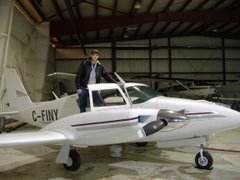
I have flown/owned airplanes on both ends of the general aviation spectrum, learning to fly in a Cessna 150 and building a couple hundred hours (plus) in that, and now flying a Twin Comanche, also closing in on a couple hundred hours. I'm at the point now that the Twin Comanche is second nature to me to fly, just like the Cessna 150 became for me. I have all the checklists committed to memory (don't worry I still pull them out and verify each time) and few challenges present themselves during the flight. The exception is of course the landing, there is ALWAYS room for improvement there.
That being said I still immensely enjoy every second of the flight. I still get a kick out of pushing the throttles forward during takeoff and seeing the runway disappear beneath me on the climbout.
This is another post reflecting on the differences between flying a Cessna 150 and a Twin Comanche. There are certain advantages to each when it comes to the pleasure flying aspect. I'm not sure if I would state either class of airplane better, just difference. I was thinking the other day how flying a Cessna 150 allows one to enjoy the visual experience far more. There is still no view that I have experienced so far that beats looking out the window 3000 ft above the earth with no wing to obstruct your view. Its fantastic. Generally in the 150 there'd be no point in climbing much higher then a couple thousand ft above the ground.
When I was cruising in the Cessna 150 with no more checklists to go through or nobody to talk to I found myself looking outside, at the ground, or of course, ahem, watching for traffic (that is of course the textbook answer). I'd watch the cars and smile that I was up here and not down there, marvel at the hilly terrain, and more or less just enjoy being above the earth. I find my time-wasting habits in the Twin Comanche are a little different in comparison. Now when I have no other pressing piloting duties I find myself more focussed on the airplane. I'll fiddle with prop controls trying to sync them better or tweak the mixture controls, or examine the rivet patterns on the wing. In the Comanche I sit directly on top of the wing, so the view to the ground isn't nearly as good, and typically I'm flying more in the 8000-10,000 ft range (ever obsessed with fuel efficiency), and of course the ground goes by much faster as well. These things don't lend themselves to sightseeing quite as well as a Cessna 150's qualities do.
I would say the Cessna 150 gives a better "flying" experience, while the Comanche gives me a better "pilot" experience. I still love the feeling I get when I fly the Comanche, and I'd never trade back (permanantly at least), but I do miss the chance to go sightseeing in the Cessna 150.
I also think I tend to have some sort of psychological "go fast" addiction when I fly the Comanche. I'm obsessed with seeing how soon I get get there and find it very difficult to pull the 2 black levers back, fly a little closer to the earth (even if its not as fuel efficient), and let the earth scroll by a little slower. At my own defense the Comanche is much less stable at slower speeds, and its nicer to fly at speeds above 150 mph indicated, but still, is it just me or is there natural pilot tendency to just get impatient when we know our machine can go faster then its currently going?
Saturday, December 6, 2008

Monday, September 29, 2008
Want a good education? Get a Pilot's License!
Flying is certainly a very specialized skill. But it is unique in that in that very specialized activity of commanding an aircraft, a very broad area of other skills and education is required. Even more so many of these skills are more then basically covered. Academically a pilot is taught and must understand (for the most part) applied physics which includes aerodynamics, meteorology which could in some cases be described as fluid dynamics. There is also mechanics/engineering, practical mathematics, geography & navigation, communication, and even psychology. Flying is even a study of art. What can show more self expression and skill then massaging an aircraft down for a "picture" perfect landing, or an aerobatic pilot making the sky his canvas?
It has also been long recognized that many valuable life skills can be taken away from inside the airplane. Pilots learn good decision making, hand-eye coordination, critical thinking, safety consciousness and the importance of being prepared. Much of the hands on life skills are easy to understand, but much of what is taught academically to a pilot can be very easily taken for granted. Much of what pilot's are taught is geared towards some sort of practical application, but in many cases the practical application can only make sense after the theory is understood.
Groundschool even for Private Pilots include almost every aerodynamic scenario an aircraft will encounter. Did you know that during a climbing turn an aircraft's inside wing is experiencing different aerodynamics then an aircraft's outside wing? Aerodynamics in a descending turn are different still. The theory behind radio waves is covered as well. In the meteorology side of things, would-be pilots are taught everything from the theory behind cloud formation and predicting what altitude they will form at, to the intimate differences of the weather at a warm front versus a cold front.
Pilot's are also expected to be able to perform on-the-fly (pardon the pun) mental calculations. One excercise, diversions, requires a student to map out a previously unplanned route to a new destination, accurately estimate the distance, calculate the heading to fly, the time it takes to get there, and a halfway point - using only a map and a pencil, while flying the aircraft! That can take some mental gymnastics when the mind is already occupied with flying.
Student pilot's even dabble in human behaviour. They learn the brain's natural decision making process and how our attitudes affect our decision making. They also study how human's communicate and how communication can often breakdown or be misinterpreted. Pilot's who will be working as part of a crew learn all about interpersonal dynamics and behavioural awareness.
Learning the skills of modern aviating is more then just air law, a bit of weather, and learning which buttons to press and how to manipulate the controls of an aircraft. The interesting thing about flying is that it draws from almost every major area of study out there. While a pilot's license won't give you a Phd in any subject, it is certainly an eye opener to the practicality of studying them.
I think sometimes I sell myself short to the skills and knowledge I've learned. The transferable skills gained from learning how to flying are countless. Aviation has taught me more then just how to fly a plane.
It has also been long recognized that many valuable life skills can be taken away from inside the airplane. Pilots learn good decision making, hand-eye coordination, critical thinking, safety consciousness and the importance of being prepared. Much of the hands on life skills are easy to understand, but much of what is taught academically to a pilot can be very easily taken for granted. Much of what pilot's are taught is geared towards some sort of practical application, but in many cases the practical application can only make sense after the theory is understood.
Groundschool even for Private Pilots include almost every aerodynamic scenario an aircraft will encounter. Did you know that during a climbing turn an aircraft's inside wing is experiencing different aerodynamics then an aircraft's outside wing? Aerodynamics in a descending turn are different still. The theory behind radio waves is covered as well. In the meteorology side of things, would-be pilots are taught everything from the theory behind cloud formation and predicting what altitude they will form at, to the intimate differences of the weather at a warm front versus a cold front.
Pilot's are also expected to be able to perform on-the-fly (pardon the pun) mental calculations. One excercise, diversions, requires a student to map out a previously unplanned route to a new destination, accurately estimate the distance, calculate the heading to fly, the time it takes to get there, and a halfway point - using only a map and a pencil, while flying the aircraft! That can take some mental gymnastics when the mind is already occupied with flying.
Student pilot's even dabble in human behaviour. They learn the brain's natural decision making process and how our attitudes affect our decision making. They also study how human's communicate and how communication can often breakdown or be misinterpreted. Pilot's who will be working as part of a crew learn all about interpersonal dynamics and behavioural awareness.
Learning the skills of modern aviating is more then just air law, a bit of weather, and learning which buttons to press and how to manipulate the controls of an aircraft. The interesting thing about flying is that it draws from almost every major area of study out there. While a pilot's license won't give you a Phd in any subject, it is certainly an eye opener to the practicality of studying them.
I think sometimes I sell myself short to the skills and knowledge I've learned. The transferable skills gained from learning how to flying are countless. Aviation has taught me more then just how to fly a plane.
Tuesday, October 16, 2007
Re: Good Pilot
After mulling over my last post for a few days, I decided to make some changes. I didn't believe I really gave good "stick and rudder" skills enough credit, so I have made the changes and re-published the post.
Wednesday, October 10, 2007
Good Pilot
Most people when they determine whether or not someone is a "good pilot" or not is usually based on how smooth their touchdown was. This is an understandable thing to base such judgements on. For most passengers, especially in an airliner setting, this is the only part of the flight that they experience first hand and the only thing they can see change from flight to flight. Everything else usually feels exactly the same. Landing is also generally known to be one of the more difficult tasks a pilot is faced with. While its true that the landing can be an excellent demonstrator of one's "stick and rudder" skills (the term used to describe one's ability to control an aircraft smoothly and accurately), I don't think it serves as a complete indicator to separate the "good" and "bad" pilots.
While it is true that it takes a great deal of skill to land an airplane, even more so in tricky conditions, such as a short field and/or gusty crosswinds, to judge a pilot soley by his landing is to sell him short of the thing that he has really spent 90% of his career trying to master. A more accurate indicator of a superior pilot comes in what is known as risk management. This is a skill far more difficult to master, far more important then superior stick and rudder skills, and far less visible to the average observer. We say risk "management" because there is always a certain degree of risk when flying. Risk ellimination would be to not go flying. Risk management is minimizing exposure to danger while still completing the flight. There are far more factors and decisions relating to risk management that a pilot must face each flight to list them exhaustively, but I'll mention a few. These decisions start before anyone even steps into the airplane.
Weather Conditions - How safe is the weather to fly in? How might it change during the flight? How do we alter our flight planning to accomodate this (wait it out, change our route, etc)?
The Airplane - Is it mechanically sound? Is anything not working properly? What do we do about it? Is the airplane's performance abilities capable of making the flight (ex. can we take off soon enough to clear those trees, are we within weight and balance limits)?
Flying - Is there any traffic presenting a hazard to us? Where is it? Is this weather presenting an unacceptable hazard to us? If we try to fly through it will be able to turn around if we can't make it? What happens if our engine quits right now? How about now? How about in 10 minutes? What if we have an instrument failure? What are our "outs"? Is the crosswind too strong for us to land on that runway? Is the runway long enough? Even if we don't make a perfect landing? What is that airplane over there doing? Is he paying attention or is he presenting a potential hazard to us?
There are alot of decisions to make relating to safety, and most of the time we have to make them on-the-fly (pardon the pun). Usually the right answers aren't always perfectly apparent. These decisions are of course entirely separate from our duties of keeping the aircraft under control. The bottom line is have we made the flight as safe as it could have possibly been? Granted good stick and rudder skills go a long way to making a flight safer, especially in tricky conditions, but good judgement can compensate for poor stick and rudder skills, whereas good stick and rudder skills can very rarely compensate for bad judgement. Risk management is something very difficult to teach. I believe it is partly a talent, partly a product of experience.
This is not to say that if the next pilot you go flying with makes a smooth touchdown not to compliment him! We still all work very hard to impress our passengers with a comfortable flight. But comfortable is not always synonimous with safe.
While it is true that it takes a great deal of skill to land an airplane, even more so in tricky conditions, such as a short field and/or gusty crosswinds, to judge a pilot soley by his landing is to sell him short of the thing that he has really spent 90% of his career trying to master. A more accurate indicator of a superior pilot comes in what is known as risk management. This is a skill far more difficult to master, far more important then superior stick and rudder skills, and far less visible to the average observer. We say risk "management" because there is always a certain degree of risk when flying. Risk ellimination would be to not go flying. Risk management is minimizing exposure to danger while still completing the flight. There are far more factors and decisions relating to risk management that a pilot must face each flight to list them exhaustively, but I'll mention a few. These decisions start before anyone even steps into the airplane.
Weather Conditions - How safe is the weather to fly in? How might it change during the flight? How do we alter our flight planning to accomodate this (wait it out, change our route, etc)?
The Airplane - Is it mechanically sound? Is anything not working properly? What do we do about it? Is the airplane's performance abilities capable of making the flight (ex. can we take off soon enough to clear those trees, are we within weight and balance limits)?
Flying - Is there any traffic presenting a hazard to us? Where is it? Is this weather presenting an unacceptable hazard to us? If we try to fly through it will be able to turn around if we can't make it? What happens if our engine quits right now? How about now? How about in 10 minutes? What if we have an instrument failure? What are our "outs"? Is the crosswind too strong for us to land on that runway? Is the runway long enough? Even if we don't make a perfect landing? What is that airplane over there doing? Is he paying attention or is he presenting a potential hazard to us?
There are alot of decisions to make relating to safety, and most of the time we have to make them on-the-fly (pardon the pun). Usually the right answers aren't always perfectly apparent. These decisions are of course entirely separate from our duties of keeping the aircraft under control. The bottom line is have we made the flight as safe as it could have possibly been? Granted good stick and rudder skills go a long way to making a flight safer, especially in tricky conditions, but good judgement can compensate for poor stick and rudder skills, whereas good stick and rudder skills can very rarely compensate for bad judgement. Risk management is something very difficult to teach. I believe it is partly a talent, partly a product of experience.
This is not to say that if the next pilot you go flying with makes a smooth touchdown not to compliment him! We still all work very hard to impress our passengers with a comfortable flight. But comfortable is not always synonimous with safe.
Saturday, August 4, 2007
Retractable Singles
Recently we've been working on a couple retractable gear single engine airplanes in the shop. We just did an annual on a Cessna 182 RG, and then just the other day a Cessna 177 Cardinal RG came in with some minor problems. I have always thought that the Cessna Cardinal was the coolest single engine Cessna ever built. Its just a slick airplane. The high wing on it is of the fully cantilevered design, meaning there are no unsightly and cumbersome struts extending out from the airplane. This feature, combined with the fact that the landing gear is slightly aft of the door makes it the easiest airplane ever to get into. It is just like getting into a car. Open the door and get in. There's no step up, climbing onto the wing, and tripping over the landing gear or wing struts. The retractable versions are fairly quick as well. The Cardinal was Cessna's competition to Piper's Arrow.
Anyways seeing all these retractable singles coming through gets me thinking about what the conventions of flying them would be, specifically, when would be the best time to retract the landing gear? I've never flown a retractable single before, so any pilots reading this who have, I'd been interested to hear your opinions.
When flying a multi-engine aircraft, we retract the landing gear once we've committed to the takeoff, or in the case of a jet where the decision to continue the takeoff (V1) is made while still on the ground, they'd retract the gear once a positive rate of climb has been developed. In a single, there's no such decision to be made. If the one engine continues operating, we continue with the takeoff, if it decides to quit at any time, there's no ifs ands or buts about it - we're going to land. So I suppose the considerations that should be made are:
1) The aircraft will climb better with the landing gear retracted.
2) A landing in the event of an engine failure is generally more survivable with the landing gear extended, whether off airport or on airport.
Keeping these in mind, what makes the most sense to me, is to make the initial climbout with the landing gear extended until you reach a height great enough to allow enough gliding time for the gear to be extended again if you have an engine failure after you rectract them. After you retract the gear it should be a priority to climb as fast as possible to reach a safe altitude.
It is important to note however that landing gear may operate differently with an engine failed, depending on the system. There are three different types of landing gear systems: Fully hydraulic, electric-hydraulic, and fully electric. Fully hydraulic, more common on multi-engine aircraft, this system uses an engine driven pump to power the hydraulic system of the landing gear. An electric-hydraulic system uses an electric motor to power the hydraulic system. A fully electric system, like in the Twin Comanche, uses an electric motor to mechanically operate the landing gear using levers and gears.
It is easy to understand that with a fully hydraulic system, the hydraulic system will stop working if the engine powering it stops working. This is generally not a problem with twins, because they'd normally be equipped with a hydraulic pump on both engines, but if this system is installed on a single, and the engine fails, you're going to have to use the alternate means of extending the landing gear, which would normally be a hydraulic hand pump.
Now I can't actually think of any single engine retractable aircraft that has a fully hydraulic landing gear system, that would be stupid. Most of them have either electric or electric-hydraulic for this reason. I thought it would be interesting to mention however, that the time that should be allowed after takeoff to extend the gear again, should be the time it takes for the landing gear to be extended with the engine failed.
I'd be interested to hear others opinions, because I've been watching these retractable singles taking off, and almost all of them retract the gear immediately after lift-off. I can't help but want to ask them, what would happen if an engine failure occurred immediately after you retract the gear? The result would likely be a belly landing on the runway... an unfortunate and very preventable mishap.
Anyways seeing all these retractable singles coming through gets me thinking about what the conventions of flying them would be, specifically, when would be the best time to retract the landing gear? I've never flown a retractable single before, so any pilots reading this who have, I'd been interested to hear your opinions.
When flying a multi-engine aircraft, we retract the landing gear once we've committed to the takeoff, or in the case of a jet where the decision to continue the takeoff (V1) is made while still on the ground, they'd retract the gear once a positive rate of climb has been developed. In a single, there's no such decision to be made. If the one engine continues operating, we continue with the takeoff, if it decides to quit at any time, there's no ifs ands or buts about it - we're going to land. So I suppose the considerations that should be made are:
1) The aircraft will climb better with the landing gear retracted.
2) A landing in the event of an engine failure is generally more survivable with the landing gear extended, whether off airport or on airport.
Keeping these in mind, what makes the most sense to me, is to make the initial climbout with the landing gear extended until you reach a height great enough to allow enough gliding time for the gear to be extended again if you have an engine failure after you rectract them. After you retract the gear it should be a priority to climb as fast as possible to reach a safe altitude.
It is important to note however that landing gear may operate differently with an engine failed, depending on the system. There are three different types of landing gear systems: Fully hydraulic, electric-hydraulic, and fully electric. Fully hydraulic, more common on multi-engine aircraft, this system uses an engine driven pump to power the hydraulic system of the landing gear. An electric-hydraulic system uses an electric motor to power the hydraulic system. A fully electric system, like in the Twin Comanche, uses an electric motor to mechanically operate the landing gear using levers and gears.
It is easy to understand that with a fully hydraulic system, the hydraulic system will stop working if the engine powering it stops working. This is generally not a problem with twins, because they'd normally be equipped with a hydraulic pump on both engines, but if this system is installed on a single, and the engine fails, you're going to have to use the alternate means of extending the landing gear, which would normally be a hydraulic hand pump.
Now I can't actually think of any single engine retractable aircraft that has a fully hydraulic landing gear system, that would be stupid. Most of them have either electric or electric-hydraulic for this reason. I thought it would be interesting to mention however, that the time that should be allowed after takeoff to extend the gear again, should be the time it takes for the landing gear to be extended with the engine failed.
I'd be interested to hear others opinions, because I've been watching these retractable singles taking off, and almost all of them retract the gear immediately after lift-off. I can't help but want to ask them, what would happen if an engine failure occurred immediately after you retract the gear? The result would likely be a belly landing on the runway... an unfortunate and very preventable mishap.
Monday, July 16, 2007
Orillia Ho!
There was a piper aztec that landed in London with a blown oil cooler on the weekend, so this morning (being Monday) it was into our shop. They had managed to hunt down a new oil cooler, but it was in Orillia, so I got the opportunity to play pilot man and fly the owner of the plane up to Orilia to pick up the part. Its always fun when I have a mission to complete, and someone else is picking up the gas tab. The flight's there and back were both uneventful, but both landings ended up being interesting in their own right.
The landing in Orilla unexpectadly turned into a little bit of a high stakes excercise in "how fast can you stop a Twin Comanche?" The touchdown was a little ugly... my fault, but then I noticed up ahead was a healthy flock of seagulls hanging out on the runway. And they didn't seem too concerned about the giant twin bladed bird mulcher bearing down on them. I managed to stop just barely in time, within 50 ft of the flock. You'd think they'd get out of the way. Oh no. I still had to practically shoo them out of the way to taxi by them. Dumb birds.
The traffic coming into London was rediculously busy, and the controller had his hands full. Our first circuit we were number 5 to land, that means there were 4 airplanes flying in front of us coming into land. They were all training aircraft. It was a good VFR day so I guess all 4 flight schools on the field all thought it'd be fun to do some circuits. We were following a Diamond Katana into runway 33 on our approach. For the controller is was a tricky excercise in traffic spacing having a slow Katana in front of a quick twin. I tried to stay a fair amount behind the Katana so I didn't overtake him, but I guess the controller was feeling pressure from the aircraft behind me, so he told me to keep my speed up. Ok, can do. I brought the flaps back up and kept my approach speed a little on the hot side until we came in a little closer. The Katana, apparently with a student pilot onboard, was cleared to land. At this point I was starting to close on him pretty quickly, and it was apparent that I was going to have to overshoot, lest I run him over. It turns out despite being cleared to land, the student pilot was intending to do a touch and go. Long story short: An upset controller, a frazzled student, and two airplanes climbing out off the same runway at the same time. So I had to overshoot, overtaking the Katana to his left. The second approach I nearly had to overshoot again, as the aircraft landing ahead of me took his sweet time getting off the runway. All turned out well though. I just delayed my touchdown a few seconds, and ended up making the smoothest landing ever! No thump, no tire squawk, just the sound of rolling tires and the airplane decelerating.
Made for a fun day, and I felt useful and important.
The landing in Orilla unexpectadly turned into a little bit of a high stakes excercise in "how fast can you stop a Twin Comanche?" The touchdown was a little ugly... my fault, but then I noticed up ahead was a healthy flock of seagulls hanging out on the runway. And they didn't seem too concerned about the giant twin bladed bird mulcher bearing down on them. I managed to stop just barely in time, within 50 ft of the flock. You'd think they'd get out of the way. Oh no. I still had to practically shoo them out of the way to taxi by them. Dumb birds.
The traffic coming into London was rediculously busy, and the controller had his hands full. Our first circuit we were number 5 to land, that means there were 4 airplanes flying in front of us coming into land. They were all training aircraft. It was a good VFR day so I guess all 4 flight schools on the field all thought it'd be fun to do some circuits. We were following a Diamond Katana into runway 33 on our approach. For the controller is was a tricky excercise in traffic spacing having a slow Katana in front of a quick twin. I tried to stay a fair amount behind the Katana so I didn't overtake him, but I guess the controller was feeling pressure from the aircraft behind me, so he told me to keep my speed up. Ok, can do. I brought the flaps back up and kept my approach speed a little on the hot side until we came in a little closer. The Katana, apparently with a student pilot onboard, was cleared to land. At this point I was starting to close on him pretty quickly, and it was apparent that I was going to have to overshoot, lest I run him over. It turns out despite being cleared to land, the student pilot was intending to do a touch and go. Long story short: An upset controller, a frazzled student, and two airplanes climbing out off the same runway at the same time. So I had to overshoot, overtaking the Katana to his left. The second approach I nearly had to overshoot again, as the aircraft landing ahead of me took his sweet time getting off the runway. All turned out well though. I just delayed my touchdown a few seconds, and ended up making the smoothest landing ever! No thump, no tire squawk, just the sound of rolling tires and the airplane decelerating.
Made for a fun day, and I felt useful and important.
Thursday, June 7, 2007
Climbing the Next Peak
So I'm finally insured to fly Pilot-In-Command of the Twin Comanche. And now that I've been flying it a bit as the only person onboard, its got me thinking again how it seems I've begun a second cycle of learning to master an airplane.
My landings, although well within the realms of safety, leave a lot to be desired in comparison to when I flew the Cessna 150. In the C-150 it got so that I could consistently put the airplane smoothly down on the runway well within 20 ft of my target touchdown point, even in a strong crosswind. In fact it got to the point where I could do that so consistently it was hardly any fun anymore. I remember back in Sarnia I was doing circuits just for kicks, and my instructor, Jason, was in another airplane holding short of the runway I was on final for. Over the radio he said, "Hey Chad, see if you can touch down right at Alpha [taxiway]." I managed to put the airplane down about 20 ft before alpha, and then have it stopped in time to smoothly turn off the runway onto that same taxiway. I could see Jason laughing incredulously at the fact that I pulled it off as I taxied by them.
This wasn't the case when the ink was still fresh on my license. It was a process to get to that point. At the beginning my landings weren't always silky smooth, and the touchdown point was always exactly where I was aiming. It seems now that I'm flying the Twin Comanche I'm back to the start - where I was with the C-150 a couple hundred and some-odd hours ago. Of course I already knew this, but I'm just reflecting. I'm going to have to work hard again to impress my passengers.
Last night I went flying, and out of my 4 landings that I did (Kitchener, Peterborough, Cornwall, London) I only rolled the wheels on once. We won't even consider whether or not I hit my exact target touchdown zone. Although sometimes after touchdown I cringe and look around to see if any other airplane saw that, its nice to have another mountain to climb. Its a breath of fresh air and I look forward to the challenge.
My landings, although well within the realms of safety, leave a lot to be desired in comparison to when I flew the Cessna 150. In the C-150 it got so that I could consistently put the airplane smoothly down on the runway well within 20 ft of my target touchdown point, even in a strong crosswind. In fact it got to the point where I could do that so consistently it was hardly any fun anymore. I remember back in Sarnia I was doing circuits just for kicks, and my instructor, Jason, was in another airplane holding short of the runway I was on final for. Over the radio he said, "Hey Chad, see if you can touch down right at Alpha [taxiway]." I managed to put the airplane down about 20 ft before alpha, and then have it stopped in time to smoothly turn off the runway onto that same taxiway. I could see Jason laughing incredulously at the fact that I pulled it off as I taxied by them.
This wasn't the case when the ink was still fresh on my license. It was a process to get to that point. At the beginning my landings weren't always silky smooth, and the touchdown point was always exactly where I was aiming. It seems now that I'm flying the Twin Comanche I'm back to the start - where I was with the C-150 a couple hundred and some-odd hours ago. Of course I already knew this, but I'm just reflecting. I'm going to have to work hard again to impress my passengers.
Last night I went flying, and out of my 4 landings that I did (Kitchener, Peterborough, Cornwall, London) I only rolled the wheels on once. We won't even consider whether or not I hit my exact target touchdown zone. Although sometimes after touchdown I cringe and look around to see if any other airplane saw that, its nice to have another mountain to climb. Its a breath of fresh air and I look forward to the challenge.
Subscribe to:
Posts (Atom)