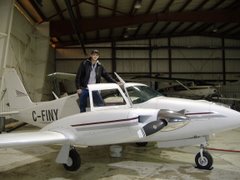
A couple months ago I was promoted to the position of Assistant Chief Pilot (unlike Assistant TO the Chief Pilot, so take that Dwight). Our previous Chief Pilot retired, which left that opening free to fill. There were two of us considered for the job, one of our King Air pilots and myself. Ultimately the King Air pilot was chosen, as he is better suited to the position, but in recognizing that we both brought different but valuable skills to the position (his personality is more suited to the administrative role of it, while I bring significantly more low level survey experience and experience on 2 of 3 of our aircraft types), they decided to create an Assistant Chief Pilot position for me as well. So as it works out I am responsible for all training and writing/rewriting of manuals applicable to the Navajo and C-206, while he will handle all that for the King Air.
So I've been recently assigned my first duty as Assistant Chief Pilot - to complete the writing of the SOPs (Standard Operating Procedures) for the Navajo. SOPs lay out, in excruciating detail, the responsibilities and procedures of each crew member while operating an aircraft in a multi-crew environment. Such things as standard terminology and standard cockpit calls to be made for each phase of flight, to what areas of the cockpit are the primary responsibility of each crew member, to how and when to complete each checklist, and most importantly how to report and respond to an emergency and in a coordinated and efficient fashion.
In actual fact I have very little multi-crew experience, but I think there's enough already written that I can get the feel for how it should be written and fill in the blank sections from there. Not to mention that is one skill-set that our new Chief Pilot brings to the table, so of course I have him as a resource/oversight. This is all of course after I finish formatting the existing document. Our old Chief Pilot who had started writing the SOPs, was a fantastic survey pilot, a true gentleman, and fully qualified to write the SOPs, but his computer skills leave a bit to be desired. I have a lot of formatting to do. Think spaces instead of proper indentations - everywhere. Oh well, it should keep me busy on the slow days off under bad weather.
I've also heard I may be hopping back into the 206 for a couple weeks to fill in for the usual pilot, who will be taking vacation. It'll be kind of fun to hop back into the old girl again (who has had a beautiful new paint job) and get reacquainted for a short while. Back in the spring I did a short repositioning flight to take her up to Muskoka from Toronto, and I was surprised to find that I have almost entirely forgotten the touch to land her! It was one ugly bounce, and the winds weren't even strong.
I'll be glad to get back in and be able to brush off the rust enough to walk away again without having to look around to see if anyone saw THAT one. Every pilot knows that feeling.
Thursday, August 23, 2012

Thursday, August 9, 2012
Frat House
"I feel like I'm in a Frat house" says our replacement processor as he walks up to our crew-house apartment from his hotel across the street. I'm standing in flip-flops, beer in hand, grilling steaks outside our door on the little portable BBQ we bought. He has just recently arrived in town to replace our current processor who is rotating out on vacation in the next couple days. Our shirtless, mullet-sporting neighbour sits on his porch pumping out rock music. I laugh because the statement is true, it pretty much is a frat-house. Since this is a longer several month project, the office arranged to rent us (the field crew) an apartment. As a result of living together there's much goofing around and bachelor pad frat-housery that occurs when we're not working, especially when the two of us are both around the same age and get along well.
Apartments are cheaper for the company than hotels for long-term jobs, but they're also kind of nice for us as well. Hotels and restaurant food get pretty old after a few weeks, never-mind the whole summer. Its kind of nice to have a home away from home.
Our apartment is located on the floor above a real estate office and hair salon. Its a pretty good sized unit, but wins no Martha Steward awards. I suppose we can't be picky in a small town. In short its a five-bedroom slum-house. One of the bedrooms is so stained and had such a musty smell we refuse to go in there and just use it for storage. It quickly earned the nickname "murder room", because the smell and carpet stains looked like there very well could have been a grisly murder take place. The 4th bedroom we've converted into a little office, while the remaining 3 serve as actual bedrooms. The rest of the apartment is dated but sufficient. In the hallway a tiny 2-stroke pocket bike sits in pieces - a result of an impulsive purchase that was a heck of a lot of fun, but only lasted 2 days before we broke it. We're in the process of repairing it, but at the moment lack the tools, expertise, and initiative to tackle it any further than disassembling it into the state that it is in now.
Aside from being away from my girl for long periods, life is here is pretty good. I could stay here all summer pretty happily if she was here with me. The weather stays relatively warm, there's lots of world-class hiking to do on our days off, and I've bought a membership to the local gym for a price that's laughably affordable. The flying schedule is undemanding to say the least as there is fog off-shore every morning, so most days we don't manage to get airborne until late-afternoon and fly until early evening.
Monday, July 30, 2012
Grind
I'm finding it difficult to write interesting posts lately about our flying. Most of it is flying long lines across empty blue seas for a half hour at a time. We get excited if we see one boat in a 4 hour flight. Even while focusing on the precision flying some days we have to fight to stay awake. The hot sun beats into the cockpit and it there is nothing interesting to look at. Perfect time for a nap... oh wait I have to fly an airplane at 200 ft. Thank goodness for my music I can pipe directly into my headset.
I am still loving my new Bose A20 headset. I'm still amazed at how quiet it is. It does such a good job at noise cancelling actually that I have a hard time syncing the props with the noise cancelling turned on. With constant speed props (adjustable pitch propellers), you set the pitch of the prop blades by moving the prop lever which controls an RPM governor. If you move the lever forward the governor decreases the pitch of the propeller blades, which decreases the load on the engine and therefore increases the engine RPM. So we set the props based on certain RPMs (usually 2300 for cruise, 2400 for climbs). With twin engine aircraft, if the props on each engine aren't spinning at exactly the same RPM you get a resonant thumping you can hear which is incredibly annoying. So we always fine tune the RPM settings by ear until the thumping disappears into a steady drone. With my new headset the noise cancelling completely cancels out the resonating sound so I can't tell if the props are out of sync. It drives my partner crazy because he uses a passive headset, so I've taken to leaving my noise cancelling feature turned off for takeoff and climb until we're into cruise and I have the props set properly, and only then do I turn the noise cancelling feature on. Its probably for the best anyway since take-off is the most critical phase of the flight, and its good to be able to hear exactly what the engine is doing. Hearing what the engine is doing can in some cases be a far better indicator than any gauge can be.
The only complaint I have with my headset is the location of the headset controls (volume, etc). On my old Davey Clark the volume knob was on the right ear-cup. As a result I always knew exactly where it was, and could instantly reach up and adjust it if I needed to. Now with the Bose, the controls on are a little pod on the headset cable. So in order to make adjustments I have to fish around my seat and find the cable, then find the cable control pod, and then adjust it from there. The cable comes with a couple clips on it so you can fasten the pod down to somewhere. My jeans have a hole in the left knee, so I usually fasten one clip to the hole in my jeans, and the other clip to my belt. That way the control panel more or less stays near my left leg. Still not as slick as the ear cup mounted controls though, but I'll never again go back to a passive headset.
Friday, July 13, 2012
Getting Work Done
Ten minutes into the flight. We've just arrived at our block, and we're over the cliffs of the south western Newfoundland shore. Our survey lines are mostly over the ocean, but the ends of them overlap onto the shore and over the 800' cliffs that drop straight into the ocean. I'm in the process of turning in to intercept our first survey line. This morning's flight was scrapped due to high winds, but those have since died down, so we're off to get some work done. The sky is mostly clear except for some low cloud draped over the cliffs below us.
It doesn't look like I can get down to our 200' survey height without going into cloud, so I'll stay a little bit higher, and then when we clear the cloud layer I'll drop in on a steep descent down to the proper altitude. We'll have to re-fly the portion of the line where we are too high later, but that's not a huge deal. The rest of the block is CAVOK (Clouds And Visibility OK). I already have the power pulled back in anticipation of our steep dive - its very easy to bury the airspeed indicator's needle past Vne (Never Exceed Speed) of 210 mph (much slower than a normal Navajo's Vne since we have our survey sensors hanging off the end of the wingtips).
We cross over the shoreline cliffs and continue our descent down below until we're skimming the sea at our usual 200'. These cliffs have caused us some consternation lately. The last few flights the wind tumbling over them has caused some severe turbulence for us, so much that we've had to avoid them entirely. In those cases you have to tighten your seatbelt as much as possible, and then you can look out the window and watch the wingtips flex up and down as they bounce through the rough air. Today the air is smooth but its the cloud cover preventing us from surveying over them.
Two hours into the flight, 50 nautical miles off shore. We bear down on a tiny little sailboat, maybe a 26 or 28 footer. Its wavy for him out here, he's bobbing like a cork but clearly sailing to somewhere. We wonder where he came from. He's a least a full day's sail from land in the direction he came from - he must have had a rough time this morning. The ocean swells now are rocking him pretty good, and it was even windier this morning. Kind of looks like fun actually. Our next line a half an hour later takes us right over top of him. Our belly camera must have surely snapped a picture of him as we went over, it might make for a cool photo. I make a mental note. We continue our precision flying back and forth, blue sea, blue sea, blue sea.
Four hours into the flight. We're headed in to land. As always the wind is blowing in from the water, so I've set us up for a tight left downwind for runway 27. Its tight because there's some tall hills to the right of me, so I can either fly a wider, higher circuit at 1500' above airport elevation, or stick to the standard 1000' circuit and stay tighter in and away from the hills. I prefer the tighter, lower circuit, but it makes for a challenging base-final approach. Its tight enough that its almost a continuous 180° descending left turn all the way down onto the runway. I'm proficient enough in the Navajo now that I can make these high demand approaches and still stay ahead of the airplane no problem. One hundred hours ago I wouldn't have the confidence to try something like this in the Navajo, but now that I'm getting consistent left-seat practice I'm really starting to meld with the airplane. It feels good.
I touch down right wheel first in the light crosswind with a bit of a bump, the remaining wheels come down smoothly. Good flight.
Sunday, June 24, 2012
Approach Energy Management
Its finally here. I've met the multi-engine time insurance requirements. I have what I needed to upgrade to full fledged Captain on the Navajo, so I finally get my upgrade. Yesterday we did my Captain check ride. Its wasn't a big deal really, did some aerial work to start off - steep turns, climbing/descending turns, slow flight, stalls. The usual. The Navajo is easily the most stable aircraft I've flown. It was smooth air during our flight, and when I was demonstrating some rate one turns (standard turn of 3°/second) with the airplane properly trimmed I was able to roll into the turn, establish the attitude, and then completely remove my hands from the controls! The Navajo would maintain a perfectly stabilized bank all on its own and carry itself all the way through the turn without any need for further adjustment. I've never seen an airplane stable enough to be able to do that. It makes me look good!
After the air work we reviewed our emergency procedures. That took us all of an hour. The ops manual mandates 3 hrs of flight time for an initial PCC (Pilot Competency Check), so we took the time to practice some IFR approaches just for the fun of it. It was fun to get back into that world again for a little bit and shake off the rust. The Navajo, being so stable, makes a great platform for IFR practice. It was also good to really get some practice fine tuning my approach skills in the Navajo.
Whenever I set up my final descents to land, either VFR or IFR I try to plan the approaches in such a way that I only ever need to reduce power, never add more as the approach progresses. Its not really critical, but it is a lot easier on the turbos, allowing them to spool down gradually with progressively lower power settings. That and its a good challenge to keep my skills sharp. It takes planning, judgement and a good knowledge of what power settings the airplane needs so as to not have to increase the power at any point during the approach.
Normally, at the beginning of the descent to land, you start off with the airplane in a clean configuration (flaps & landing gear up) and a cruise power setting (high airspeed), but by short final you should have full flaps set, the landing gear down, and a low power setting sufficient to provide an appropriate descent angle of around 3° and nice slow approach speed. Its easy enough to set the power to set up your approach angle and airspeed, but if you set the power to give you the proper descent angle and airspeed BEFORE you have the flaps and gear down, you're going to have to ADD power again later when you lower the landing gear or flaps to account for the increased drag. With an equal power setting, flaps and gear will always either increase your descent angle (if you maintain the same airspeed), or it will decrease your airspeed (if you maintain the same descent angle). A stable approach should always have a constant descent angle, so we should strive for that.
The first thing they teach you when you first start flying an airplane is that on approach, power controls the descent angle, attitude (the angle of the nose to the horizon) controls airspeed. This means that if the current descent angle is going to bring you short of the runway, rather then pulling back and raising the nose (the natural inclination) you need to add power. Pulling back will reduce your airspeed, so you should only pull back if you need to slow the airspeed, otherwise the potential exists for a stall. Alternatively if you're going to land long, rather than pushing forward, which will just increase your airspeed and still cause you land long, you must reduce the power. The concept of "Attitude controls airspeed, power controls glide slope" methodology works quite well for teaching purposes. It keeps things simple for new pilots who still have to use the cognitive part of their brain to control their approach. As proficiency increases you learn to do both (control attitude and power) simultaneously as needed to achieve the right approach and right airspeed, and it becomes second nature. Using power to control glideslope and attitude to control airspeed never ceases to be a safe method for flying an approach even for experience pilots, but it can be sloppy in the sense that it requires constant power adjustments, and small increases in power each time landing gear and flaps are lowered.
So as professional pilots we can take it one step further and rather than just manage our airspeed and approach angle as separate variables, we can focus on energy management as an entire system. Lowering the flaps and landing gear are removing energy from the system in the form of extra drag, so rather than having to replace it with more energy by adding power, we can plan for it in advance by already having extra energy in the system. The key to holding extra energy is to do so in the form of carrying extra airspeed at the beginning of our approach.
Now rather than adding power every time we lower the next notch of flaps or landing gear, we want to start our approach with a higher airspeed then what we want to end up with on short final. In the Navajo for example, or short final we want a stable approach at 120 mph, with full flaps and landing gear down. That means when we start our approach with a clean configuration (flaps/gear up), we should start with a higher airspeed, perhaps around 150 mph. In this way each time we introduce more drag into the system by lower gear or flaps, rather than countering the energy loss by adding power, we use the extra drag to our advantage by allowing it to slow us down. Hopefully if our judgements are correct, by time we have all flaps and landing gear lowered, we're at a stable 120 mph, having never touched the power since we first started our descent.
In this way we're actually simplifying our approach by allowing each new drag element to slow us down rather than adding the extra steps of trying to slow down at the beginning by pulling the power WAY back, and then compensating for it later when we add more drag. When done properly the engines are happy because they have received consistent inputs, any traffic behind us is happy because we didn't hold them up by dragging our way all the way down the approach at a slow airspeed, and we're happy because our workload is less and we're demonstrating a mastery of our aircraft.
Thursday, June 21, 2012
Full Bore
The last 4 days have been a whirlwind. We had a 4000 line km deadline to meet with the client by June 21st, and we arrived onsite on the 15th. Normally it takes about a week to get good weather and a good calibration flight down, and set up our other ground equipment before we're off to the races surveying. On top of that, 4000 line km is roughly 4 full days of flying. Well, we lucked out with good weather, a good calibration flight on the first try, and we've been going full bore since. We finished over 4000 line km with a day to spare. That's gotta be some kind of record! Almost 20 hrs flight time in two days, lol.
Today was spent revving back a little bit as our inspection is coming due, and we have a lot of catchup with paperwork and setting up the crew house that we plan on moving in to. Tomorrow we'll spend some time training - I have my Captain upgrade to get done, and then I'll be renewing my Co-Captain's annual training. Then airplane inspection. Much to be done.
As for the flying, its not nearly as interesting as France or Ireland, or even northern Canada. Offshore is just... water. We haven't even seen any boats or whales yet. Oh well, you gotta take the good with the bad, at least I'll be logging multi-PIC time soon.
Thursday, June 14, 2012
Number 10 to Land
Toronto Buttonville. If its not the busiest general aviation airport in Canada I would be surprised. Its my turn to sit left seat in the Navajo, we're returning to home base from Ottawa to fix some more technical issues. We've had a really terrible string of bad luck lately. I've got the ATIS and make my 10 mile call as requested by ATC. (ATIS - Air Traffic Information Service, an automated radio service to tell aircraft pertinent details for departure and arrivals, such as winds, runway in use, etc.).
"Golf Sierra Xray is 10 miles east, 2000 ft."
Its a beautifully calm, blue skied evening and there are at least 4 airplanes doing touch and goes and another 6, including us inbound to land. The controller is making radio calls nearly continuously but still sounds totally calm, maybe even bored. I'm impressed.
"Golf Sierra Xray you're gonna have to pull it right back, right now you're about number 10 for the field. Call me 3 miles out."
Wow poor guy, 10 airplanes and with so little airspace to work with. Two more airplanes report inbound. Make that 12 total.
I pull the two power levers in my hand way back to 23" Manifold Pressure, and we slow down to 120 mph, something a little closer to what a Cessna 172 would be cruising at. Normally we don't slow down this much until we turn onto our final approach to land. I watch the miles tick down as we creep along closer to the airport. I'm anticipating joining the circuit on a right base for runway 33, and both of us in the cockpit have our eyes out side looking for the other 9 airplanes around us. The radio calls are still going rapid fire, and our portable traffic awareness system is also beeping with almost as much frequency.
I make my 3 mile position report. When the radio is this saturated, it can be difficult to jump in and make your required reports without stepping on someone else.
"Golf Sierra Xray turn right to come overhead the field, I'm going to bring you in on a left downwind. You're going to be following a Cessna 172 in the downwind."
I make a shallow right turn to head over the airport instead of setting up for a right base, and we meander our way over top of the field. At 120 mph the controls are no longer the crisp responsive feel that they are at normal cruise speeds. With this much less airflow the airplane feels more like a lumbering beast, and the earth is creeping by in slow motion, but this is a good pace to fit in with the rest of the traffic and gives us enough time to try to spot everyone else up here with us.
We try to find our traffic ahead of us, and I spot a Cessna turning base, but that's a different one than the one we're supposed to be following. The controller is extending everyone's downwind legs to make room for everybody. We're way south of the airport now, heading towards the east of Toronto. We end up turning base, and then final, close in behind a Piper Cheyenne - too close actually. At this spacing he won't have time to clear the runway before we're ready to land. Even though we're still 4 miles back I drop all the flaps and lower the landing gear to slow down even further. I'm riding blue line, 112 mph - the slowest safe speed we can fly. The Cheyenne slowly pulls away from us. It looks like we might be all right, but we still prepare for the possibility of an overshoot if the Cheyenne can't clear the runway in time for us to land. Mixtures rich, propellers to high RPM. We're short final, the Cheyenne is down and turning off the runway just in time. We're cleared to land.
I touch down smoothly in the calm evening air and am stopped in time to exit onto the inactive cross runway. Taxi in, shut down. That was fun!
Subscribe to:
Posts (Atom)