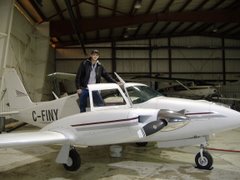
Recently we've been working on a couple retractable gear single engine airplanes in the shop. We just did an annual on a Cessna 182 RG, and then just the other day a Cessna 177 Cardinal RG came in with some minor problems. I have always thought that the Cessna Cardinal was the coolest single engine Cessna ever built. Its just a slick airplane. The high wing on it is of the fully cantilevered design, meaning there are no unsightly and cumbersome struts extending out from the airplane. This feature, combined with the fact that the landing gear is slightly aft of the door makes it the easiest airplane ever to get into. It is just like getting into a car. Open the door and get in. There's no step up, climbing onto the wing, and tripping over the landing gear or wing struts. The retractable versions are fairly quick as well. The Cardinal was Cessna's competition to Piper's Arrow.
Anyways seeing all these retractable singles coming through gets me thinking about what the conventions of flying them would be, specifically, when would be the best time to retract the landing gear? I've never flown a retractable single before, so any pilots reading this who have, I'd been interested to hear your opinions.
When flying a multi-engine aircraft, we retract the landing gear once we've committed to the takeoff, or in the case of a jet where the decision to continue the takeoff (V1) is made while still on the ground, they'd retract the gear once a positive rate of climb has been developed. In a single, there's no such decision to be made. If the one engine continues operating, we continue with the takeoff, if it decides to quit at any time, there's no ifs ands or buts about it - we're going to land. So I suppose the considerations that should be made are:
1) The aircraft will climb better with the landing gear retracted.
2) A landing in the event of an engine failure is generally more survivable with the landing gear extended, whether off airport or on airport.
Keeping these in mind, what makes the most sense to me, is to make the initial climbout with the landing gear extended until you reach a height great enough to allow enough gliding time for the gear to be extended again if you have an engine failure after you rectract them. After you retract the gear it should be a priority to climb as fast as possible to reach a safe altitude.
It is important to note however that landing gear may operate differently with an engine failed, depending on the system. There are three different types of landing gear systems: Fully hydraulic, electric-hydraulic, and fully electric. Fully hydraulic, more common on multi-engine aircraft, this system uses an engine driven pump to power the hydraulic system of the landing gear. An electric-hydraulic system uses an electric motor to power the hydraulic system. A fully electric system, like in the Twin Comanche, uses an electric motor to mechanically operate the landing gear using levers and gears.
It is easy to understand that with a fully hydraulic system, the hydraulic system will stop working if the engine powering it stops working. This is generally not a problem with twins, because they'd normally be equipped with a hydraulic pump on both engines, but if this system is installed on a single, and the engine fails, you're going to have to use the alternate means of extending the landing gear, which would normally be a hydraulic hand pump.
Now I can't actually think of any single engine retractable aircraft that has a fully hydraulic landing gear system, that would be stupid. Most of them have either electric or electric-hydraulic for this reason. I thought it would be interesting to mention however, that the time that should be allowed after takeoff to extend the gear again, should be the time it takes for the landing gear to be extended with the engine failed.
I'd be interested to hear others opinions, because I've been watching these retractable singles taking off, and almost all of them retract the gear immediately after lift-off. I can't help but want to ask them, what would happen if an engine failure occurred immediately after you retract the gear? The result would likely be a belly landing on the runway... an unfortunate and very preventable mishap.
Saturday, August 4, 2007

Monday, July 16, 2007
Orillia Ho!
There was a piper aztec that landed in London with a blown oil cooler on the weekend, so this morning (being Monday) it was into our shop. They had managed to hunt down a new oil cooler, but it was in Orillia, so I got the opportunity to play pilot man and fly the owner of the plane up to Orilia to pick up the part. Its always fun when I have a mission to complete, and someone else is picking up the gas tab. The flight's there and back were both uneventful, but both landings ended up being interesting in their own right.
The landing in Orilla unexpectadly turned into a little bit of a high stakes excercise in "how fast can you stop a Twin Comanche?" The touchdown was a little ugly... my fault, but then I noticed up ahead was a healthy flock of seagulls hanging out on the runway. And they didn't seem too concerned about the giant twin bladed bird mulcher bearing down on them. I managed to stop just barely in time, within 50 ft of the flock. You'd think they'd get out of the way. Oh no. I still had to practically shoo them out of the way to taxi by them. Dumb birds.
The traffic coming into London was rediculously busy, and the controller had his hands full. Our first circuit we were number 5 to land, that means there were 4 airplanes flying in front of us coming into land. They were all training aircraft. It was a good VFR day so I guess all 4 flight schools on the field all thought it'd be fun to do some circuits. We were following a Diamond Katana into runway 33 on our approach. For the controller is was a tricky excercise in traffic spacing having a slow Katana in front of a quick twin. I tried to stay a fair amount behind the Katana so I didn't overtake him, but I guess the controller was feeling pressure from the aircraft behind me, so he told me to keep my speed up. Ok, can do. I brought the flaps back up and kept my approach speed a little on the hot side until we came in a little closer. The Katana, apparently with a student pilot onboard, was cleared to land. At this point I was starting to close on him pretty quickly, and it was apparent that I was going to have to overshoot, lest I run him over. It turns out despite being cleared to land, the student pilot was intending to do a touch and go. Long story short: An upset controller, a frazzled student, and two airplanes climbing out off the same runway at the same time. So I had to overshoot, overtaking the Katana to his left. The second approach I nearly had to overshoot again, as the aircraft landing ahead of me took his sweet time getting off the runway. All turned out well though. I just delayed my touchdown a few seconds, and ended up making the smoothest landing ever! No thump, no tire squawk, just the sound of rolling tires and the airplane decelerating.
Made for a fun day, and I felt useful and important.
Thursday, June 7, 2007
Climbing the Next Peak
So I'm finally insured to fly Pilot-In-Command of the Twin Comanche. And now that I've been flying it a bit as the only person onboard, its got me thinking again how it seems I've begun a second cycle of learning to master an airplane.
My landings, although well within the realms of safety, leave a lot to be desired in comparison to when I flew the Cessna 150. In the C-150 it got so that I could consistently put the airplane smoothly down on the runway well within 20 ft of my target touchdown point, even in a strong crosswind. In fact it got to the point where I could do that so consistently it was hardly any fun anymore. I remember back in Sarnia I was doing circuits just for kicks, and my instructor, Jason, was in another airplane holding short of the runway I was on final for. Over the radio he said, "Hey Chad, see if you can touch down right at Alpha [taxiway]." I managed to put the airplane down about 20 ft before alpha, and then have it stopped in time to smoothly turn off the runway onto that same taxiway. I could see Jason laughing incredulously at the fact that I pulled it off as I taxied by them.
This wasn't the case when the ink was still fresh on my license. It was a process to get to that point. At the beginning my landings weren't always silky smooth, and the touchdown point was always exactly where I was aiming. It seems now that I'm flying the Twin Comanche I'm back to the start - where I was with the C-150 a couple hundred and some-odd hours ago. Of course I already knew this, but I'm just reflecting. I'm going to have to work hard again to impress my passengers.
Last night I went flying, and out of my 4 landings that I did (Kitchener, Peterborough, Cornwall, London) I only rolled the wheels on once. We won't even consider whether or not I hit my exact target touchdown zone. Although sometimes after touchdown I cringe and look around to see if any other airplane saw that, its nice to have another mountain to climb. Its a breath of fresh air and I look forward to the challenge.
Thursday, May 31, 2007
Aero Engines #2
I'll continue with our aero engine discussion. This time I'll focus on reliability issues. It goes without saying that the stakes are much higher for airplanes then then are for any other form of powered travel when it comes to the reliability of engines. They just have to work. When engingeering something for reliability, there's two approaches you can take. The first is to make things as mechanically simple as possible - the less things on the engine there are to break, the less often it will break. You can also approach it from the point where if the first option won't work, you need to create redundancy in the system so when something does break, something else is in place to take over.
Aero engines are I supposed a comprimise between the two, but they definitely lean more towards the simplicity approach. The simplicity approach also has its advantages in the weight department. The less stuff there is tacked onto the engine, the lighter it will be, and that's a critical factor when designing airplanes.
Lets take for example the cooling system on an airplane... oh wait, there isn't one. Well not like a car has one at least. A car has a system of tubes that run liquid through the hot parts of the engine to absorb the heat. The liquid is then piped through a radiator, which cools the liquid by allowing the heat to vent into the air. A liquid coolant system works remarkably well in regulating engine temperature, but how many times over your life have you been driving and had your car overheat? It doesn't happen often, but it does happen - coolant leaks out, rad caps burst, whatever. You pull over to the side of the road. Aero engines are completely air cooled. Its quite simple to explain actually. Aircraft engines are fitted with baffling systems to take in ram air from the plane moving forward and the prop blowing air into the cowl, and direct it over the cylinders to cool it down. Some of the more complex airplanes, like the Twin Comanche, have cowl flaps. These are doors out the back of the engine that can be manually opened and closed to allow the air in the cowl to be flushed out the back of the engine. This keeps fresh constant airflow over the engine, which results in better cooling. We use this in situations where the engine is either working very hard (like takeoff and landing) and needs extra cooling, or during ground operations when the speed of the aircraft isn't great enough to allow enough airflow over the engines. That's all there is to it. I would be hard pressed to explain anything else about aero engine cooling. The cooling system I'd say is pretty reliable, air doesn't break down.
An example of a system that takes the opposite engineering approach would be the magnetos. Magnetos could be described as something along the lines of an ignition coil, alternator, and distributer all wrapped up in one. Magnetos are driven by a shaft directly off the engine. This shaft turns a coil which generates voltage and delivers it to the required spark plug. Magnetos are really nice because they have no connection to any other system on the airplane, so are dependant only on themselves to keep working. In a car, the distributer is dependant on the coil to produce the spark, which is dependant on the battery for its charge, which is dependant on the alternator to continue charging the battery. The magneto bypasses this long line of fallable equipment, so as long as the magneto is working properly, the engine will still run. The magneto is relatively small, only about the size of both your fists stacked on top of each other, but its not simple. So the engine is equipped with two magnetos. Each magneto has its own set of spark plugs running into the engine, and the engine is capable of running on only one magneto. So a four cylinder engine actually has 8 spark plugs. This provides excellent redundancy, as well as better fuel combustion.
The oil systems are virtually the same as cars. There are two different types, the wet sump system, and the dry sump system. A wet sump is simply oil sitting in an oil pan under the engine, which sloshes up and lubricates the pistons. A dry sump is a system where the oil is stored in a resevoir seperate from the engine, and is then pumped through to the parts needing lubrication. Most piston engines use a wet sump system for reasons of simplicity, lightweight, and low cost.
Everything else on the engine is pretty basic once you learn it. There are the accessories driven off the engine like the alternator, vacuum pump (which power some of our cockpit instruments), and fuel pumps on more complex aircraft. For the most part these are all simply bolt on components, similar to a car.
All in all aero engines are incredibly simple compared to their groundbased counterparts. With the exception of a couple brand new airplanes there are no fancy computer parts, no over-engineering. Just a simple, robust piece of machinery.
Aero Engines vs Automobile Engines
If you were to compare an aircraft engine with an automobile engine you would notice that they operate on the same basic principle - a 4 stroke gasoline powered piston engine. However that's about where the similarities end.
My Twin Comanche is equipped with Lycoming IO-320's. All those letters and numbers mean something, so let me break it down for you. Lycoming is the manufacturer. There are two major aero engine manufacturers, one being Lycoming, and other being Continental. The "I" in the engine model number stands for "Injected", meaning its fuel injected as opposed to carbureted, and "O" means the engine is of the horizontally opposed type (O for Opposed). A horizontally opposed engine is where the cylinders are facing directly away from each other, with the crankshaft running down the middle of the engine. In contrast, a car usually has either an inline engine, meaning the cylinders are all lined up in a row, or a V engine, meaning the cylinders are lined up opposite each other (line a horizontally opposed engine), except with a slight upward angle, so if you look from front to back the cylinders make a V shape. The 320 in the model number is the displacement of the engine in cubic inches.
So if we have an IO-320, that means we have a fuel injected, horizontally opposed, 320 cubic inch engine. In this case, its a four cylinder. The model number does not tell you how many cylinders it has, but usually judging by the displacement size you can figure it out. For some of you automobile engine savvy readers, you may be thinking, "Holy crap! 320 cubic inches is a ton of displacement for only a 4 banger!". You would be correct, that's huge. GM has V-8 engines with only a displacement of 305 or 350 cubic inches, and those are considered big engines. The old Ford Mustang has its famous 5.0L engine (302 cubic inches). In the case of aero engines, my IO-320's are considered small. Many slightly larger light twins are equipped with IO-540's (meaning 540 cubic inches).
You might also find it perplexing when you compare the horsepower between the two engines. My IO-320's output only 160 HP each. When you compare it to GM's 350 V-8, which has been known to output easily over 300 HP in many cases, and is not much larger in displacement then the IO-320, there's quite a difference. So what gives then?
The principle reason why the output seems so low on such relatively huge aircraft engines is simple - its the speed at which the engine turns. Car engines can easily rev up to 5000-6000 RPM with no problems whatsover. However an engine spinning a prop doesn't have that luxury. For weight and simplicity reasons, the vast majority of aero engines are directly linked to the propeller - no transmission, no reduction gears. The prop will spin at the same speed as the engine. If a propeller was spinning as fast as an automobile engine does, the tips of the props would be breaking the speed of sound. When something breaks the speed of sound, in a nutshell, a shockwave is produced creating turbulent air around the object. I could go into the physics of that, but for now we just have to know that this can't really be allowed to happen. This is also to assume that the propeller wouldn't shred itself spinning at 6000 RPM.
This means that propellers, and thus aero engines are limited to relatively low RPMs. Therefore aero engines are built to produce lots of power at low RPMS (2700 RPM is usually redline). That's where the massive displacement comes in. Engines with fewer cylinders that are much larger can produce lots more power at low RPMs then something with smaller cylinders but more of them.
I've wondered how this affects fuel economy, but it would be difficult to make that comparison without actual testing, because fuel economy is measured differently with airplanes and cars, and the way the engines are operated are completely different as well. Airplanes for the most part have a completely constant power setting once cruise is reached, whereas a car is always stop and go, even on a highway you have to make slight adjustments to maintain your speed when going up and down hills, and this has a very large factor on fuel economy.
So there's some food for thought, maybe next post I'll continue on what else makes aero engines different then automobile engines.
Wednesday, May 23, 2007
Trust the Instruments?
In an aircraft there are three different types of instruments in the cockpit: There are the primary flight instruments, navigational instruments, and gauges. There are six primary flight instruments and these are always situated directly in front of the pilot. These instruments give information regarding the orientation of the airplane - direction, altitude, speed, etc. The navigational instruments give information regarding the geographical position of the aircraft. Examples would be GPS, VOR, ADF, DME, and a host of others. The gauges give information regarding the status of the aircraft's systems and engine. Even the simplest of certified aircraft are equipped with a Tachometer, Oil Pressure, Oil Temp, Fuel Quantity, Ammeter, and Suction Gauge (shows the health of some of the primary flight instruments, more on that shortly). More complext aircraft in addition will always have Cylinder Head Temp, Manifold Pressure, and Fuel Flow gauges. There are a host of other gauges airplanes can be equipped with to give a better indication of engine and systems health/performance.
Below is a picture of the primary flight instruments. Clockwise from the top left is the Airspeed Indicator, Attitude Indicator, Altimeter, Vertical Speed Indicator, Heading Indicator, and Turn Coordinator.
Below is a picture of the primary flight instruments. Clockwise from the top left is the Airspeed Indicator, Attitude Indicator, Altimeter, Vertical Speed Indicator, Heading Indicator, and Turn Coordinator.
When flying in IMC (Instrument Meterological Conditions, aka "The Soup"), its commonly said that you should "always trust your instruments". This is because its instinct to naturally trust what your body tells as far as orientation goes. When you have no visual cues, its very easy to become disoriented, because the tools your body uses to determine what is up and what is down, can be very easily confused, and what you feel may be up could quite possibly be completely wrong.
As far as the say goes to "always trust your instruments", this is not always very good advice either. While it may be true that the instruments are right 99% of the time, they are still a mechanical fallable device. I think the saying should read, "Never trust your body, and be sure to question your instruments.". The two centre instruments in the picture, the attitude indicator and the heading indicator, are the two instruments that most intuitively show orientation, are actually powered by the same system - the vacuum system. The vacuum system is powered by an engine driven vacuum pump, which keeps a gyroscope spinning. The gyroscope is the heart of these two instruments, and if it stops spinning, these two instruments stop working.
Conviently, the vacuum pump drive shaft is built in such a way that it will shear off if something in it goes wrong. This may seem like a lame idea, but the idea is to protect the engine. Vacuum pump failures can and do happen - I experienced one once flying my Cessna 150. I was flying VFR naturally, so in those situations its more of a pain in the butt and a, "Dang, I wonder how much this is going to cost" problems. A vacuum pump failure through IMC is a little more serious, because that would mean we've just lost two of our better ways of determining orientation and direction, but all is not lost. In fact we can have any of the six instruments fail and we'd still have a way out. Our way out is called an instrument cross check.
The beautiful thing about the six primary flight instruments, is that many of them really have the ability to show two different kinds of information. The second type of information they show may be a little less intuitive, but the information is there. The concern of course is ending up in a spiral towards the ground and not knowing it, or banked at an extreme angle to cause a stall, resulting in a spin. This is where the instrument cross-check comes in.
The airspeed indicator as well as showing airspeed can also show us vertical speed, so can the altimeter. If we were in a nose down dive, the airspeed would be rapidly increasing. If we were in a nose up attitude, the airspeed would be decreasing. Make sense? If the airspeed is holding steady, we know we're holding altitude. The turn coordinator is our backup for bank information. The little airplane on the instrument will roll back and forth to indicate the rate and direction of a turn. The ball in the little glass tube below it will show slip or skid indications. So if the little airplane is level, and the ball is in the centre, we know we're holding our heading. So the airspeed indicator combined with the turn coordinator gives all the information we need for orientation, and our magnetic compass, which I didn't really mention (but we still have) can show us direction (just not as instantaneously as the heading indicator).
Any time we're flying by instruments, we are continuously doing an instrument cross check to verfiy the accuracy of the instruments. "Always question your instruments." If the attitude indicator is showing a bank to the left, but the turn coordinator is showing a turn to the right, or straight flight, we know one of them has failed. The instrument cross check is taught right from the Private Pilot License training. On the Private Pilot flight test, during the instrument flying portion, the examiner will actually have the pilot close their eyes while the examiner puts the aircraft into whats called an unusual attitude - an attitude the airplane will not normally be in, either extremely nose up or extremely nose down, with an element of bank in there as well. The student then has to quickly identify the problem and take the correct actions to recover before the airplane stalls or develops into a spiral. This is all with foggles on, glasses to simulated IMC conditions. The commercial flight test takes it one step further. The same thing is done, except both the Attidue and Heading Indicator are failed, and the pilot has to then recover using only the four remaining instruments.
Instrument failures can and do happen, and it would be foolish to place complete faith in one instrument. Instruments must always be verified by the information given on other instruments, and action taken immediately if a discrepancy is noticed.
Engine and nav instruments can also be cross checked to verify accuracy and identify problems, but I'll make that my next post if any of you found that interesting. Give me some feedback before I launch into another cockpit management related post.
Sunday, May 20, 2007
VFR Weather Minima - What is really safe?
The easiest way to explain flying under VFR (Visual Flight Rules) is flying in good weather. While this a good generalization, its not really the whole truth. VFR flights CAN be completed safely and legally in some pretty crappy weather conditions. The legal VFR minimums while not exceedingly simple, are very well defined. VFR weather minima are broken into different categories and sub categories, and are different for each one. Here they are as follows:
Within Controlled Airspace (Such as within the 5 mile radius designated around many airports)
Visibility 3 miles
Aircraft must be operated a minimum of 500 ft agl, and must remain 500 ft vertically, and 1 mile horizontally from cloud.
Within Uncontrolled Airspace
At Or Above 1000 ft AGL aircraft must remain 500 ft vertically and 2000 ft horizontally from cloud.
Vis during Day - 1 mile
Vis at Night - 3 miles
Below 1000 ft AGL aircraft must simply remain clear of cloud.
Vis during Day - 2 miles
Vis at Night - 3 miles
As you can see, weather minimum in controlled airspace is for the most part stricter then it is in uncontrolled airspace. This could potentially be problematic and restricting if the weather actually is poorer then the controlled airspace minima permits, however we have a nifty little tool available to solve this. Its called Special VFR. Pilots can request Special VFR to air traffic control, and the weather minima for aircraft operating under special VFR is reduced to 1000 ft ceilings, and visibility of 1 mile. This is certainly not good weather! Special VFR can be authorized for both taking off and landing during daylight, but only for landing during nighttime. If we were to visualize these conditions during the day, imagine us sitting at the end of an average length runway of 5000 ft, ready to take off. 1 mile visibility is 5280 ft, therefore we would just barely be able to see the end of the runway. Any traffic ahead would be flying half as high as they usually do in the circuit, at only 500 ft above ground.
The question that may be asked now, is this actually safe? Well, that can still depend on the weather. Other weather considerations need to be considered outside of the defined minimums also. In the winter time, we need to be more aware of icing conditions, but for the most part, that only occurs in cloud, so since VFR flying needs to be clear of cloud, it doesn't really come into place. Thunderstorms in the summer are the bane of small aircraft pilots. Thunderstorms bring severe turbulence, heavy downdrafts, hail, and lightning. All of these can be deadly. Heavy rain resulting in IFR conditions can also be a concern. The good thing about thunderstorms, is unless they are associated with a massive front moving across the country, they generally come and go quickly, so its possible to wait them out or, depending on the size of the storm and speed of the aircraft, we can fly around them.
There are loads of weather data, reports, forecasts, and charts available to pilots. There is weather reporting equipment at nearly every medium-large airport to give us hourly reports on visibility, ceiling, winds, temperature, dewpoint, and atmospheric pressure. We also have graphic charts to depic icing conditions, turbulence, clouds, weather fronts, atmospheric pressure, and winds. There is also weather radar charts and satallite images. These are all available online. We can use these charts to gain an intimate knowledge of the weather of that day, and draw our own conclusions as to what its doing. There is also a system in place to allow pilots to report actual weather conditions they have encountered, so pilots on the ground can get a first-hand report. We also have the option to phone the Flight Information Centre (we have one located in London, that serves nearly all of Ontario). The Flight Service Specialists there are available to brief pilots on the weather conditions if we are unable to access the charts. Their expert opinion can be invaluable.
All these resources can be used to make an informed go-no-go decision, and rarely to we have to depart without having a very good idea of what we are going to encounter. It is impossible to simply define what is go weather, and what is no-go weather, but VFR flights really can be completed safely in some relatively poor conditions. It just requires more attention, planning and good judgement from the pilot.
Subscribe to:
Posts (Atom)