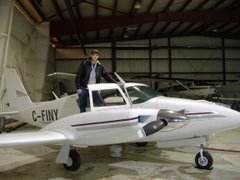
Has it really been over a year and a half since writing? Wow.
Well, it is with a lot of satisfaction, and a little bit of sadness that I am announcing the end to this blog. I have (almost) entirely transitioned into a new career in web development, and since my professional flying career is drawing to a close, and I no longer have a personal aircraft, there won't be much to write about. And indeed my sources of inspiration have been growing thin for a while now. Not that I don't still enjoy flying, in fact like many things that have been a part of your life for many years (15+ years now for me), flying has become more like an old friend. What once was new, exhilarating, and a grande adventure has now become familiar and comfortable. Not that one state is better than the other, its just a natural progression.
All good things must come to an end. My decision to leave professional aviation comes mainly for family reasons -- I now have a young daughter, and the airborne survey demands too much travel to enjoy and be there for my family. So now I've switched to my other primary interest in life -- coding. I work out of my basement, I lunch-break with my wife, and I can finally do things I never could before like join a summer baseball team.
Its a bit sad to think that I'm leaving a career that's been a part of my life since I was 16, but does anyone REALLY ever leave aviation? My old company will still call me on occasion to go fly for them for short stints, and maybe someday I'll purchase another private aircraft. The future is not set.
Thanks to my readers and supporters who encouraged me to continue writing and expressed their enjoyment of my posts. And to my sister, again, who at one point compiled and edited my entire blog archive into a printed book. That was a special gift.
Tuesday, July 14, 2015

Wednesday, December 18, 2013
Higher, Faster, Further
I looked up at the sky as we pack the airplane. The local weather station was reporting CLR - no clouds below 10 thousand feet - but I can definitely see some moving in. I'm concerned about the system moving in from the west, threatening to ground me here. We've finished our last job, just days before Christmas, and I've got clearance to fly the airplane home. Basically across the entire continental US - over a 1600 nautical mile trip. The airplane is dangerously close to timing out for maintenance and leaving me stuck somewhere waiting for an inspection, but I have an ace up my sleeve - or more accurately a stroke of good luck. High up there's winds sweeping eastward at 40+ knots - and I have the oxygen, the performance, and the weather to get me up there.
A half hour later I shake the hands of my coworkers who've dropped me off and are driving out to catch an airline flight, and I'm on my own. I fire up both engines and wave as I taxi out. I can see further to the south some mountain ridges are obscured by cloud, but to the east things look ok - not that I can see far. This airport is sitting right in the valley of two 14,000 ft mountain ridges. The weather reports look ok though. There was an AIRMET warning of a small section to the east with IFR conditions, but I can divert to the south and go around it if I run into anything too bad.
Ten minutes later my Navajo is pointed skywards. I love cold weather performance. I'm getting 1000 fpm at full gross weight. Even though she's climbing like a homesick angel, I still have to fly parallel to the mountain ridge for a several minutes to get high enough to turn eastward and cross over. I finally crest the ridge going through 13,000 ft, turn on my supplemental oxygen and also for the first time get a good look at the weather ahead. It looks good now, and even better ahead. Through 15,000 ft and well clear of the mountains I give Salt Lake Centre a call on the radio and request flight following.
The airplane's pitch sensitivity today is annoyingly twitchy, a side effect of loading the airplane with an aft-ward centre of gravity (but still within limits). I make a mental note to move some cargo to the nose compartment for my next leg to make it easier on myself. Theoretically since the tailplane is exerting a downward force - in opposition to the wing - the more aft the centre of gravity, the less opposing force is required to balance the aircraft and a higher cruise speed can be achieved. But I'm doubtful that it makes a difference of more than a few knots, and I'd rather not have to constantly re-trim a twitchy airplane.
Leveling off at 17,500 ft, I lean out the mixtures and switch to the outboard fuel tanks. They should last me 2.3 hours at my planned cruise power setting. The climb up to this altitude burned a lot of fuel and took twenty minutes. I do a quick calculation to see how much I burned and how much I now have left and mark it down on my kneeboard. That 20 minute climb burned an equivalent of 46 minutes of fuel at cruise power, but it should pay off. I'm now cruising at 202 kts groundspeed, and I expect stronger winds the further east I go.
I cross some very tall snowy mountain peaks below me and snap a picture on my phone. They're still impressive even though I'm several thousand feet above the highest ridges, but not nearly as intimidating as surveying in and around them down low. I also can't help but snap pictures of the groundspeed readout on the Garmin 430 each time it slowly ticks up as the stronger and stronger winds whisk me along faster and faster.
Salt Lake Center hands me off to Denver Center and I start getting shuffled through their frequencies. The gps map shows me approaching the general area of where we did another survey previously in the year, right in the heart of the Colorado Rockies. The town we stayed in had a ski-hill which I was dying to go snowboarding on, but it was too early in the year. The visual of the ski slope would be a dead giveaway to confirm where it was, but I can't find it. I eventually realize that its quite a few miles south of me, and it only looked close on the gps map because I had it zoomed way out. Bummer. Its always kind of fun to fly into or by places you've been before and think you'll never see again.
Its lunch time, and the in-flight meal today is cold pizza from last night's dinner and a slosh of powerade that I left in the plane from the last flight. This actually beats out most of my in-flight meals which more often consist of a bag of peanuts, or nothing at all. Before long flights I'm usually stuck in 'flight planning' mode, and often forget entirely to think about what I'm going to eat.
Its about time to switch the fuel tanks again back to the mains. They didn't run dry before the expected 2.3 hours (but were pretty darn close according to the fuel gauges), which confirms my expected fuel burn of 32 gph, and with a bit of arithmetic also verifies that the fuel remaining in the main tanks will last me the rest of the flight with a healthy 1 hour of reserve fuel. Its always good to double check your fuel burns and never take any fuel flow gauge or book figures at face value.
By now the rocky mountains have gradually leveled out into the flat farmland of Nebraska. Not much to see now.
Three hours into the flight and I'm holding a steady 228 kts groundspeed - the highest I've ever seen as a pilot. I think I saw 210 kts in the Twin Comanche once way back when, and that was down at 3000 ft when I picked up a low level jet stream flying from London to Brantford. That flight was pretty cool.
An hour out from my destination now and start prepping for the descent and landing. I review the airport frequencies, runway diagram, and do a quick calculation of when I need to start my descent. My destination airport is just over 1000' feet elevation, so that's 16,500' I'll need to let down by. A 750 fpm descent (any faster is uncomfortable on the ears) will mean I'll have to start letting down with no less than 22 minutes to go, but I add a few more minutes fudge factor because I'll certainly be going faster when I push the nose down which will mean a descent is needed even sooner.
Denver Center hands me off to Minneapolis Center, who then eventually switches me to over to my destination's Approach Control. I'm well into the descent now, slowly pulling back the power bit by bit to give the engines a nice slow cool-down and prevent shock cooling, and also because I need to start thinking about slowing down. I'm still doing well over 152 knots indicated airspeed, which is my maximum for lowering the first notch of flaps, and I'll need those to slow me down even further. Approach finally hands me off to the Tower, which asks if I have information 'Whiskey' (the current automated advisory for airport weather and other pertinent terminal information) and then immediately clears me to land for runway 13. Its a slow day when you get cleared to land and you're still 10 miles out. I touch down in the light winds and taxi in. Eight hundred and sixty nautical miles in 4.2 hours - not too shabby if I do say so myself. Halfway home.
A half hour later I shake the hands of my coworkers who've dropped me off and are driving out to catch an airline flight, and I'm on my own. I fire up both engines and wave as I taxi out. I can see further to the south some mountain ridges are obscured by cloud, but to the east things look ok - not that I can see far. This airport is sitting right in the valley of two 14,000 ft mountain ridges. The weather reports look ok though. There was an AIRMET warning of a small section to the east with IFR conditions, but I can divert to the south and go around it if I run into anything too bad.
Ten minutes later my Navajo is pointed skywards. I love cold weather performance. I'm getting 1000 fpm at full gross weight. Even though she's climbing like a homesick angel, I still have to fly parallel to the mountain ridge for a several minutes to get high enough to turn eastward and cross over. I finally crest the ridge going through 13,000 ft, turn on my supplemental oxygen and also for the first time get a good look at the weather ahead. It looks good now, and even better ahead. Through 15,000 ft and well clear of the mountains I give Salt Lake Centre a call on the radio and request flight following.
The airplane's pitch sensitivity today is annoyingly twitchy, a side effect of loading the airplane with an aft-ward centre of gravity (but still within limits). I make a mental note to move some cargo to the nose compartment for my next leg to make it easier on myself. Theoretically since the tailplane is exerting a downward force - in opposition to the wing - the more aft the centre of gravity, the less opposing force is required to balance the aircraft and a higher cruise speed can be achieved. But I'm doubtful that it makes a difference of more than a few knots, and I'd rather not have to constantly re-trim a twitchy airplane.
Leveling off at 17,500 ft, I lean out the mixtures and switch to the outboard fuel tanks. They should last me 2.3 hours at my planned cruise power setting. The climb up to this altitude burned a lot of fuel and took twenty minutes. I do a quick calculation to see how much I burned and how much I now have left and mark it down on my kneeboard. That 20 minute climb burned an equivalent of 46 minutes of fuel at cruise power, but it should pay off. I'm now cruising at 202 kts groundspeed, and I expect stronger winds the further east I go.
I cross some very tall snowy mountain peaks below me and snap a picture on my phone. They're still impressive even though I'm several thousand feet above the highest ridges, but not nearly as intimidating as surveying in and around them down low. I also can't help but snap pictures of the groundspeed readout on the Garmin 430 each time it slowly ticks up as the stronger and stronger winds whisk me along faster and faster.
Salt Lake Center hands me off to Denver Center and I start getting shuffled through their frequencies. The gps map shows me approaching the general area of where we did another survey previously in the year, right in the heart of the Colorado Rockies. The town we stayed in had a ski-hill which I was dying to go snowboarding on, but it was too early in the year. The visual of the ski slope would be a dead giveaway to confirm where it was, but I can't find it. I eventually realize that its quite a few miles south of me, and it only looked close on the gps map because I had it zoomed way out. Bummer. Its always kind of fun to fly into or by places you've been before and think you'll never see again.
Its lunch time, and the in-flight meal today is cold pizza from last night's dinner and a slosh of powerade that I left in the plane from the last flight. This actually beats out most of my in-flight meals which more often consist of a bag of peanuts, or nothing at all. Before long flights I'm usually stuck in 'flight planning' mode, and often forget entirely to think about what I'm going to eat.
Its about time to switch the fuel tanks again back to the mains. They didn't run dry before the expected 2.3 hours (but were pretty darn close according to the fuel gauges), which confirms my expected fuel burn of 32 gph, and with a bit of arithmetic also verifies that the fuel remaining in the main tanks will last me the rest of the flight with a healthy 1 hour of reserve fuel. Its always good to double check your fuel burns and never take any fuel flow gauge or book figures at face value.
By now the rocky mountains have gradually leveled out into the flat farmland of Nebraska. Not much to see now.
Three hours into the flight and I'm holding a steady 228 kts groundspeed - the highest I've ever seen as a pilot. I think I saw 210 kts in the Twin Comanche once way back when, and that was down at 3000 ft when I picked up a low level jet stream flying from London to Brantford. That flight was pretty cool.
An hour out from my destination now and start prepping for the descent and landing. I review the airport frequencies, runway diagram, and do a quick calculation of when I need to start my descent. My destination airport is just over 1000' feet elevation, so that's 16,500' I'll need to let down by. A 750 fpm descent (any faster is uncomfortable on the ears) will mean I'll have to start letting down with no less than 22 minutes to go, but I add a few more minutes fudge factor because I'll certainly be going faster when I push the nose down which will mean a descent is needed even sooner.
Denver Center hands me off to Minneapolis Center, who then eventually switches me to over to my destination's Approach Control. I'm well into the descent now, slowly pulling back the power bit by bit to give the engines a nice slow cool-down and prevent shock cooling, and also because I need to start thinking about slowing down. I'm still doing well over 152 knots indicated airspeed, which is my maximum for lowering the first notch of flaps, and I'll need those to slow me down even further. Approach finally hands me off to the Tower, which asks if I have information 'Whiskey' (the current automated advisory for airport weather and other pertinent terminal information) and then immediately clears me to land for runway 13. Its a slow day when you get cleared to land and you're still 10 miles out. I touch down in the light winds and taxi in. Eight hundred and sixty nautical miles in 4.2 hours - not too shabby if I do say so myself. Halfway home.
Tuesday, July 2, 2013
The Intricacies of the Checklist
Checklists. Some pilots swear BY them, other pilots swear AT them. You either love them or you couldn't be bothered to ever look at them and your checklist has been lost under the seats for the last 6 months. You know if I'm talking to you. I've been on both sides of the camp at one time or another, but I think a lot depends on whether or not the checklist has been tailored specifically for your own specific operation or not. A well designed checklist is crucial to whether its useful in the cockpit or viewed as an inefficient formality that eventually gets disregarded.
Our operation, being survey, is vastly different than the majority of operations out there in some very specific ways, and if we were to use a stock off-the-shelf checklist for a Piper Navajo in our operation it would be essentially useless. Being a survey operation we're an extreme example, but the same holds true in some way or another for probably every other operation out there, whether its a private owner/pilot that flies mostly VFR, IFR commercial charter operation, cargo carrier, or any of the other endless combinations in between.
There's a fine line between having every conceivable item on the checklist so that it can be 100% reliable in every situation, and having SO many items on it that in regular operations it becomes so cumbersome that pilots start to skim over it or disregard it completely. Take for example VFR flying and IFR flying. In IFR flying there a lot of additional instrument checks that need to be made before each flight. If you're going to be navigating by VOR (a radio nav-aid) for example, its imperative that you check your VOR instrument's accuracy before you take-off and start to rely on it to take you to your destination. If you're flying VFR however and primarily by GPS and pilotage (navigation by looking out the window and comparing with your map), checking your VOR indicator for accuracy is of critical importance. And if you fly VFR 99.9% of the time, if you had to slog through a checklist designed for IFR, eventually you'd get tired of the inefficient process of going through all the "not applicable" items, and you'd either stop using the checklist altogether, or start skimming through the items, which has arguably more potential for missing critical items then not using it at all.
Another reason against using off-the-shelf checklists that are not tailored to your operation is because they may not contain critical items on them that are specific to your particular operation, and you won't be able to rely on them 100%. If you can't trust your checklist, what good is it?
Furthermore, checklists have to be structured in such a way that they prove to be an efficient and useful tool in an environment as dynamic as a cockpit. There was an accident several years ago of a passenger airline, the time and place of which I can't remember anymore, that was part of a Mayday episode. The airplane blew a tire on take-off which went unnoticed by the flight crew. The blown tire ended up erupting into a fire, which spread throughout the airplane after they retracted the landing gear into the aircraft's belly. The airplane ended up crashing, and while it wasn't the main cause, the investigators noted that the airplane's cabin fire checklist was a sequence that could take as long as 30 minutes to complete. Due to this the flight crew chose to circle for several minutes while they went through and completed the checklist. Unfortunately the airplane didn't have that long before the fire consumed the aircraft. When they could have been descending to land and survive, their checklist and standard operating procedures failed them by requiring that they remain airborne until they completed their checklist.
That is an extreme example of course, but good checklist design can even be applied in the case of an engine failure in a small aircraft. After an engine failure there are several things that need to be accomplished very quickly in order to maximize your chances of survival. After those are finished you may or may not have bought yourself a little extra time to troubleshoot the situation. In almost all cases it makes sense to complete those immediate critical items by memory first as a "flow", and then only once you have time, pull out the checklist, verify what you've already did, and then continue on with the troubleshooting using the checklist line-by line. This is a great example of using a checklist in two different ways (Do & Verify, or Read & Do line by line), and a checklist design can either hinder that or help that by organizing each section of the checklist appropriately for the method that is best used at each time.
Consider even a pre-landing checklist on a small airplane. Most pre-landing checklists are completed in the traffic circuit, the time in the flight with the highest air traffic density and when the pilot should have most of his attention focused outside to look for other aircraft and flying the airplane. A poorly designed and unnecessarily long-winded checklist takes the pilot's attention away from looking for airplanes and down to his lap has he checks off each item line by line. It may also increase the chances that it doesn't get completed if a distraction occurs mid-checklist (like a radio call).
Until I started putting thought into designing checklists its easy to overlook the multitude of human and operational factors that need to be considered when creating checklists. Its quite the science actually, and there's even been studies and papers done on the topic. Here's a fantastic paper from NASA on the concepts, design & use of cockpit checklists. I found it one day when I was overhauling our checklist for the Navajo and was looking on some guidance on how to structure it.
If you're one of the pilots who isn't in the habit of using your checklist religiously for EVERY phase of flight, maybe you should consider why. Is it designed in such a way that makes using it inefficient or cumbersome, is it not tailored specifically to your type of operation? Maybe you'd benefit from a checklist overhaul.
Saturday, June 8, 2013
Zen
After the usual hectic spring rush of dusting off the airplanes from the winter hibernation and getting all the proper survey equipment installed and working, we're off to the races. We have numerous US contracts lined up for pretty much the whole summer, unfortunately their locations are confidential, so I'm going to have to limit my geographically specific writing. Actually I think I'm going to change my blogging style a little anyway.
I used to write in a way that would pretty much follow me along in my exploits chronologically, but I don't write as frequently as I used to, and it gets tiresome to constantly be writing updates to fill in my readers (if I even still have some) on what has happened since I last wrote. Instead I think I'll go back to using the blog as a place to write my musings on aviation related matters, which is sort of how it started to begin with. That way I can maintain the confidentiality requirements of the job and also not feel obligated to keep filling everybody in on what has happened between posts.
Seeing as how I've been flying professionally in the same job now for a few years, new and exciting experiences are becoming fewer and fewer - at least ones that are exciting to write about. This is a good thing career-wise, but makes for boring blogging.
-------------------------
Over the last couple years I've noticed my flying style changing, but not only my style, but how I judge what are good practices and what are not. When I first started flying professionally in Moosonee I was struck by how quickly and proficiently the pilots there would flow through the pre-flight actions. I was impressed by the proficiency and tried to emulate it. I say action and not checklist because we never actually used any physical checklist, it was all by memory and conducting a flow - completing actions by moving from one side of the cockpit to the other in an orderly fashion.
The area where I have changed my thinking now however is that I used to look at the speed at which things are accomplished in the cockpit and equate that with proficiency. Its been through flying with and watching the pilot who first trained me on the Navajo, and through some lessons learned on my own, that speed and fast hands in the cockpit isn't a good measure of skill or cockpit discipline.
There are a lot of external factors exerted on pilots to rush through things. Unexpected hiccups always seem to pop up and bring us behind schedule, company management can instill flight crews with a sense of urgency, and even weather can conspire to create a rushed environment.
The thing I've observed in my pilot-mentor however is that once it comes time to pre-flight the airplane and then climb into the cockpit and start up, he's never in a rushed frame of mind. At first glance, to me at least, when I first started flying with him, his calm, meticulous demeanor came across to me as the opposite of proficiency. Why are you taking so long to start the engines? Haven't you done this 1000 times before?
After a while though I realized that he's taking his time not because he doesn't know what he's doing, just the opposite, but he understands its well worth the extra few seconds to make sure he does things right. Like I mentioned there can be a dozen different factors which contribute to a sense of urgency in the cockpit, but the cockpit should be a place where calm and un-rushed thinking and action takes place. In reality, with the exception of a few specific situations, like an engine failure after take off, very few things with flying take a rushed demeanor and lightning fast reflexes. Almost everything takes a clear mind and can benefit from taking a few extra moments to collect yourself and double check that the action or decision you're making is rational and correct.
Its through watching this pilot that I've learned that a safe flight is much better accomplished by pausing, taking a deep breath, and making sure you take your time and do everything correctly the first time. The rest of life can be hectic, rushed, require snap decisions, go-go-go, but as soon as you walk out to that airplane, its time to change that. Take a deep breath. Do the walk-around slowly. Are the chocks out, is the fuel drained for contaminants, are all the covers off? And down the list you go. When its time to climb into the cockpit; another deep breath. Flight plan filed and open? Cockpit organized? The pressure of time can sometimes tempt you to start up first and then organize things on the go. Temptation tells us "we can do all that stuff later, lets just get out of here first". But as soon as those engines are running, part of your attention for the rest of the flight is diverted to the needs of the airplane. Its only prudent to do as much as you can while the airplane is stationary and not requiring the attention of the pilot. Forget about any pressure to do it faster. Once the cockpit is organized, charts and publications at hand, kneeboard and pen within easy reach, checklist on your lap - another deep breath. Time to start up.
Its all about changing your tempo as soon as you're around the airplane. I call it my zen state. The pace of decisions slow down, the automatic reactions are reeled in and double checked. No external pressure or schedule has any justification anymore to make you go faster than what it takes to do things right.
It can be difficult to switch gears like that, especially for me, but that's where the discipline lies.
Sunday, January 6, 2013
3 Flights, 2 Planes, 1 Day
November 18, 2012
Of course our demob falls on a Sunday. It always seems to happen like that. Sundays are the worst days to travel on: Places are closed down for the weekend, key personnel aren't working, and we have minimal support from our own office if we need it. Nonetheless today looks like our only weather window for us to get out of here. Unless we stop at the hunting lodge on our way back again, like we did on the way up, its going to be a 4 hour flight to Chibougamau for our first fuel stop. We'll only stop at the lodge if we have to. There's a few different cloud layers reported on the weather charts for our first leg. They all look ok. The Icing chart is forecasting possible icing from the surface to 3000 ft. If we get stuck scud running again, we might end up having to descend into the icing. Its actually kind of a crapshoot. But if we run into icing we can turn around and go back to Kuujjuaq. It'll be a real bummer if we fly for 2 hours and have to turn around and fly another 2 back, but that's the chance we'll have to take. Today's our only option for several days.
Our itinerary dictates a stop in Val-d'or again, as our 206 has been left there for maintenance, and the office wants it back in Buttonville for the winter. So I'll hop out in Val-d'or, my colleague will continue on in the Navajo and I'll come back in the 206. I'm told (after double checking), that all the paperwork is in order for the 206 and its all ready for me to just hop in and go. I don't want any surprises when I get there.
We head out to the airport while its still dark. We gave our gate key back yesterday, so we're hoping we can get in through the construction fence that is left unlocked and can be swung open. We drive up and I hop out to swing it open. No luck. The bottom of it is stuck in the crusty snow. I can't open it for the life of me. Now what? Its early Sunday morning, there's nobody around, even the main terminal building is locked. There's a crew house that straddles the airport fence, I hop out of the truck and knock on the door, hoping someone's home and can let us in. No luck, but I go around to the side of the building and see a light on in one of the rooms. Its a guy sitting in what looks like the lounge watching TV. Sheepishly I knock on the window to get his attention, and motion towards the door. Success! He meets me a the door and I explain who I am, and he lets us through. He doesn't have a key for the main gate, so we can't bring the truck through, so its a good thing we have already packed the plane, and we just have our own personal bags to bring through. We unload what we do have and my colleague goes off the park our rental truck and drop the keys.
The sun is coming up now. Preflight is done, our cargo is tied down, we've checked the weather one last time by huddling up against the terminal building to grab the wi-fi signal there on our phones. Its time go. Ten minutes later I'm pulling back on the controls and we "slip the surly bonds of earth". Gear up, flaps up, power reduced a tad, emergency fuel pumps off, and then a visual check outside to make sure there's no fire or spraying fuel.
There's multiple cloud layers pretty much as predicted on the GFA (weather chart). We keep a running dialogue on which ones we should go over top and which ones we should duck under. If we go over top of them we risk trapping yourself on top, unless we're sure the cloud layers clear up before our destination, we go underneath, we risk getting pushed lower and lower and possibly into the icing layer that was forecast. We spend the first half of the flight in uncertainty analysing the cloud layers and hoping we don't encounter any icing. We go through a few snow showers, but overall everything goes smoothly. We land in Chibougamau, fuel up and check the weather. The weather south of us looks good still, so no overnight here with $7 beer pints. Onward to Val-d'or! Another hour's worth of flying and we touch down in Val-d'or. We're making excellent progress, considering how long it took us to get up to Kuujjuaq a month ago.
We spend about an hour sitting in the Val-d'or FBO checking the weather again and each doing our flight planning from Val-d'or to Buttonville. By now its 2 PM. The weather looks promising. Another 3 hours (at a Cessna pace this time) and I'll be back in Toronto. Kuujjuaq to Toronto with 2 stops in between in one day is a pretty good day! I'm really itching to get home too, this last month has been a frustrating one, and the thought at getting all the way back to Toronto in one day is an exciting one.
I start pre-flighting the 206. Check the fuel, throw my gear in, and check the logs to make sure everything is indeed in order - except that its not. There's no maintenance release in the Journey Log. A maintenance release is the paperwork by the shop signing off that the maintenance accomplished has in fact been completed and the aircraft has been "released" back to service. That is proof to the pilot that the airplane is airworthy. Even if everything has been physically done on the airplane, if there's no maintenance release, the airplane can't legally fly. I can't believe it. I specifically asked if it was ready to go, and its not. And its also a Sunday afternoon. The people I need to track down now aren't around. Suddenly my hopes of getting home today start to fade...
After about a half dozen phone calls I manage to track down the guy that I need from the shop here that can issue me a maintenance release. Long story short, 2 hours later I've got the paperwork I need, and I'm ready to get on my way.
It'll be dark in an hour. Its a good thing the 206 is equipped for night flying, and I can legally do it, so that's not an issue. By 16:30 I've blasted off for my final 3 hour leg into Buttonville.
By 6:00 PM the sky is pitch black. I'm still north of Algonquin Park, and there's very little civilization around, so the black hole effect is in full force, and I'm flying on instruments. I see a flicker of mist go over my head, and I wonder if I'm going into cloud. I turn the landing light on which will reveal any cloud vapour. I'm just skirting underneath a thin layer, so I drop down a couple hundred feet just to be sure I don't go IMC. I've got the red cockpit map light on and my VNC (VFR Navigational Chart) on my map, following along my progress as best I can. Highway 17 is just about to pass under me, and I can see the lights of the occasional lonely car winding its way along. I look out my right window towards North Bay and while I can't see it directly, I can make out the faint glow of the city lights. That also means I can probably tune into the automated radio weather report that the North Bay airport broadcasts. Sure enough its reporting a scattered layer at 3000 ft, which just about matches up to the layer I'm passing under. I check my map to make sure my altitude of 2500' is still above the MOCAs (minimum obstacle clearance altitude) for the sectors I'm flying through. Barely, but it is. MOCAs account for clearance above the highest terrain or man made obstacles in a map sector plus an extra couple hundred feet. It would be very imprudent to descend below the MOCA while flying on a dark night when the ground is nothing but blackness.
I watch as the highway passes beneath me, and I know I'll be over Algonquin Park shortly. I can only faintly make out the differences between the little lakes and forests passing underneath me. It would be a very bad time for an engine failure right now.
Twenty minutes later I see Huntsville off to my right, which signifies my exit out the south side of the park. Civilization is starting to appear more and more, which is comforting as now that I can make out more and more ground lights I can transition back to visual flying. Soon enough I'm skirting along the eastern shore of Lake Simcoe, and the glow of Toronto comes into view. I look out over the simcoe region and take in the patchwork grid of streetlights and small communities amid the darkness. Night flying really is stunningly beautiful in a really lonely way. I wish I could get to do it more.
I expect Buttonville airport will be fairly sleepy after dark, as most flight training is done during the day. Boy am I wrong. I tune into the tower frequency and once again its rapid fire radio calls. Approaching the zone I'm cleared for left base for runway 15 behind a Cessna 150, with an altitude restriction to stay above 2000 ft. I look for the 150, and also for the airport. Buttonville airport is notoriously difficult to find visually at night, hidden in among all the city lights, but I can see highway 404 so I know where it SHOULD be, and according to my GPS I'm lined up for a good base leg. Its likely I'll find it when I turn to light up with the runway.
Soon enough I'm turning final, and I still haven't had my altitude restriction cancelled. In between the radio chatter I manage to squeeze in a request for confirmation that I can descend freely, which I'm granted. I dump the flaps and pull the power off. This plane will sink like a rock if you want her to. Its been a while since I've landed at night. Its a matter of feeling your way down into the flare ever so slowly until the wheels touch. The tires rolling onto the pavement catch me by surprise. My night touchdowns usually do. For some reason I always think I'm a littler higher than I really am, but they're also almost always buttery smooth. I suppose I should be happy it was such a good landing, but it doesn't feel satisfying when it happens before I'm ready.
I taxi in and find a parking spot. With perfect timing my colleague pulls up in the Van, I guess he decided to wait for me after all. What a guy, its nice to have a welcoming party. Toronto here I am! Its been a long day, and I still find it hard to believe I was in Kuujjuaq just this morning. That's some serious mileage behind us in one day. We really lucked out with the weather. I think that's actually the furthest I've flown as the crow flies in a single day. We check into our hotel for the night. Tomorrow we'll stop by the office and square some things away. While this was the last job of 2012, I'm in the process of being promoted to Chief Pilot, so I'll have lots of desk flying to keep me busy in the downtime.
Saturday, January 5, 2013
By Golly We Did It
November 17, 2012
By golly we did it. In truth it was just luck of the weather really. The last couple days before our deadline the weather cleared up - not beautifully - but just enough to go flying. We got our last couple flights in and finished the project the day before our deadline. As far as the office is concerned, we're heroes! We're happy to take the credit - of course if the weather didn't clear up we'd be blaming the weather left and right.
Now we gotta get out of here. We pack up what we can while we wait for approval from the office to demobilize. Until we get clearance to go we have to remain operational in case we have some re-flights to do. That means keeping our base station set up, and the airplane ready to survey. We're busy organizing things getting ready to go however. It looks like there might be a small weather window tomorrow to get out of here before another snowstorm hits.
We get our approval to get out of here. We spend the rest of the day tearing down our base station, and packing the plane. There's more than one extension cord frozen into the ground or buried beneath several inches of crusted snow. I manage to extricate all but one. The last one is a lost cause, so some lucky person gets a free extension cord when it finally melts free in the spring. Its not the first time we've had to leave extension cords that have been frozen or buried. Go to bed early tonight, we're going to shoot for an early morning departure tomorrow, and it might be a long day.
By golly we did it. In truth it was just luck of the weather really. The last couple days before our deadline the weather cleared up - not beautifully - but just enough to go flying. We got our last couple flights in and finished the project the day before our deadline. As far as the office is concerned, we're heroes! We're happy to take the credit - of course if the weather didn't clear up we'd be blaming the weather left and right.
Now we gotta get out of here. We pack up what we can while we wait for approval from the office to demobilize. Until we get clearance to go we have to remain operational in case we have some re-flights to do. That means keeping our base station set up, and the airplane ready to survey. We're busy organizing things getting ready to go however. It looks like there might be a small weather window tomorrow to get out of here before another snowstorm hits.
We get our approval to get out of here. We spend the rest of the day tearing down our base station, and packing the plane. There's more than one extension cord frozen into the ground or buried beneath several inches of crusted snow. I manage to extricate all but one. The last one is a lost cause, so some lucky person gets a free extension cord when it finally melts free in the spring. Its not the first time we've had to leave extension cords that have been frozen or buried. Go to bed early tonight, we're going to shoot for an early morning departure tomorrow, and it might be a long day.
Wednesday, November 14, 2012
Winter Surveying
Northern Quebec in late autumn was indeed a bad idea. We spent over two weeks watching Low pressure system after Low pressure system pass over top of of us. Rain, freezing rain, snow, winds, low cloud, you name it. Finally about a week ago things started clearing enough for us to go flying.
These survey blocks are short lines, tightly spaced, in very jagged terrain, and with no drape file. Very intensive flying. A drape file is a file that's loaded into our navigation system to give us terrain guidance based on topographical data. We fly lines in both directions to make a grid, and for data-quality reasons the line intersections between both directions have to cross at the same height. So to make it easy on us, the drape file is like "draping" a blanket over the hills. This gives us a vertical flight profile that follows the hilly terrain in a general fashion, crossing the small valleys smoothly and giving us an achievable climb gradient to get up the mountains within the aircraft's performance limitations. Without drape guidance, we have to estimate ourselves what height we should be at any given time. With practice and experience it can be done, but it is one more variable to stay on top of.
With the short lines it means we can do upwards of 60 lines every flight, which also means 60 turns. Turns are similar to an IFR procedure turn - after exiting the block you make a 45° turn away from your next line, wait until you're a certain number of metres away from the line laterally, and then make a 180° back around the other way to intercept the line. Generally turns take about 2 minutes, but if we're doing 60 turns a flight, for every ten seconds we can shave off in each turn, we can save ourselves 10 minutes over the course of the flight, so in these scenarios its highly beneficial to do what I'm going to call a "performance turn". With performance turns we accomplish the entire turn in about 1 minute. This is done by shortening each leg of the turn, and then instead of a 30-35° bank, we're banking as hard as 45-60°. And we make the timing such that we roll out level on-line only seconds before entering the grid. Its half science, half art to get the turns and timing perfect enough that you're not wasting time rolling out onto the line too far back, but not so close that you risk entering the block before you're lined up. Its all based on hitting your key points: At 90° to my line I should be at 900 metres cross-track - if I'm less I need to pull harder, more and I can relax the turn a bit. 60° to my line - 500 metres, 30° - 200 metres, and if I hit 20° and 100 metres I can start rolling out smoothly and I should end up wings level within +/- 30 metres of my line. From there it takes only a few more seconds to fine tune it to less than a couple metres. No more than a minute from exiting the grid to entering again on the next line. Things happen fast. This is high workload flying indeed.
Our day starts long before this however. We leave our hotel rooms at 05:45 AM, its still dark. We have limited daylight and we're trying to make use of the good weather and get two flights in today, but everything has to go perfectly - any delays and taking off for a second flight won't be practical. We're shooting to be airborne by first light. We have to fuel the airplane, brush off the 4 inches of snow that accumulated last night, unplug the two engine heaters and 1 cabin heaters and pull off the engine blankets, and then start up our base station so its logging atmospheric magnetic data (a requirement for a survey flight).
Our fuel drums are stuck in a pile of ice and snow. We work away in the dark. It takes two of us to wrestle each of the four 300 lb steel barrels out of the snow and get them on the ramp where we can roll them over to the airplane. Even rolling them isn't easy today. Two of the drums are dented so badly they don't roll very well. I'm exhausted by the time we get them to the airplane, and my throat is hoarse from the exertion and sucking in -10° C air. My foot also hurts - in the process of standing one of the drums up, I let it land on my foot. I'm okay, but I'm already a little bit grumpy in the morning as it is, dropping a 300 lb drum on my foot doesn't help my mood.
I help get my colleague set up to fuel out of the first drum, and I start to brush the snow off the airplane. Its been cold enough that the snow easily brushes off, thank goodness. The windshield is a different story. We have to keep a space heater running inside the cabin to keep the survey gear warm, and as a result the snow that has fallen on the windshield has partially melted, and then frozen solid to the window. Unlike a car windshield, our airplane windshield is plexi-glass, so we can't just scrape it off or we'll scratch it all up. I climb into the cabin and position the space heater up at the front, pointing at the window. Back to brushing.
Finally we're fuelled and the airplane is clean - off we go. We're behind schedule now and the sky is bright morning, but we're airborne, the weather is clear, and the airplane is climbing like a homesick angel in the cold air. Up until now the few flights we have been able to do have been through snow showers and moderate turbulence. The kind of turbulence where you have to brace your palm against the throttle quadrant and adjust the leavers by pushing them at the base, lest a big bump causes you to yank on them. Its a little bit smoother today however.
Three hours later. We're churning out survey lines like a well-oiled machine. I'm pulling hard through a "performance turn". On this line in particular, in addition to watching the numbers on my digital display tick away like a slot machine on steroids and making sure I hit my key points, my neck cranes just a bit as I watch out my window. There's a cliff scrolling by my windscreen from top to bottom as I crank the airplane around in a steep turn. Its just a little cliff, peaking about 100' below my altitude so we'd clear it anyway if it wasn't already outside my turning radius, but its still an obstacle to keep in sight.
Rolling out on-line and entering the block, there's a small cliff we dive over and then skim a small lake at 230' agl. Its starting to freeze over. From there its up the side of a rocky 1000' mountain. The pine trees start to thin out about halfway up as the soil gives way to exposed windswept rock. Everything is covered in a blanket of white. If I looked down to see some chipmunks and reindeer throwing tinsel on a tree I wouldn't bat an eye. Most of the mountain is on my left side. To my right I look down to the valley, spotted with lakes and carpeted by pine. I glance at the mountain to my left every few seconds - this time not because its a hazard, but because I have remember/imagine what height we were at when we came cruising down the side of it on the lines running perpendicular to the ones we're flying now. Remember we have to intersect lines at the same height, and we're working without a drape.
In the past my colleague and I have been known to engage in some good natured debating over what the proper height should be. We have differing views on how a lot of things should be done actually, but we handle it in a humourous manor so in fact we get along quite well. Its almost tradition now for whoever is riding shotgun at any particular moment to engage in some armchair aviating over what the proper drape height should be. A guy's gotta get his two cents in. Not much of that today though, we're both pretty busy and in the groove, not much talking is going on.
Four hours later. We finish our last line, this block is finished, and our fuel will be running low soon, its time to head back. There's more blocks to do however, and we're still entertaining the thought of getting two flights in. We land, relieve ourselves, grab something to eat, and get right back to work fueling again. This time our fuel drums are not only stuck in the snow, they're frozen solid to the ground under almost an inch of ice. After much kicking, prying, chipping, and grunting we get them free, but that delay was the nail in the coffin for flight number 2. By the time we get them free enough to roll over to the airplane we should have been almost ready to start the engines. Time to call it a day.
Friday, October 26, 2012
I Love the Smell of Avgas in the Morning
We spent 3 more days stuck in Chibougamau while a stationary Low pressure system had its fun swirling around in the North Atlantic bringing a mixture of freezing rain, low cloud and high winds in Northern Quebec. In the meantime my colleague and I found a bar in town that served fantastic ribs and $5 pints.
Finally the weather forecast clears enough for us to take a shot at going north. The weather in Kuujjuaq is currently showing the ceilings at 3500' with an improving trend, but the forecast still says its going to drop to 1500, but no freezing rain is forecast like what has been common for the past few days. Thirty-five hundred feet is plenty, and I wonder if the forecast is wrong as it has been made several hours ago, even if its not it should still be enough to get make it in, even with the rising terrain in the surrounding area. We have also found a good place to stop for fuel about halfway in between Chibougamau and Kuujjuaq. On the suggestion of another colleague we found an airstrip belonging to a hunting lodge. They had fuel and rooms available in case we had to stay overnight. That meant if we stopped for fuel there we would have enough range to fly to Kuujjuaq and then come back to the lodge if the weather turned sour. The runway at the hunting lodge was a 3500' gravel strip. Under the current conditions our performance charts list the landing distance as 2500' under ideal conditions, which means 3500' is long enough to get into, but you also don't want to waste any time getting on the ground when landing, especially on a gravel strip where there will be limited braking effectiveness.
Before we take off I call to make sure someone could meet us at the airport to give us fuel. The CFS notes to overfly the lodge prior to landing to alert them of the arriving aircraft. I'm slightly disappointed when the woman I'm talking to assures me that won't be necessary and she'll make sure someone is there at the time we expect to arrive. Two hours later and the airstrip comes into view. We fly overhead first to check the windsock to determine which direction to land in. The winds were pretty light, in the 5-8 knot range, 90° to the runway. On final I shave 5 mph off our normal approach speed of 120, and tell myself if I'm not on the ground in the first third of the runway, we'll go around. It always helps to remind yourself of the options, and review the actions you'll take, that way it will take less time to process and make the decision if you have to. Hesitating at those moments is what leads to accidents.
The key to remember during short field landings, is that the landing flare always results in landing long of where you aim the airplane during your approach. So if you want to touch down at the runway threshold, you have to start your flare slightly prior to crossing the threshold. A flare is the process of trading in your last bits of excess airspeed (kinetic energy) in exchange for slowing the loss of altitude (potential energy), so naturally this will carry you further down the runway. So I aim for 50 ft before the runway begins, and I smoothly pull the power off as I clear the last few trees.
Most of the runways we've been landing on this summer have been 10,000 ft long, so up until now I've been enjoying the extra space to try and finesse the airplane down with as little bump as possible. To do so you leave a little bit of power on into the flare which gives you more time to find the sweet spot before your last bits of airspeed bleed off and the airplane stalls onto the runway. I've been getting pretty good at it if I do say so myself, but I use up a lot of runway in the process. This time however, the priority is not about greasing the touchdown, but to get the airplane down as close to the runway threshold as I can. A power off flare means the airspeed diminishes rapidly and you have less time to find the sweet spot in the flare. I manage to nail my target touchdown point, and the touchdown itself is not too bad either. The next concern now is to keep the controls pulled back as much as possible to keep the nose of the airplane high and the props from sucking up bits of gravel. The props on this airplane are brand new from the overhaul shop, and my boss would have my head if I put a ding in them from improper gravel runway operations. Since I've managed not to waste any runway I can also keep the braking to almost nil as well, which also helps to keep the nose up. We keep the airplane rolling (another technique to prevent gravel being sucked into the props) until we pull up onto the concrete pad at the fuel pumps. I get a nod of "very nicely done" from my colleague, and we shut down.
Its cold here, we've gone from a crisp winter air in Chibougamau to a biting winter cold here in the interior of northern Quebec. I was wearing my running shoes, but decide its time to put my boots on. Winter has arrived, or I suppose more accurately we have arrived where it is winter.
Airplane gassed up, and we're ready to go again on our second leg. We manage to quickly check the weather at the lodge, and its now saying 1700' overcast - looks like the forecast came true after all The lodge airstrip here is in the highest terrain, pretty much everything from here on to Kuujjuaq is downhill to Ungava Bay. The clouds here are also still pretty thin, and high enough not to pose a problem. We shouldn't have any problems with the terrain rising to meet the cloud layer, and hopefully, not visa versa either. I decide to continue on. Turns out not so much. Much of our flight is spent descending lower and lower. The terrain is descending, but so are the clouds, and at a faster rate. Fifty miles from Kuujjuaq and we find ourselves scud running at less than 500' agl and weaving around freezing rain patches. In built up terrain like southern Ontario this would be a no-no as there are restrictions on how low we can fly over built up areas and other property and people (except during survey where we usually have permits to do so). But in remote, uncontrolled airspace like northern Quebec, our only requirement is to remain clear of cloud, so from a legal standpoint we're still ok. From a safety standpoint if it came down to it we could climb up through the clouds if we absolutely had to.
Finally as we near Kuujjuaq the last bits of higher terrain fall away and we find ourselves back at a reasonable altitude. We made it, finally.
Friday, October 19, 2012
Contingency Plans
We have a short survey to do up in Kuujjuaq, QC. For those who don't know where that is, its on the southern tip of Ungava Bay in Northern Quebec. Its really a bad time of year to go up and do a survey there, but our client is in a bind, so we're going up anyways. It has not been a good start. We got out of Toronto ok, and met up with the 206 crew in Val-d'or for the night, as they had some parts in the van that we needed to take with us. The next day the weather was good enough to get to Chibougamau, which is only about an hour flight NE of Val-d'or, but beyond that the weather had turned sour. So we stayed here for the night. A little progress at a time is better than none. Our next hop however is going to have be in one go all the way up to Kuujjuac, which is 540 nm, or about 3.5 hrs, the only airport that is even remotely in between is La Grande-4 (CYAH) - you know, the one next to Lake Katatipawasakakamaw. Yes that is a real lake, and the spelling is correct. Anyway that's not even really a real airport, just an airstrip to service the generating station. There's certainly no Avgas available.. But it looks like we're going to be hanging out here in the "Chiboug" for a bit as the weather for the next few days is going to be crap.
We actually had a CHANCE that we could have made it into Kuujjuaq yesterday, and I'll elaborate on that in a bit, but first I'm going to change topics.
I've started reading a book recently called Bravo Two Zero. Its about a British SAS team behind the lines in Iraq, and their mission to go blow up some SCUD sites and communication lines. I'm only about a third into it now, and up until this point its just been build-up, mostly about planning the mission. He goes into excruciating detail on how they did their mission planning, and I actually find it quite fascinating to learn how they operate. He describes how they have a contingency plan for every possible scenario. If some of their guys go missing on patrol, they will rendezvous at such and such a place at such and such a time and wait for a defined period of time. If the RV isn't made by the deadline, they have further procedures laid out to follow. The order at which they exit the helicopter is preplanned so when they get dropped off they are able to follow certain procedures in case they end up unloading under fire. They even have procedures to follow in case they have a communications failure with home base - they will RV with the helicopter at a specified time and place, down to the details of how the team leader will approach the helicopter and exchange radios and the signals to be used in case the heli has an urgent message for the team leader. They have a plan for every possible scenario.
I'm sure by now some of you may see where I'm going with this. Flying is done in much the same way, especially IFR flying - every possible contingency is planned for. In IFR flying we try to plan for every possible contingency with the assumption that nothing is going to go right. With IFR of course the assumption is always that the weather will be IMC (Instrument Meteorological Conditions). So what if we have an emergency immediately after takeoff, such as an engine failure or fire, or other malfunction? Of course we won't be able to return for a landing visually, so we better already have our Nav instruments tuned so that we're ready to conduct an instrument approach to land at the airport we just departed from. That way there's no scramble to re-tune everything in what is already going to be a hectic cockpit environment.
There are also standard procedures laid out for a communications failure at any phase of the flight so that both pilot and controller already know what to expect from the other. Controllers when they issue instructions or clearances, such as a hold, they'll include a statement at the end that says, "... expect further clearance at [time] (for example 12:36)". That is more than just for the pilot's convenience, it is so that if a comm failure happens at some point following the last issued clearance, the pilot will then know for how long to continue his hold for before he can then automatically continue on to the next step, and he can do so knowing that ATC is expecting this.
Of course I also have to mention the contingencies that are in place regarding carrying extra fuel. Even though IFR flying is intended to give the ability to fly and land at your destination in bad weather, there still exists the possibility that the weather will be SO bad that we won't be able to sight the runway even if we're flying an instrument approach. In this case before we even take off we've included in our planning an alternate airport. This alternate airport must have weather that is forecast to be significantly better than what would normally considered to be IFR weather minimums. It is for this reason that the regulations state that we must carry sufficient fuel to:
1) Fly to our destination
2) Carry out an instrument approach, AND a missed approach (which is the procedure to overshoot and climb back to a safe altitude if the runway isn't visually spotted)
3) Fly to our alternate and carry out an approach there
4) Fly for an ADDITIONAL 45 minutes
These requirements are actually pretty restrictive, but its all designed so that we have a plan in place for every possible scenario, which is key in managing unforeseen circumstances that are out of our control. In Southern Ontario or most of the United States these fuel restrictions would actually be no big deal most of the time, because your options for finding an alternate are many, so chances are you'll be able to find an airport that's not too far out of your way that has good enough weather to land, and also has gas available to refuel. In the north however, airports are few and far between which means your alternate is going to be a LONG way away, and you better call first and VERIFY that they have fuel available, cause many times even though its listed as having fuel in the publications, it may be in drums. If it is you better be carrying a pump with you. Even still they may not even have some in stock. This ain't no USA where you can land anywhere and have your pick of where you buy your fuel. Planning is even more critical in remote areas like Northern Canada.
There's FAR fewer legal restrictions on VFR flight planning. We only legally require to have an extra 30 minutes of fuel onboard, and much more is left up to the pilot's best judgement in regards to how to handle communications failures and the like. This means much more freedom, but also requires an equal amount of more caution and good judgement. In our case at this moment, if we were to file IFR to Kuujjuaq, we'd be able to penetrate the weather that is grounding us right now, but we wouldn't actually be able to carry the legal minimum in fuel. At our current weight we're only able to take 5.2 hrs of fuel with us, but to file IFR we'd need 3.5 hrs to get to Kuujjuac, roughly another 0.3 to complete the approach and missed approach, and then from Kuujjuac the best alternate I can come up with at the moment that has fuel (just by taking a quick look) is 315 nm away, which is another 2.2 hrs of flying including the approach, and then add on our 45 minutes reserve fuel. That's a total required fuel load of 6.8 hrs! Almost double what we're actually going to burn, and WAY more than we can physically carry. IFR isn't always a feasible option.
Of course the flip-side is that if we fly VFR we can legally make the flight without having to have enough fuel to go somewhere else - that's a big extra freedom - but we better be dang well sure we're going to be able to land when we get there, because the fuel we'll have left in the tanks won't be enough to take us to the next nearest place that has avgas available. So its nice that we have the freedom to do that flying VFR, but it requires that we play it extra conservatively with the weather. Which brings us full circle all the way back to yesterday:
When we landed here in Chibougamau yesterday and checked the weather, the Kuujjuac weather was reporting 1 1/2 miles visibility with 400 ft vertical visibility (not a cloud ceiling but snow that was thick enough prevent visual contact with the ground above 400 ft). That's certainly not VFR. The weather forecast however was saying that by the time we got there it would have cleared up to marginal VFR weather conditions, which would allow us just enough leeway to land. BUT - without enough fuel to go somewhere else, do we put all our cards on the weather forecast and bank on it clearing up? I think not.
We actually had a CHANCE that we could have made it into Kuujjuaq yesterday, and I'll elaborate on that in a bit, but first I'm going to change topics.
I've started reading a book recently called Bravo Two Zero. Its about a British SAS team behind the lines in Iraq, and their mission to go blow up some SCUD sites and communication lines. I'm only about a third into it now, and up until this point its just been build-up, mostly about planning the mission. He goes into excruciating detail on how they did their mission planning, and I actually find it quite fascinating to learn how they operate. He describes how they have a contingency plan for every possible scenario. If some of their guys go missing on patrol, they will rendezvous at such and such a place at such and such a time and wait for a defined period of time. If the RV isn't made by the deadline, they have further procedures laid out to follow. The order at which they exit the helicopter is preplanned so when they get dropped off they are able to follow certain procedures in case they end up unloading under fire. They even have procedures to follow in case they have a communications failure with home base - they will RV with the helicopter at a specified time and place, down to the details of how the team leader will approach the helicopter and exchange radios and the signals to be used in case the heli has an urgent message for the team leader. They have a plan for every possible scenario.
I'm sure by now some of you may see where I'm going with this. Flying is done in much the same way, especially IFR flying - every possible contingency is planned for. In IFR flying we try to plan for every possible contingency with the assumption that nothing is going to go right. With IFR of course the assumption is always that the weather will be IMC (Instrument Meteorological Conditions). So what if we have an emergency immediately after takeoff, such as an engine failure or fire, or other malfunction? Of course we won't be able to return for a landing visually, so we better already have our Nav instruments tuned so that we're ready to conduct an instrument approach to land at the airport we just departed from. That way there's no scramble to re-tune everything in what is already going to be a hectic cockpit environment.
There are also standard procedures laid out for a communications failure at any phase of the flight so that both pilot and controller already know what to expect from the other. Controllers when they issue instructions or clearances, such as a hold, they'll include a statement at the end that says, "... expect further clearance at [time] (for example 12:36)". That is more than just for the pilot's convenience, it is so that if a comm failure happens at some point following the last issued clearance, the pilot will then know for how long to continue his hold for before he can then automatically continue on to the next step, and he can do so knowing that ATC is expecting this.
Of course I also have to mention the contingencies that are in place regarding carrying extra fuel. Even though IFR flying is intended to give the ability to fly and land at your destination in bad weather, there still exists the possibility that the weather will be SO bad that we won't be able to sight the runway even if we're flying an instrument approach. In this case before we even take off we've included in our planning an alternate airport. This alternate airport must have weather that is forecast to be significantly better than what would normally considered to be IFR weather minimums. It is for this reason that the regulations state that we must carry sufficient fuel to:
1) Fly to our destination
2) Carry out an instrument approach, AND a missed approach (which is the procedure to overshoot and climb back to a safe altitude if the runway isn't visually spotted)
3) Fly to our alternate and carry out an approach there
4) Fly for an ADDITIONAL 45 minutes
These requirements are actually pretty restrictive, but its all designed so that we have a plan in place for every possible scenario, which is key in managing unforeseen circumstances that are out of our control. In Southern Ontario or most of the United States these fuel restrictions would actually be no big deal most of the time, because your options for finding an alternate are many, so chances are you'll be able to find an airport that's not too far out of your way that has good enough weather to land, and also has gas available to refuel. In the north however, airports are few and far between which means your alternate is going to be a LONG way away, and you better call first and VERIFY that they have fuel available, cause many times even though its listed as having fuel in the publications, it may be in drums. If it is you better be carrying a pump with you. Even still they may not even have some in stock. This ain't no USA where you can land anywhere and have your pick of where you buy your fuel. Planning is even more critical in remote areas like Northern Canada.
There's FAR fewer legal restrictions on VFR flight planning. We only legally require to have an extra 30 minutes of fuel onboard, and much more is left up to the pilot's best judgement in regards to how to handle communications failures and the like. This means much more freedom, but also requires an equal amount of more caution and good judgement. In our case at this moment, if we were to file IFR to Kuujjuaq, we'd be able to penetrate the weather that is grounding us right now, but we wouldn't actually be able to carry the legal minimum in fuel. At our current weight we're only able to take 5.2 hrs of fuel with us, but to file IFR we'd need 3.5 hrs to get to Kuujjuac, roughly another 0.3 to complete the approach and missed approach, and then from Kuujjuac the best alternate I can come up with at the moment that has fuel (just by taking a quick look) is 315 nm away, which is another 2.2 hrs of flying including the approach, and then add on our 45 minutes reserve fuel. That's a total required fuel load of 6.8 hrs! Almost double what we're actually going to burn, and WAY more than we can physically carry. IFR isn't always a feasible option.
Of course the flip-side is that if we fly VFR we can legally make the flight without having to have enough fuel to go somewhere else - that's a big extra freedom - but we better be dang well sure we're going to be able to land when we get there, because the fuel we'll have left in the tanks won't be enough to take us to the next nearest place that has avgas available. So its nice that we have the freedom to do that flying VFR, but it requires that we play it extra conservatively with the weather. Which brings us full circle all the way back to yesterday:
When we landed here in Chibougamau yesterday and checked the weather, the Kuujjuac weather was reporting 1 1/2 miles visibility with 400 ft vertical visibility (not a cloud ceiling but snow that was thick enough prevent visual contact with the ground above 400 ft). That's certainly not VFR. The weather forecast however was saying that by the time we got there it would have cleared up to marginal VFR weather conditions, which would allow us just enough leeway to land. BUT - without enough fuel to go somewhere else, do we put all our cards on the weather forecast and bank on it clearing up? I think not.
Monday, October 15, 2012
Oh You're a Pilot?
I just recently met a friend of my girlfriend, who had been told by her that I was a pilot and that I was leaving for deployment again shortly. We talked for a bit and she mentioned that my girlfriend had told her I was a pilot, but she was confused because she didn't understand why I would be leaving for somewhere else for a long period. To her a pilot just flies back and forth from A to B, so there would be no need for me to leave for extended periods. It was an innocent assumption made by someone who isn't aware of all the different amazing things you can do with an aircraft. You could see the light come on as I explained the type of flying I do, and why it now made sense that I leave for extended periods
Its actually a fairly common scenario: Somebody asks what I do, and I tell them I'm a pilot. Invariably the next question is "Who do you work for?". I dislike that question, as I would guess at least 95% of every other pilot out there does - we've all had it. Its an innocent question, but the chances are that whoever is asking will have never heard of the company we work for. When they ask it, they're expecting one of three answers: Air Canada, Westjet, or Porter (or insert any other well known regional airline that is common to the area). But what they don't realize is that those airlines really only represent probably less than 10% of the entire pilot workforce in Canada, and unless whoever is asking actually works in the Aviation industry, I can guarantee they've never heard of the company that comes as the answer. So I think most of my fellow aviators including myself are expecting the blank stare that comes when we answer their question.
I still haven't figured out how to best explain what I do in a succinct, clear answer. How do you explain in one or two sentences in a casual conversation what I do as a low-level geophysical survey pilot?
Sometimes I also get the question "What do you fly?" This is a little better question to ask. At least if they don't know what a Piper Navajo is I can easily explain that its a twin engine propeller plane that normally holds about 8 people. That's enough information for most people to imagine something that's pretty close to a Navajo. When I flew the 206 that was even easier, because everyone knows what a Cessna is.
And then there's the "Are you still building hours to become an airline pilot?" I usually have fun explaining that I'd NEVER want to become an airline pilot. There's so many better and more interesting options to strive for than airline flying, at least in my opinion.
Its a shame that people equate airline flying as the only pinnacle to a successful flying career, and associate flying a small single engine piston plane with a low-experience entry level job. While those both can be true - a good airline job CAN be the pinnacle of a successful flying career and flying around a small single-engine piston is OFTEN for entry level pilots, its not always the case. Some airline pilot jobs are the lowest paying jobs in the industry, and some light piston plane jobs can require some of the highest most refined skill level of any pilot. Some good examples are the small speciality flying charter companies that operate in and out of super-short unimproved strips or ski-plane operations that take hunters into and out of half-thawed lakes. They may be flying the same aircraft that a low-time private pilot would be flying, but what they do certainly takes the skill of a high-time professional.
As Aviatrix mentions, a better question to ask after you find out that someone is a pilot is not who they work for but "What kind of operation is it?" That's a question that will impress us, and we'll also enjoy talking about it.
Its actually a fairly common scenario: Somebody asks what I do, and I tell them I'm a pilot. Invariably the next question is "Who do you work for?". I dislike that question, as I would guess at least 95% of every other pilot out there does - we've all had it. Its an innocent question, but the chances are that whoever is asking will have never heard of the company we work for. When they ask it, they're expecting one of three answers: Air Canada, Westjet, or Porter (or insert any other well known regional airline that is common to the area). But what they don't realize is that those airlines really only represent probably less than 10% of the entire pilot workforce in Canada, and unless whoever is asking actually works in the Aviation industry, I can guarantee they've never heard of the company that comes as the answer. So I think most of my fellow aviators including myself are expecting the blank stare that comes when we answer their question.
I still haven't figured out how to best explain what I do in a succinct, clear answer. How do you explain in one or two sentences in a casual conversation what I do as a low-level geophysical survey pilot?
Sometimes I also get the question "What do you fly?" This is a little better question to ask. At least if they don't know what a Piper Navajo is I can easily explain that its a twin engine propeller plane that normally holds about 8 people. That's enough information for most people to imagine something that's pretty close to a Navajo. When I flew the 206 that was even easier, because everyone knows what a Cessna is.
And then there's the "Are you still building hours to become an airline pilot?" I usually have fun explaining that I'd NEVER want to become an airline pilot. There's so many better and more interesting options to strive for than airline flying, at least in my opinion.
Its a shame that people equate airline flying as the only pinnacle to a successful flying career, and associate flying a small single engine piston plane with a low-experience entry level job. While those both can be true - a good airline job CAN be the pinnacle of a successful flying career and flying around a small single-engine piston is OFTEN for entry level pilots, its not always the case. Some airline pilot jobs are the lowest paying jobs in the industry, and some light piston plane jobs can require some of the highest most refined skill level of any pilot. Some good examples are the small speciality flying charter companies that operate in and out of super-short unimproved strips or ski-plane operations that take hunters into and out of half-thawed lakes. They may be flying the same aircraft that a low-time private pilot would be flying, but what they do certainly takes the skill of a high-time professional.
As Aviatrix mentions, a better question to ask after you find out that someone is a pilot is not who they work for but "What kind of operation is it?" That's a question that will impress us, and we'll also enjoy talking about it.
Sunday, October 7, 2012
Courtesy. Professionalism.
Eighteen miles Northeast of the field. Two other aircraft have reported inbound already, I'm about to be the third. One will land well ahead of me, but I didn't catch the position of the other one.
Val-d'or airport is equipped with an MF radio service, which is halfway in between a tower and an uncontrolled airport. With a radio service there is at least one person, sitting somewhere, monitoring and communicating with traffic going in and out of the airport. They could actually be physically sitting in a tower at the airport, or even be located off-site somewhere. The main difference between a radio service and a control tower however is the principle that they do not provide controlling instructions to aircraft, but are only an advisory service. They are able to assist in the safe separation of aircraft as well as provide reports on current weather conditions. Sometimes they are radar equipped, like at Thompson, MB, but usually not, so they keep track of current traffic by asking for pilot position reports.
I make my report, "Val-d'or radio, this is XXX, 18 miles to the northeast of the field, 2100 ft, inbound for landing estimating the field in 8 minutes.".
I remind myself to use proper terminology and speak clearly and directly. I'm speaking English over the radio in Quebec, and even though the radio operator's english is very good, it is still clearly his second language. Radio communications can have enough clarity issues before you introduce multiple languages into the mix.
He responds and advises me of the location and estimated arrival times of the other two aircraft. The first one as expected will land well ahead of me and won't be a factor. The other one however, a Dash 8, is reporting 30-something miles north-east as well, with an estimate to the field at the same time as myself.
My spidy-sense tingles as I recognize my level of situational awareness is going to have to be elevated now that there could be a potential traffic conflict. The Dash 8 is making an approach onto the south facing runway despite the winds favouring the north direction. Its probably for instrument approach reasons. I choose to land in the opposite direction which means I'll join a straight in right-hand downwind.
The radio advisor asks me to slow it back and remain to the east to land number 2. Technically speaking since I'm the aircraft that is closer to the airport and at the lower altitude, I have the right of way to land first, but as a courtesy I comply and confirm that I'll slow it up to give way to the larger, faster, and thirstier aircraft. Not that the 206 already doesn't fly painfully slow, but its all relative. I pull the throttle back a hair and start to set up for joining my downwind leg.
I'm mid-downwind now, directly abeam the runway. From here under normal circumstances I would be on the ground in less than two minutes from now, but I know I'm probably going to have to extend my downwind a little bit for the Dash 8. Val-d'or radio advises me that the Dash 8 is now on 10 mile final. What?! Still? If his initial estimate to the field was accurate he would be just touching down by now. Its not an uncommon scenario actually - highly optimistic reports for eta to landing made by faster aircraft. Its all really a result of lazy airmanship from the pilots. The initial eta reports are made when the aircraft is in their descent phase at a high rate of speed. At 220 knots and 30 miles from the field the GPS is going to tell them they'll arrive in 8 minutes, but they're not going to be flying all the way into the airport at 220 knots. At some point between when they make that report and landing they're going to have to slow down to approach speed - 80 to 90 knots slower! As they slow down obviously their eta is going to increase significantly, which they didn't bother to account for. Meanwhile waiting for them to land, I've extended my downwind leg so far now that I've almost cleared the 5 mile control zone out the other side!
The weather was a VFR day, which for them as an IFR flight, still means they have to conform to VFR traffic rules in and around the airport. If an IFR aircraft is cleared for an approach into an airport by their IFR controller, it is still the responsibility of the aircraft to conform to the rules regarding VFR traffic separation. Unfortunately its been my experience that airliners don't tend to play nicely with VFR traffic, and they'd almost rather just pretend that we don't exist so they can continue to fly like its a purely IFR environment. In this case it seemed like they were happy to let me take the entire responsibility of getting out of their way, despite the fact that I technically had the right of way.
I could have easily landed and cleared the runway well before the Dash 8 if they had made a proper eta report, because I was actually almost 5 minutes ahead of them. But now I'm forced to go way out of my way as a courtesy to them. The least they could have done was hurry it up a little. Finally I land, and the radio service operator thanks me sincerely for my cooperation. That dissolves my annoyance significantly.
Its amazing what a thank you can do, but ultimately my annoyance is not with the radio operator, as he was only operating with the information he was given, and I have only ever experienced excellent service from all of those guys/girls. It is the Jazz Dash 8 pilots who displayed lazy airmanship because of the discourteous assumption that the little guy in the Cessna will let them go first, even if they're actually 5 full minutes behind him. Next time I'm half tempted to assert my right of way to land number one, but that wouldn't be courteous, nor by extension, professional. I'm sure going to rant about it on my blog though.
Val-d'or airport is equipped with an MF radio service, which is halfway in between a tower and an uncontrolled airport. With a radio service there is at least one person, sitting somewhere, monitoring and communicating with traffic going in and out of the airport. They could actually be physically sitting in a tower at the airport, or even be located off-site somewhere. The main difference between a radio service and a control tower however is the principle that they do not provide controlling instructions to aircraft, but are only an advisory service. They are able to assist in the safe separation of aircraft as well as provide reports on current weather conditions. Sometimes they are radar equipped, like at Thompson, MB, but usually not, so they keep track of current traffic by asking for pilot position reports.
I make my report, "Val-d'or radio, this is XXX, 18 miles to the northeast of the field, 2100 ft, inbound for landing estimating the field in 8 minutes.".
I remind myself to use proper terminology and speak clearly and directly. I'm speaking English over the radio in Quebec, and even though the radio operator's english is very good, it is still clearly his second language. Radio communications can have enough clarity issues before you introduce multiple languages into the mix.
He responds and advises me of the location and estimated arrival times of the other two aircraft. The first one as expected will land well ahead of me and won't be a factor. The other one however, a Dash 8, is reporting 30-something miles north-east as well, with an estimate to the field at the same time as myself.
My spidy-sense tingles as I recognize my level of situational awareness is going to have to be elevated now that there could be a potential traffic conflict. The Dash 8 is making an approach onto the south facing runway despite the winds favouring the north direction. Its probably for instrument approach reasons. I choose to land in the opposite direction which means I'll join a straight in right-hand downwind.
The radio advisor asks me to slow it back and remain to the east to land number 2. Technically speaking since I'm the aircraft that is closer to the airport and at the lower altitude, I have the right of way to land first, but as a courtesy I comply and confirm that I'll slow it up to give way to the larger, faster, and thirstier aircraft. Not that the 206 already doesn't fly painfully slow, but its all relative. I pull the throttle back a hair and start to set up for joining my downwind leg.
I'm mid-downwind now, directly abeam the runway. From here under normal circumstances I would be on the ground in less than two minutes from now, but I know I'm probably going to have to extend my downwind a little bit for the Dash 8. Val-d'or radio advises me that the Dash 8 is now on 10 mile final. What?! Still? If his initial estimate to the field was accurate he would be just touching down by now. Its not an uncommon scenario actually - highly optimistic reports for eta to landing made by faster aircraft. Its all really a result of lazy airmanship from the pilots. The initial eta reports are made when the aircraft is in their descent phase at a high rate of speed. At 220 knots and 30 miles from the field the GPS is going to tell them they'll arrive in 8 minutes, but they're not going to be flying all the way into the airport at 220 knots. At some point between when they make that report and landing they're going to have to slow down to approach speed - 80 to 90 knots slower! As they slow down obviously their eta is going to increase significantly, which they didn't bother to account for. Meanwhile waiting for them to land, I've extended my downwind leg so far now that I've almost cleared the 5 mile control zone out the other side!
The weather was a VFR day, which for them as an IFR flight, still means they have to conform to VFR traffic rules in and around the airport. If an IFR aircraft is cleared for an approach into an airport by their IFR controller, it is still the responsibility of the aircraft to conform to the rules regarding VFR traffic separation. Unfortunately its been my experience that airliners don't tend to play nicely with VFR traffic, and they'd almost rather just pretend that we don't exist so they can continue to fly like its a purely IFR environment. In this case it seemed like they were happy to let me take the entire responsibility of getting out of their way, despite the fact that I technically had the right of way.
I could have easily landed and cleared the runway well before the Dash 8 if they had made a proper eta report, because I was actually almost 5 minutes ahead of them. But now I'm forced to go way out of my way as a courtesy to them. The least they could have done was hurry it up a little. Finally I land, and the radio service operator thanks me sincerely for my cooperation. That dissolves my annoyance significantly.
Its amazing what a thank you can do, but ultimately my annoyance is not with the radio operator, as he was only operating with the information he was given, and I have only ever experienced excellent service from all of those guys/girls. It is the Jazz Dash 8 pilots who displayed lazy airmanship because of the discourteous assumption that the little guy in the Cessna will let them go first, even if they're actually 5 full minutes behind him. Next time I'm half tempted to assert my right of way to land number one, but that wouldn't be courteous, nor by extension, professional. I'm sure going to rant about it on my blog though.
Thursday, October 4, 2012
Airport Hassles
I'm just coming off a rotation from flying the 206 for the last couple weeks, its been a whirlwind of small jobs and moving on to new places. We completed the job in Gander, and since moved on the Wabush, finished that job in one flight, and we're now in Val-d'or (from henceforth to be known as Valdor since the proper spelling is incredibly annoying to type out).
Valdor is a much nicer airport to work out of compared to the last two we came from, which were both highly frustrating due to the security measures. Gander did not have ground-side access to the FBO we were stationed at, so to get out to the plane we had to call ahead for an escort, and then wait with our car outside the gate for someone to come and let us in, and then escort us in our vehicle over to the FBO.
Wabush was equally as frustrating to get airside to the aircraft, as we had to notify security and then would go out and unlock the gate for us, but the problem was that security was never around when you needed them, we once waited for a half hour wondering if security would come back to their desk just to so we could ask them to open the gate and let us out to our airplane. I'm glad both of those places were only very short surveys there.
Valdor is wonderful in comparison. They have a real FBO with friendly people who are always there, a beautiful pilot lounge, and most of all private ramp separated from the security nonsense of the airline world.
I arrived a day before my operator was able to get here on an airline service (another reason why flying a personal aircraft beats the heck out of airline travel), so rather than wait for him to get here, I figured hey, I know how to operate the survey equipment, and I know how to fly the airplane, I might as well go up and try an FOM by myself! It ended up paying off, the FOM result was a pass and by the time my operator arrived we were one step ahead of the game and all we had to do was set up our base station and we were good to survey.
Doing the job of two people in the aircraft was a little extra workload, I just had to take it slow and be deliberate in my actions to make sure I didn't miss any flying related tasks or any technical steps required to set the survey gear up for flying the FOM. After the survey gear is set up, there's isn't much else for the operator to do during the actual manoeuvres, so I could purely focus on the flying aspect.
As for now, I'm on my way back home as I write this, flying home Air Canada. The other pilot arrived yesterday, back from his vacation, so we spent the day getting him back up to speed before I handed over the airplane keys and wished them luck.
Sunday, September 23, 2012
Switch it Up
So for the time being I've switched off from the Navajo to fly the 206 for a few days while our regular 206 pilot is on vacation. The 206 was just coming out of a 100 hr inspection in Gander, and the Navajo was just heading up to Gander for its 100 hr inspection, so I hitched a ride with my AME co-worker. It was a pleasant 1 hr flight that would otherwise have been a 6 hour drive for me if the timing didn't work out perfectly like it did.
The job we have here for the 206 is only a tiny little one-flight'er. Logistically speaking things have gone fairly smoothly so far. My operator arrived, and by the next day the weather cleared up enough for us to get an FOM in. The FOM was a pass on the first try fortunately, and by day 2 despite a little bit of bad weather in the morning we were airborne by 10:30 to go get the one and only survey flight done. Five hours later, we touch back down in Gander - done and done. While it was all well and good logistically speaking - not so much for my operator. It must have been something he ate (or maybe my flying?) but he was sick the whole flight. Not much fun for him, but he's a trooper, rather than wanting to go home, he toughed it out for the whole 5 hours and we got the job done.
The flight went by fairly fast for me. The survey lines are quite short, so the constant turns keep me busy, and it was interesting scenery. The north end of the block contained a lake that was very much cottage country. I flew over a couple sitting out on the end of their dock enjoying the last sliver of summer. Each time I went over they waved. They seemed to enjoy the show, which is a change from our experience in Ireland where we had to deal with numerous complaints.
I forgot how sloppy that airplane is compared to the Navajo, or anything else really. I guess all 206's are like that though. In a previous post a few years ago I described a different 206 I flew as feeling like a "flying contraption" rather than a well refined airplane - I'd still stand by that statement. It doesn't feel crisp at all like the low wing Pipers do. Oh well, at least it looks good. This spring it got a beautiful fancy new paint job which is a nice change from the stripped down bare metal fuselage is sported for a few years.
I'm glad this is a small job. This Gander airport is ridiculous for general aviation. The Shell FBO where we are parked does not have ground side access, so every time we want to go out to our airplane we have to call them, and then wait for them to come to the gate, let us in, and then escort us in our car over to the building. It would drive me crazy if we had to do this for weeks on end for a large job.
That was yesterday. Today we're waiting around for approval from our geophysicist to demobilize, or rather mobilize to our next job - in Wabush. Unfortunately we're having issues booking a hotel room... apparently they always fill up during the week due to mining crews... not quite sure how we're going to work this one out...
The job we have here for the 206 is only a tiny little one-flight'er. Logistically speaking things have gone fairly smoothly so far. My operator arrived, and by the next day the weather cleared up enough for us to get an FOM in. The FOM was a pass on the first try fortunately, and by day 2 despite a little bit of bad weather in the morning we were airborne by 10:30 to go get the one and only survey flight done. Five hours later, we touch back down in Gander - done and done. While it was all well and good logistically speaking - not so much for my operator. It must have been something he ate (or maybe my flying?) but he was sick the whole flight. Not much fun for him, but he's a trooper, rather than wanting to go home, he toughed it out for the whole 5 hours and we got the job done.
The flight went by fairly fast for me. The survey lines are quite short, so the constant turns keep me busy, and it was interesting scenery. The north end of the block contained a lake that was very much cottage country. I flew over a couple sitting out on the end of their dock enjoying the last sliver of summer. Each time I went over they waved. They seemed to enjoy the show, which is a change from our experience in Ireland where we had to deal with numerous complaints.
I forgot how sloppy that airplane is compared to the Navajo, or anything else really. I guess all 206's are like that though. In a previous post a few years ago I described a different 206 I flew as feeling like a "flying contraption" rather than a well refined airplane - I'd still stand by that statement. It doesn't feel crisp at all like the low wing Pipers do. Oh well, at least it looks good. This spring it got a beautiful fancy new paint job which is a nice change from the stripped down bare metal fuselage is sported for a few years.
I'm glad this is a small job. This Gander airport is ridiculous for general aviation. The Shell FBO where we are parked does not have ground side access, so every time we want to go out to our airplane we have to call them, and then wait for them to come to the gate, let us in, and then escort us in our car over to the building. It would drive me crazy if we had to do this for weeks on end for a large job.
That was yesterday. Today we're waiting around for approval from our geophysicist to demobilize, or rather mobilize to our next job - in Wabush. Unfortunately we're having issues booking a hotel room... apparently they always fill up during the week due to mining crews... not quite sure how we're going to work this one out...
Sunday, September 16, 2012
Welcome to the Show
FOMs. Every geophysical survey pilot's dread. FOM stands for Figure of Merit. Its a technical term for what is basically a flight to calibrate the data acquisition computer for the magnetic sensors. Every manoeuvre of the airplane causes reading error in the magnetic sensors, so the Figure of Merit flight is the way we teach the computer to recognize the manoeuvres of the airplane and remove them from the equation, and then prove that the calibration was successful. It involves flying a a box of 4 headings (usually N, S, E and W) and executing a number of pitch, roll and yaw manoeuvres to exacting standards. The computer then learns to recognize these manoeuvres and remove them from the equation. We then fly a second box doing essentially the same thing. It is this second box that we call the Figure of Merit, which is the proof that the calibration was successful.
That's the theory. Its always a highly delicate procedure requiring a high degree of precision from the pilots. After that we land and then hand the data over to our processor/geophysicist who then determines if the calibration was successful to the degree that is stated in the job contract. Even if we as the pilots do a good job flying the FOM, getting an acceptable result can still be a shot in the dark at times, and its not uncommon to have our first attempt fail for reasons that no one can explain. Its a highly complex, mysterious algorithm the computer uses to compute the calibration values, and sometimes it just plain doesn't work very well in the real world. To make matters worse, when its a government contract (like this one) the calibration standards are even higher, requiring a result value that is so demanding it is essentially random chance as to whether or not the computer will achieve it, even if all the conditions are perfect.
Ask how it all works and you'll see heads shake and shoulders shrug and hear words like "voodoo" and "magic", even from the experts. One of our processors has started referring to it as "FOM theatre with Chad and Charles (other pilot)", because it always seems like a big show and no one knows how its going to end or when its going to be over.
Every survey pilot dreads them. The manoeuvres themselves can be uncomfortable, like a nauseating roller-coaster ride, especially for the operators who are just the helpless passengers along for the ride. I once did 3 FOMs in 1 day, in two different airplanes. Even I could feel a tinge of nausea, and I DON'T get motion sick - EVER. And then there's the fact that it requires such focus from the pilot to perform the manoeuvres correctly and with enough precision. The whole nerve racking process of doing a flight and then waiting around to hear if the results passed or not can bring even the most steely eyed and confident pilots to their knees quivering with doubts about their ability as an airman and a survey pilot. Its like taking an exam and having no idea how you did until you get your marks back. Usually after we complete the FOM and are on our way back to land, the pilot and operator try to offer words of encouragement, "I think that was good, don't you?"
"Ya I'd say so, it looked good to me..."
But really we have no idea. Not until we get the data back to the processor and he has time to look it over and do the math. FOM theatre. Its time. Welcome to the show, and please take your seat.
That's the theory. Its always a highly delicate procedure requiring a high degree of precision from the pilots. After that we land and then hand the data over to our processor/geophysicist who then determines if the calibration was successful to the degree that is stated in the job contract. Even if we as the pilots do a good job flying the FOM, getting an acceptable result can still be a shot in the dark at times, and its not uncommon to have our first attempt fail for reasons that no one can explain. Its a highly complex, mysterious algorithm the computer uses to compute the calibration values, and sometimes it just plain doesn't work very well in the real world. To make matters worse, when its a government contract (like this one) the calibration standards are even higher, requiring a result value that is so demanding it is essentially random chance as to whether or not the computer will achieve it, even if all the conditions are perfect.
Ask how it all works and you'll see heads shake and shoulders shrug and hear words like "voodoo" and "magic", even from the experts. One of our processors has started referring to it as "FOM theatre with Chad and Charles (other pilot)", because it always seems like a big show and no one knows how its going to end or when its going to be over.
Every survey pilot dreads them. The manoeuvres themselves can be uncomfortable, like a nauseating roller-coaster ride, especially for the operators who are just the helpless passengers along for the ride. I once did 3 FOMs in 1 day, in two different airplanes. Even I could feel a tinge of nausea, and I DON'T get motion sick - EVER. And then there's the fact that it requires such focus from the pilot to perform the manoeuvres correctly and with enough precision. The whole nerve racking process of doing a flight and then waiting around to hear if the results passed or not can bring even the most steely eyed and confident pilots to their knees quivering with doubts about their ability as an airman and a survey pilot. Its like taking an exam and having no idea how you did until you get your marks back. Usually after we complete the FOM and are on our way back to land, the pilot and operator try to offer words of encouragement, "I think that was good, don't you?"
"Ya I'd say so, it looked good to me..."
But really we have no idea. Not until we get the data back to the processor and he has time to look it over and do the math. FOM theatre. Its time. Welcome to the show, and please take your seat.
Wednesday, September 5, 2012
Mountain Turbulence
If there's one thing a survey pilot learns about first hand more than probably any other kind of pilot its turbulence associated with mountains. The diagram below pretty much explains it better than I can. Note there is turbulent air on both sides of the mountain, but the windward side tends to be updrafts, whereas the leeward side tends to be downdrafts.

For survey pilots, often our flight profile takes us over the peak as low as 100 ft above the surface. In fact high peaks are often when we fly the lowest. It doesn't take a large mountain to generate severe turbulence and down-drafts that close to the terrain, and that height leaves little margin to react to the down-draft or manoeuvre out of it, so its important that we always remain very aware of wind conditions, especially on the leeward side. It wouldn't take much for a down-draft to drive us into the hill-side when we're climbing up the leeward side of a mountain. Climbing up the windward side can also create different problems of an illusionary nature, simply because climbing the windward side means you're flying downwind, which can decrease your climb angle and carry you into the mountain even though it looks like you should clear it - but that's a discussion for another day.
I remember I cautioned one of our pilots (who shall remain nameless) about mountain flying once. He was not new to being a pilot, in fact has more hours then me, but completely green to low level survey. He dismissed my words confidently saying that he would be concerned about weather conditions, but not about terrain that doesn't move. His statement exposed his inexperience with flying close to the ground and revealed a little of his ego in general, but it wouldn't have been fruitful for me to do anything but leave it at that.
This mountain turbulence has been a reoccurring issue for us throughout our time in Newfoundland because the terrain rises sharply to almost 1500 ft ASL right out of the ocean, and even though our survey block is mostly offshore, it overlaps land by about 3-5 km, so every line we fly involves either climbing up over the shoreline hills, or descending over it. Today was no exception. The weather was kind of a scuzzy overcast of about 4-5000 ft, isolated rain-showers, and a strong but mainly steady wind (at least over the water). We're at a section of the block where the terrain rises out of a valley very steeply - almost vertically for 1800 ft. Its quite a stunning vista actually, but not so much when you're bouncing around trying to keep the airplane level and on line. It was once of those days where you pull your seatbelt as tight as it can go.
I did not take the pictures below, but I found them from a google search on a hiking website - they are the exact area we flew over today, right down to the canyon lake (bottom photo) which we ended up flying right over. Anyone who can guess the exact area based on the pictures gets 100 points, which are redeemable towards recognition as a Canadian traveller and bragging rights.


So back to the story. As we near the end of our line the mountain ridge looms in our windscreen. Keeping the airplane on a laser-accurate flight line doesn't take the concentration that it used to when I first started flying survey, which is good because I can devote more of my cognitive abilities to deciding how to handle the approaching mountain. Our grid actually ends about 3 km before the mountains in the top picture begin, which means we're tasked with either 1) making our turn-around inside a 3 km area, 2) climbing above the mountains and making our turn-around above them, or 3) crashing into the side of them. Option 3 would make for a bad day, option 1 would be possible but very risky due to requiring high bank angles close to a wall of mountains, and in turbulence even, which is exactly when you DON'T want to be banking hard, which really only leaves option 2.
So today we were left only with the option to climb over the mountains to make our turn. Under normal conditions I could have continued a straight over climb and clear the peak by a couple hundred feet, but in today's conditions that's not much margin to leave in case we experienced a heavy down-draft. I elect to turn left and climb parallel to the hills until we're well clear of the peak, and then begin our right turn over the ridge and follow it back to re-intercept our line descending down over the ridge. Its not the most time-efficient turn, but its the safest action. Sure enough as I was paralleling the ridge on my way back to the line we experienced a small but steady down-draft right at the crest of the ridge. In level flight at higher airspeeds it didn't end up being a factor and the airplane could handle it no problem, but encountered during the climb when airspeed is slow and the airplane is already approaching the maximum climb performance, it might have been a little hairier.
Luckily we were only faced with that condition for only the last 3 lines of the flight. These ones in particular are short lines, and making efficient turns can really cut down on unproductive flight time. Hopefully the winds on our next flight will be a little calmer, or in a different direction and we won't have to go out of our way so much.
Thursday, August 23, 2012
SOPs
A couple months ago I was promoted to the position of Assistant Chief Pilot (unlike Assistant TO the Chief Pilot, so take that Dwight). Our previous Chief Pilot retired, which left that opening free to fill. There were two of us considered for the job, one of our King Air pilots and myself. Ultimately the King Air pilot was chosen, as he is better suited to the position, but in recognizing that we both brought different but valuable skills to the position (his personality is more suited to the administrative role of it, while I bring significantly more low level survey experience and experience on 2 of 3 of our aircraft types), they decided to create an Assistant Chief Pilot position for me as well. So as it works out I am responsible for all training and writing/rewriting of manuals applicable to the Navajo and C-206, while he will handle all that for the King Air.
So I've been recently assigned my first duty as Assistant Chief Pilot - to complete the writing of the SOPs (Standard Operating Procedures) for the Navajo. SOPs lay out, in excruciating detail, the responsibilities and procedures of each crew member while operating an aircraft in a multi-crew environment. Such things as standard terminology and standard cockpit calls to be made for each phase of flight, to what areas of the cockpit are the primary responsibility of each crew member, to how and when to complete each checklist, and most importantly how to report and respond to an emergency and in a coordinated and efficient fashion.
In actual fact I have very little multi-crew experience, but I think there's enough already written that I can get the feel for how it should be written and fill in the blank sections from there. Not to mention that is one skill-set that our new Chief Pilot brings to the table, so of course I have him as a resource/oversight. This is all of course after I finish formatting the existing document. Our old Chief Pilot who had started writing the SOPs, was a fantastic survey pilot, a true gentleman, and fully qualified to write the SOPs, but his computer skills leave a bit to be desired. I have a lot of formatting to do. Think spaces instead of proper indentations - everywhere. Oh well, it should keep me busy on the slow days off under bad weather.
I've also heard I may be hopping back into the 206 for a couple weeks to fill in for the usual pilot, who will be taking vacation. It'll be kind of fun to hop back into the old girl again (who has had a beautiful new paint job) and get reacquainted for a short while. Back in the spring I did a short repositioning flight to take her up to Muskoka from Toronto, and I was surprised to find that I have almost entirely forgotten the touch to land her! It was one ugly bounce, and the winds weren't even strong.
I'll be glad to get back in and be able to brush off the rust enough to walk away again without having to look around to see if anyone saw THAT one. Every pilot knows that feeling.
So I've been recently assigned my first duty as Assistant Chief Pilot - to complete the writing of the SOPs (Standard Operating Procedures) for the Navajo. SOPs lay out, in excruciating detail, the responsibilities and procedures of each crew member while operating an aircraft in a multi-crew environment. Such things as standard terminology and standard cockpit calls to be made for each phase of flight, to what areas of the cockpit are the primary responsibility of each crew member, to how and when to complete each checklist, and most importantly how to report and respond to an emergency and in a coordinated and efficient fashion.
In actual fact I have very little multi-crew experience, but I think there's enough already written that I can get the feel for how it should be written and fill in the blank sections from there. Not to mention that is one skill-set that our new Chief Pilot brings to the table, so of course I have him as a resource/oversight. This is all of course after I finish formatting the existing document. Our old Chief Pilot who had started writing the SOPs, was a fantastic survey pilot, a true gentleman, and fully qualified to write the SOPs, but his computer skills leave a bit to be desired. I have a lot of formatting to do. Think spaces instead of proper indentations - everywhere. Oh well, it should keep me busy on the slow days off under bad weather.
I've also heard I may be hopping back into the 206 for a couple weeks to fill in for the usual pilot, who will be taking vacation. It'll be kind of fun to hop back into the old girl again (who has had a beautiful new paint job) and get reacquainted for a short while. Back in the spring I did a short repositioning flight to take her up to Muskoka from Toronto, and I was surprised to find that I have almost entirely forgotten the touch to land her! It was one ugly bounce, and the winds weren't even strong.
I'll be glad to get back in and be able to brush off the rust enough to walk away again without having to look around to see if anyone saw THAT one. Every pilot knows that feeling.
Thursday, August 9, 2012
Frat House
"I feel like I'm in a Frat house" says our replacement processor as he walks up to our crew-house apartment from his hotel across the street. I'm standing in flip-flops, beer in hand, grilling steaks outside our door on the little portable BBQ we bought. He has just recently arrived in town to replace our current processor who is rotating out on vacation in the next couple days. Our shirtless, mullet-sporting neighbour sits on his porch pumping out rock music. I laugh because the statement is true, it pretty much is a frat-house. Since this is a longer several month project, the office arranged to rent us (the field crew) an apartment. As a result of living together there's much goofing around and bachelor pad frat-housery that occurs when we're not working, especially when the two of us are both around the same age and get along well.
Apartments are cheaper for the company than hotels for long-term jobs, but they're also kind of nice for us as well. Hotels and restaurant food get pretty old after a few weeks, never-mind the whole summer. Its kind of nice to have a home away from home.
Our apartment is located on the floor above a real estate office and hair salon. Its a pretty good sized unit, but wins no Martha Steward awards. I suppose we can't be picky in a small town. In short its a five-bedroom slum-house. One of the bedrooms is so stained and had such a musty smell we refuse to go in there and just use it for storage. It quickly earned the nickname "murder room", because the smell and carpet stains looked like there very well could have been a grisly murder take place. The 4th bedroom we've converted into a little office, while the remaining 3 serve as actual bedrooms. The rest of the apartment is dated but sufficient. In the hallway a tiny 2-stroke pocket bike sits in pieces - a result of an impulsive purchase that was a heck of a lot of fun, but only lasted 2 days before we broke it. We're in the process of repairing it, but at the moment lack the tools, expertise, and initiative to tackle it any further than disassembling it into the state that it is in now.
Aside from being away from my girl for long periods, life is here is pretty good. I could stay here all summer pretty happily if she was here with me. The weather stays relatively warm, there's lots of world-class hiking to do on our days off, and I've bought a membership to the local gym for a price that's laughably affordable. The flying schedule is undemanding to say the least as there is fog off-shore every morning, so most days we don't manage to get airborne until late-afternoon and fly until early evening.
Apartments are cheaper for the company than hotels for long-term jobs, but they're also kind of nice for us as well. Hotels and restaurant food get pretty old after a few weeks, never-mind the whole summer. Its kind of nice to have a home away from home.
Our apartment is located on the floor above a real estate office and hair salon. Its a pretty good sized unit, but wins no Martha Steward awards. I suppose we can't be picky in a small town. In short its a five-bedroom slum-house. One of the bedrooms is so stained and had such a musty smell we refuse to go in there and just use it for storage. It quickly earned the nickname "murder room", because the smell and carpet stains looked like there very well could have been a grisly murder take place. The 4th bedroom we've converted into a little office, while the remaining 3 serve as actual bedrooms. The rest of the apartment is dated but sufficient. In the hallway a tiny 2-stroke pocket bike sits in pieces - a result of an impulsive purchase that was a heck of a lot of fun, but only lasted 2 days before we broke it. We're in the process of repairing it, but at the moment lack the tools, expertise, and initiative to tackle it any further than disassembling it into the state that it is in now.
Aside from being away from my girl for long periods, life is here is pretty good. I could stay here all summer pretty happily if she was here with me. The weather stays relatively warm, there's lots of world-class hiking to do on our days off, and I've bought a membership to the local gym for a price that's laughably affordable. The flying schedule is undemanding to say the least as there is fog off-shore every morning, so most days we don't manage to get airborne until late-afternoon and fly until early evening.
Monday, July 30, 2012
Grind
I'm finding it difficult to write interesting posts lately about our flying. Most of it is flying long lines across empty blue seas for a half hour at a time. We get excited if we see one boat in a 4 hour flight. Even while focusing on the precision flying some days we have to fight to stay awake. The hot sun beats into the cockpit and it there is nothing interesting to look at. Perfect time for a nap... oh wait I have to fly an airplane at 200 ft. Thank goodness for my music I can pipe directly into my headset.
I am still loving my new Bose A20 headset. I'm still amazed at how quiet it is. It does such a good job at noise cancelling actually that I have a hard time syncing the props with the noise cancelling turned on. With constant speed props (adjustable pitch propellers), you set the pitch of the prop blades by moving the prop lever which controls an RPM governor. If you move the lever forward the governor decreases the pitch of the propeller blades, which decreases the load on the engine and therefore increases the engine RPM. So we set the props based on certain RPMs (usually 2300 for cruise, 2400 for climbs). With twin engine aircraft, if the props on each engine aren't spinning at exactly the same RPM you get a resonant thumping you can hear which is incredibly annoying. So we always fine tune the RPM settings by ear until the thumping disappears into a steady drone. With my new headset the noise cancelling completely cancels out the resonating sound so I can't tell if the props are out of sync. It drives my partner crazy because he uses a passive headset, so I've taken to leaving my noise cancelling feature turned off for takeoff and climb until we're into cruise and I have the props set properly, and only then do I turn the noise cancelling feature on. Its probably for the best anyway since take-off is the most critical phase of the flight, and its good to be able to hear exactly what the engine is doing. Hearing what the engine is doing can in some cases be a far better indicator than any gauge can be.
The only complaint I have with my headset is the location of the headset controls (volume, etc). On my old Davey Clark the volume knob was on the right ear-cup. As a result I always knew exactly where it was, and could instantly reach up and adjust it if I needed to. Now with the Bose, the controls on are a little pod on the headset cable. So in order to make adjustments I have to fish around my seat and find the cable, then find the cable control pod, and then adjust it from there. The cable comes with a couple clips on it so you can fasten the pod down to somewhere. My jeans have a hole in the left knee, so I usually fasten one clip to the hole in my jeans, and the other clip to my belt. That way the control panel more or less stays near my left leg. Still not as slick as the ear cup mounted controls though, but I'll never again go back to a passive headset.
I am still loving my new Bose A20 headset. I'm still amazed at how quiet it is. It does such a good job at noise cancelling actually that I have a hard time syncing the props with the noise cancelling turned on. With constant speed props (adjustable pitch propellers), you set the pitch of the prop blades by moving the prop lever which controls an RPM governor. If you move the lever forward the governor decreases the pitch of the propeller blades, which decreases the load on the engine and therefore increases the engine RPM. So we set the props based on certain RPMs (usually 2300 for cruise, 2400 for climbs). With twin engine aircraft, if the props on each engine aren't spinning at exactly the same RPM you get a resonant thumping you can hear which is incredibly annoying. So we always fine tune the RPM settings by ear until the thumping disappears into a steady drone. With my new headset the noise cancelling completely cancels out the resonating sound so I can't tell if the props are out of sync. It drives my partner crazy because he uses a passive headset, so I've taken to leaving my noise cancelling feature turned off for takeoff and climb until we're into cruise and I have the props set properly, and only then do I turn the noise cancelling feature on. Its probably for the best anyway since take-off is the most critical phase of the flight, and its good to be able to hear exactly what the engine is doing. Hearing what the engine is doing can in some cases be a far better indicator than any gauge can be.
The only complaint I have with my headset is the location of the headset controls (volume, etc). On my old Davey Clark the volume knob was on the right ear-cup. As a result I always knew exactly where it was, and could instantly reach up and adjust it if I needed to. Now with the Bose, the controls on are a little pod on the headset cable. So in order to make adjustments I have to fish around my seat and find the cable, then find the cable control pod, and then adjust it from there. The cable comes with a couple clips on it so you can fasten the pod down to somewhere. My jeans have a hole in the left knee, so I usually fasten one clip to the hole in my jeans, and the other clip to my belt. That way the control panel more or less stays near my left leg. Still not as slick as the ear cup mounted controls though, but I'll never again go back to a passive headset.
Friday, July 13, 2012
Getting Work Done
Ten minutes into the flight. We've just arrived at our block, and we're over the cliffs of the south western Newfoundland shore. Our survey lines are mostly over the ocean, but the ends of them overlap onto the shore and over the 800' cliffs that drop straight into the ocean. I'm in the process of turning in to intercept our first survey line. This morning's flight was scrapped due to high winds, but those have since died down, so we're off to get some work done. The sky is mostly clear except for some low cloud draped over the cliffs below us.
It doesn't look like I can get down to our 200' survey height without going into cloud, so I'll stay a little bit higher, and then when we clear the cloud layer I'll drop in on a steep descent down to the proper altitude. We'll have to re-fly the portion of the line where we are too high later, but that's not a huge deal. The rest of the block is CAVOK (Clouds And Visibility OK). I already have the power pulled back in anticipation of our steep dive - its very easy to bury the airspeed indicator's needle past Vne (Never Exceed Speed) of 210 mph (much slower than a normal Navajo's Vne since we have our survey sensors hanging off the end of the wingtips).
We cross over the shoreline cliffs and continue our descent down below until we're skimming the sea at our usual 200'. These cliffs have caused us some consternation lately. The last few flights the wind tumbling over them has caused some severe turbulence for us, so much that we've had to avoid them entirely. In those cases you have to tighten your seatbelt as much as possible, and then you can look out the window and watch the wingtips flex up and down as they bounce through the rough air. Today the air is smooth but its the cloud cover preventing us from surveying over them.
Two hours into the flight, 50 nautical miles off shore. We bear down on a tiny little sailboat, maybe a 26 or 28 footer. Its wavy for him out here, he's bobbing like a cork but clearly sailing to somewhere. We wonder where he came from. He's a least a full day's sail from land in the direction he came from - he must have had a rough time this morning. The ocean swells now are rocking him pretty good, and it was even windier this morning. Kind of looks like fun actually. Our next line a half an hour later takes us right over top of him. Our belly camera must have surely snapped a picture of him as we went over, it might make for a cool photo. I make a mental note. We continue our precision flying back and forth, blue sea, blue sea, blue sea.
Four hours into the flight. We're headed in to land. As always the wind is blowing in from the water, so I've set us up for a tight left downwind for runway 27. Its tight because there's some tall hills to the right of me, so I can either fly a wider, higher circuit at 1500' above airport elevation, or stick to the standard 1000' circuit and stay tighter in and away from the hills. I prefer the tighter, lower circuit, but it makes for a challenging base-final approach. Its tight enough that its almost a continuous 180° descending left turn all the way down onto the runway. I'm proficient enough in the Navajo now that I can make these high demand approaches and still stay ahead of the airplane no problem. One hundred hours ago I wouldn't have the confidence to try something like this in the Navajo, but now that I'm getting consistent left-seat practice I'm really starting to meld with the airplane. It feels good.
I touch down right wheel first in the light crosswind with a bit of a bump, the remaining wheels come down smoothly. Good flight.
Sunday, June 24, 2012
Approach Energy Management
Its finally here. I've met the multi-engine time insurance requirements. I have what I needed to upgrade to full fledged Captain on the Navajo, so I finally get my upgrade. Yesterday we did my Captain check ride. Its wasn't a big deal really, did some aerial work to start off - steep turns, climbing/descending turns, slow flight, stalls. The usual. The Navajo is easily the most stable aircraft I've flown. It was smooth air during our flight, and when I was demonstrating some rate one turns (standard turn of 3°/second) with the airplane properly trimmed I was able to roll into the turn, establish the attitude, and then completely remove my hands from the controls! The Navajo would maintain a perfectly stabilized bank all on its own and carry itself all the way through the turn without any need for further adjustment. I've never seen an airplane stable enough to be able to do that. It makes me look good!
After the air work we reviewed our emergency procedures. That took us all of an hour. The ops manual mandates 3 hrs of flight time for an initial PCC (Pilot Competency Check), so we took the time to practice some IFR approaches just for the fun of it. It was fun to get back into that world again for a little bit and shake off the rust. The Navajo, being so stable, makes a great platform for IFR practice. It was also good to really get some practice fine tuning my approach skills in the Navajo.
Whenever I set up my final descents to land, either VFR or IFR I try to plan the approaches in such a way that I only ever need to reduce power, never add more as the approach progresses. Its not really critical, but it is a lot easier on the turbos, allowing them to spool down gradually with progressively lower power settings. That and its a good challenge to keep my skills sharp. It takes planning, judgement and a good knowledge of what power settings the airplane needs so as to not have to increase the power at any point during the approach.
Normally, at the beginning of the descent to land, you start off with the airplane in a clean configuration (flaps & landing gear up) and a cruise power setting (high airspeed), but by short final you should have full flaps set, the landing gear down, and a low power setting sufficient to provide an appropriate descent angle of around 3° and nice slow approach speed. Its easy enough to set the power to set up your approach angle and airspeed, but if you set the power to give you the proper descent angle and airspeed BEFORE you have the flaps and gear down, you're going to have to ADD power again later when you lower the landing gear or flaps to account for the increased drag. With an equal power setting, flaps and gear will always either increase your descent angle (if you maintain the same airspeed), or it will decrease your airspeed (if you maintain the same descent angle). A stable approach should always have a constant descent angle, so we should strive for that.
The first thing they teach you when you first start flying an airplane is that on approach, power controls the descent angle, attitude (the angle of the nose to the horizon) controls airspeed. This means that if the current descent angle is going to bring you short of the runway, rather then pulling back and raising the nose (the natural inclination) you need to add power. Pulling back will reduce your airspeed, so you should only pull back if you need to slow the airspeed, otherwise the potential exists for a stall. Alternatively if you're going to land long, rather than pushing forward, which will just increase your airspeed and still cause you land long, you must reduce the power. The concept of "Attitude controls airspeed, power controls glide slope" methodology works quite well for teaching purposes. It keeps things simple for new pilots who still have to use the cognitive part of their brain to control their approach. As proficiency increases you learn to do both (control attitude and power) simultaneously as needed to achieve the right approach and right airspeed, and it becomes second nature. Using power to control glideslope and attitude to control airspeed never ceases to be a safe method for flying an approach even for experience pilots, but it can be sloppy in the sense that it requires constant power adjustments, and small increases in power each time landing gear and flaps are lowered.
So as professional pilots we can take it one step further and rather than just manage our airspeed and approach angle as separate variables, we can focus on energy management as an entire system. Lowering the flaps and landing gear are removing energy from the system in the form of extra drag, so rather than having to replace it with more energy by adding power, we can plan for it in advance by already having extra energy in the system. The key to holding extra energy is to do so in the form of carrying extra airspeed at the beginning of our approach.
Now rather than adding power every time we lower the next notch of flaps or landing gear, we want to start our approach with a higher airspeed then what we want to end up with on short final. In the Navajo for example, or short final we want a stable approach at 120 mph, with full flaps and landing gear down. That means when we start our approach with a clean configuration (flaps/gear up), we should start with a higher airspeed, perhaps around 150 mph. In this way each time we introduce more drag into the system by lower gear or flaps, rather than countering the energy loss by adding power, we use the extra drag to our advantage by allowing it to slow us down. Hopefully if our judgements are correct, by time we have all flaps and landing gear lowered, we're at a stable 120 mph, having never touched the power since we first started our descent.
In this way we're actually simplifying our approach by allowing each new drag element to slow us down rather than adding the extra steps of trying to slow down at the beginning by pulling the power WAY back, and then compensating for it later when we add more drag. When done properly the engines are happy because they have received consistent inputs, any traffic behind us is happy because we didn't hold them up by dragging our way all the way down the approach at a slow airspeed, and we're happy because our workload is less and we're demonstrating a mastery of our aircraft.
After the air work we reviewed our emergency procedures. That took us all of an hour. The ops manual mandates 3 hrs of flight time for an initial PCC (Pilot Competency Check), so we took the time to practice some IFR approaches just for the fun of it. It was fun to get back into that world again for a little bit and shake off the rust. The Navajo, being so stable, makes a great platform for IFR practice. It was also good to really get some practice fine tuning my approach skills in the Navajo.
Whenever I set up my final descents to land, either VFR or IFR I try to plan the approaches in such a way that I only ever need to reduce power, never add more as the approach progresses. Its not really critical, but it is a lot easier on the turbos, allowing them to spool down gradually with progressively lower power settings. That and its a good challenge to keep my skills sharp. It takes planning, judgement and a good knowledge of what power settings the airplane needs so as to not have to increase the power at any point during the approach.
Normally, at the beginning of the descent to land, you start off with the airplane in a clean configuration (flaps & landing gear up) and a cruise power setting (high airspeed), but by short final you should have full flaps set, the landing gear down, and a low power setting sufficient to provide an appropriate descent angle of around 3° and nice slow approach speed. Its easy enough to set the power to set up your approach angle and airspeed, but if you set the power to give you the proper descent angle and airspeed BEFORE you have the flaps and gear down, you're going to have to ADD power again later when you lower the landing gear or flaps to account for the increased drag. With an equal power setting, flaps and gear will always either increase your descent angle (if you maintain the same airspeed), or it will decrease your airspeed (if you maintain the same descent angle). A stable approach should always have a constant descent angle, so we should strive for that.
The first thing they teach you when you first start flying an airplane is that on approach, power controls the descent angle, attitude (the angle of the nose to the horizon) controls airspeed. This means that if the current descent angle is going to bring you short of the runway, rather then pulling back and raising the nose (the natural inclination) you need to add power. Pulling back will reduce your airspeed, so you should only pull back if you need to slow the airspeed, otherwise the potential exists for a stall. Alternatively if you're going to land long, rather than pushing forward, which will just increase your airspeed and still cause you land long, you must reduce the power. The concept of "Attitude controls airspeed, power controls glide slope" methodology works quite well for teaching purposes. It keeps things simple for new pilots who still have to use the cognitive part of their brain to control their approach. As proficiency increases you learn to do both (control attitude and power) simultaneously as needed to achieve the right approach and right airspeed, and it becomes second nature. Using power to control glideslope and attitude to control airspeed never ceases to be a safe method for flying an approach even for experience pilots, but it can be sloppy in the sense that it requires constant power adjustments, and small increases in power each time landing gear and flaps are lowered.
So as professional pilots we can take it one step further and rather than just manage our airspeed and approach angle as separate variables, we can focus on energy management as an entire system. Lowering the flaps and landing gear are removing energy from the system in the form of extra drag, so rather than having to replace it with more energy by adding power, we can plan for it in advance by already having extra energy in the system. The key to holding extra energy is to do so in the form of carrying extra airspeed at the beginning of our approach.
Now rather than adding power every time we lower the next notch of flaps or landing gear, we want to start our approach with a higher airspeed then what we want to end up with on short final. In the Navajo for example, or short final we want a stable approach at 120 mph, with full flaps and landing gear down. That means when we start our approach with a clean configuration (flaps/gear up), we should start with a higher airspeed, perhaps around 150 mph. In this way each time we introduce more drag into the system by lower gear or flaps, rather than countering the energy loss by adding power, we use the extra drag to our advantage by allowing it to slow us down. Hopefully if our judgements are correct, by time we have all flaps and landing gear lowered, we're at a stable 120 mph, having never touched the power since we first started our descent.
In this way we're actually simplifying our approach by allowing each new drag element to slow us down rather than adding the extra steps of trying to slow down at the beginning by pulling the power WAY back, and then compensating for it later when we add more drag. When done properly the engines are happy because they have received consistent inputs, any traffic behind us is happy because we didn't hold them up by dragging our way all the way down the approach at a slow airspeed, and we're happy because our workload is less and we're demonstrating a mastery of our aircraft.
Subscribe to:
Posts (Atom)