Thursday, September 15, 2011

Landin... wait... ok Landings

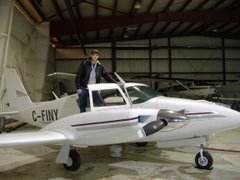
*CHIRP*...................*Chirp* Dang it. I bounced it again. But I know exactly what I did wrong. I'm having trouble nailing down a good landing in the Navajo. I haven't really gotten that much practice lately. The Captain and I usually alternate Pilot Flying duties every flight, but the last two flights that were supposed to be mine the Captain ended up doing the landings because it was fairly gusty with a bit of a crosswind. I'm not complaining, I still don't feel perfectly at home yet in the airplane, and would rather get my practice in on calmer days. Part of it has to do with the fact that I've never flown an airplane from the right seat before, so I have to develop some new muscle memory skill sets. What used to be my throttle hand is now my flying hand, and my flying hand is now my throttle hand. Its also quite a bit bigger airplane than I have experience in.

This time the the reason I bounced all tied back to not having a stable approach. Normal approaches in the Navajo are done at 120 mph, and as we cross the airport fence we pull off the power slowly and let the airspeed bleed off so we're around 110 mph crossing the runway threshold. I'm finding that the Navajo is fairly sensitive to power changes, and it builds speed fairly quickly and doesn't lose it easily. Initially as I turned base I had the airspeed pegged at 120, but I found myself a little high, so I pushed the nose down and pulled off a touch of power, but apparently not enough, and soon enough I found the airspeed way up past 130 - way too fast. I spent the rest of the approach trying to work it back down, and ended up crossing the threshold carrying way too much speed. We floated for a long while in ground effect waiting for it to slow down, until the Captain eventually called me to chop the power cause we would be running out of runway soon. I pulled the power back to idle, and then that resulted in a bit of a firm landing with a small bounce.

That was a couple days ago, and today it was my turn again. This time I made sure I had the airplane properly slowed down and the approach speed and glideslope pegged with lots of time to spare. I made sure I stayed much more aware of my airspeed during power adjustments, and made a decent landing this time with no bounces. Still room for improvement, but we'll get there.

On a separate subject I saw a Twin Comanche doing touch and goes at our airport a few days ago. I couldn't help but stand and watch for a bit. It brought back memories, and made me wish for a few moments that I still had mine. It was just so much FUN.

Thursday, September 8, 2011

Flight Planning

Part of the requirements of our permits that allow us to overfly small communities at low altitude is that we have to notify each town when we'll be overflying them. Part of that involves faxing a map of our flight path off to each town hall as well. So far I've compiled a database of over 100 small communities in our survey block that we've been notifying when our flight for the day takes us over them. Its tedious work to determine when exactly we'll be overflying each town, and which ones. So why put up with tedious monotony when you can write a computer program to do it for you?

I've gone over almost the entire map now, and recorded in a spreadsheet the names of the towns and the line # that runs over top of them. Every flight line in our grid is numbered, and the company geophysicist, who processes our data keeps a spreadsheet list of each numbered line, and how long it is. So after obtaining that, I've written a VBA (Visual Basic for Applications) excel program, and now I can specify the line # we're going to start our flight on, and the time we're going to begin surveying, and my VBA program will chew through my database of communities and the geophysicist's spreadsheet of survey lines, and spit out a list of each town we'll be overflying for that particular flight, and the start and end time of each line we fly. I send that list over to the Captain, and he sends out faxes to each community with the calculated time we'll be flying overhead. Done and done.

Now I don't have to spend hours pouring over the map calculating what towns and when we'll be flying over them. It just takes 10 seconds to get the program to spit me out a list, and if we change our flight plan I've only wasted 10 seconds and not an hour. Its also useful to find out how many lines and line kms we can expect to fly for the day. Its always fun when a hobby like computer programming becomes useful.

Sunday, August 28, 2011

Traffic Awareness

Today was our first day we managed to get two flights done in a single day. Yay for us. Being a Sunday and a beautiful clear day it was also quite busy in the air around the local airports, and we had our hands full tracking all the local general aviation traffic that was up for a Sunday joy-ride.

Despite the heavily populated countryside our survey lines still dictate that we just plow right over top of any local airports in our survey block at the usual 200 ft. The less times we have to break line and go around things the better our data is. Unfortunately overflying airports at 200 ft can provide for some unique safety issues if the airport does have local traffic flying around, so its important to keep in radio contact and keep other traffic informed, as well as have both sets of eyes scanning for traffic.

The Navajo is also equipped with a Zaon PCAS (Portable Collision Avoidance System) unit, and it got a pretty full workout today. I have to say I'm impressed with it. I've seen them before in Aviation shops before but never got to use them, but have always been intrigued by the idea but have been a little skeptical. But I can honestly say this thing is an excellent piece of gear for what you would pay for it.

As far as air-to-air collision avoidance systems go, there a few different levels, all with a different levels of features, and different levels with which they will drain your bank account.

All of these systems are dependent on potential conflict aircraft being equipped with a functioning transponder that will send out return signals after it receives an "interrogation" signal from either a ground radar site, or a special type of transponder (Mode S) from another aircraft. If the other airplane that is about to cross your path doesn't have a transponder, or its not turned on, no system is going to see it - unless of course you're flying a military jet that's equipped with air-to-air radar. The good news is that the vast majority of airplanes do have transponders.

A PCAS system like the one we have in the airplane is entirely passive. It doesn't have the ability to send out its own interrogation signals, but merely listens for the reply signals of other airplanes, and it can plot their position relative to itself that way. Like I said I'm quite surprised how well it works. The major disadvantage to it being passive however is that it is depending on ground radar stations or third party Mode S equipped aircraft to send an interrogation signal and trigger the target aircraft's transponder reply. That means that PCAS is basically useless up north where there is no ground radar coverage. If an aircraft doesn't have its transponder triggered, the PCAS can't see it. For use in medium to high density airspace however, where there most likely is ground radar coverage that can trigger transponders, it has been excellent. The model we have does give relative direction, distance, and altitude with reasonable accuracy. And I've been able to visually spot targets in about the same amount of time it takes me to find traffic when its vocally pointed out by ATC for me.

We happened to buzz by a para-glider who was floating around in the updrafts of some hills, and the PCAS didn't pick him up (no transponder) but his big parachute was easy to spot nonetheless. We probably scared the pants off of him though, haha.

Saturday, August 20, 2011

Rock & Roll!


Well finally after a painfully slow and troublesome start we have had our first actual production survey flight! Surveying in France is not like going up to the Northern Canada Bush and doing a survey job like I have been used to in the 206. The airspace here is incredibly dense.

Surveying in the north involves little more than setting up at the nearest airport, and going flying. Up there you can fly at 200 ft all day every day and no one cares because its just wilderness. Here in France its a little different. We're buzzing towns at 200 ft agl, blowing right over top of local airports, criss-crossing military airspace and even working around a nuclear generating plant. Part of the reason of the slow start was getting all the government permits to do this. Even though we're allowed to fly over top of small towns, we have to notify a half dozen different agencies and organizations every time we fly. That's the boring part.

The exciting part is the actual flying. To be a honest I was wondering if I would be of much use as co-pilot/operator, considering this kind of flying is usually done single-pilot with an unlicensed operator. But after today's flight I felt like I contributed to the flight considerably as co-pilot and not just "operator". The navigating is intense! The entire 4 hr flight I served as navigator while the Captain flew the lines. In Canada if we're surveying and we see a road, that's been an eventful flight. Here, there's so many things to look out for; airports, airplanes, power lines, towers and restricted airspace that we were both kept on our toes. I never thought that anyone would let us fly over built up areas at 200 ft agl, everything about flight training says its not allowed, but surprisingly our permits basically (with lots of fine print) allow us to fly over everything but the larger towns. The flight planning and flying is quite complex, and its going to be a great learning experience. I would never know how to even attempt a job like this on my own, so its fascinating to be involved in the planning and thought process of a pilot who has done this before.

There's lots to see scenery wise as well. We flew past about a half dozen great big French castles, and some cathedrals, and just in general French countryside is very beautiful.

Usually I don't bother to share photos on this blog, but these ones are worth sharing for sure.

Its incredibly warm here though, over 30 degrees C, and one thing I forgot about Pipers is that there isn't nearly enough ventilation for them. Cessnas have those big ol' overhead vents that you can direct at your face, but the Navajo only has little tiny ones like you'd find on an airliner, and then the side storm windows, which give good airflow but are really noisy to open. We're thinking we might buy some flex hose to stick one end out the window into the airflow and the other end down our shirts to keep us cool. I'll report on how that works out if/when it happens.

Monday, August 15, 2011

Navajo Checkout

So I got a little more than half of my Navajo PCC done today in a beautiful warm, calm day. I still need 1.1 hrs more flight training to be considered complete.

I am SO glad to be back into multi-engine flying. Its just so much more fun. We started out with a briefing on the things we planned to cover - all the typical air work stuff like turns, steep turns, slow flight, approach to stall, etc. and then fired the ol' girl up and taxied out. The first take-off went ok, it was both fun and challenging to get back into the swing of a busy take-off roll and climb-out. The biggest error I made was getting distracted after we were airborne with retracting the landing gear and flaps and setting climb power and letting my airspeed decrease too much. Airspeed should always be maintained during the climb-out after takeoff. But that will come as I get more accustomed to the airplane.

Up at altitude most of the air work was a piece of cake, and most of the multi-engine emergency procedures came back to me fairly quickly as well. I was obviously no multi-engine master, but I think I did represent my experience fairly well and looked like someone who didn't have to be taught all over again how to fly a twin.

We went back to the airport for a couple circuits, and although my approach was fairly good, the first landing attempt was pretty ugly. This is no Cessna anymore! Actually the Navajo behaves very similarly to how the Twin Comanche behaves on landing, it just sits much higher off the ground. I think I overcompensated for the high stance and ended up flaring too high, didn't have enough power on into the flare and ended up stalling it onto the runway. Nothing too jolting, but still it was one of those "oh crap add power" moments just as we were touching down.

Unfortunately a few months ago back in the spring, the Company tried to hire a pilot for the Navajo, but unfortunately he couldn't really get the hang of the airplane and during training he put it down hard and did many thousands of dollars of damage to the landing gear. I think that is still in the back of everyone's mind and is still a bruise to the company wallet, so the pressure is on both for me, and for my training Captain not to let the same thing happen again.

My second approach I was feeling that pressure. In mind its acceptable to not grease your first attempt at landing a new aircraft, so there's really not a whole lot of pressure there as long as you don't panic and over-control and do something stupid. But the second attempt you had better have learned. I was feeling the pressure on final for our second landing. My approach was perfect - nice and stabilized, my target airspeed was pinned, and I had a good power setting and glideslope going in. Even still I had a moment where my heart started beating and I was thinking "Don't screw this up!". I actually don't remember when was the last time in my professional career that I felt the pressure like that. Luckily I did have the advantage of a perfectly calm day, and I managed to overcome any anxiety and make the touchdown a pretty good one (of course there is much room for mastery yet). The Captain seemed happy, so we taxied into the fuel pumps and shut down. He didn't say much about anything, which I interpret as meaning I did a good job, and I was fairly satisfied with my performance. You always have to be sparing with the praise when you're dealing with pilots, otherwise our heads swell and it makes it difficult to fit into the cockpit.

Ego's are a difficult thing to manage when two pilots are working together. Unfortunately I have almost zero experience working side-by-side with other pilots. My jobs prior to now have been single-pilot affairs, so I pretty much got to be the one and final authority in the airplane. If I made a small mistake, no one would notice and I wouldn't look stupid to anyone. But also I didn't have the advantage of spending mass amounts of time watching a more experienced pilot do his thing. All my experience up until now has been born out of personal lessons I've learned and experience from being Pilot-in-Command and I've had very little influence from watching more seasoned pilots. This is one thing I'm actually really looking forward to - getting to tag along as First Officer with a high-time pilot to see how he does things. Its also going to be a challenge as well though, because now there are two ego's in the cockpit, and a first officer has to walk a fine line between challenging the Captain's ego, and safely managing his human side (that can sometimes make mistakes) to contribute to a safer flight. Its going to be especially challenging because this is the first time the company is implementing two-crew SOPs (standard operating procedures) for the Navajo, so up until now my Captain has been accustomed to flying the airplane all by himself (as have I in the airplanes I've flown), so giving up a little bit of control and trusting the guy next to you is going to be a bit of a change for both of us.

Sunday, August 14, 2011

Happy Days!

Well since my last post I have trained a new pilot to replace me on the 206, gone on vacation to visit The Lovely Girlfriend in the merry old land of Auz, and now I'm once again deployed - to France this time! France is quite beautiful, I just wish I could speak the language a little better, as we're located in a fairly small town and not many people speak English. My French is improving though.

HOWEVER, I mentioned I trained a pilot to replace me on the 206 because I am finally being promoted to co-pilot on the company Navajo! Finally a twin job! Whoo hoo!! Part of the deal with the upgrade is that I also have operator duties, so I've been trained on that already, and I'm now in the midst of writing the PA-31 type exams for the Navajo. Let me tell you in comparison to all the other aircraft I have flown since now, the Navajo is like a REAL airplane. It has a very detailed Flight Manual (which I've been buried in the last couple days), lots of power with the ability to go really high in the form of two 325 HP turbocharged piston engines (More than double the power of any other airplane in my logbook), an air-stair door, copilot flight instruments, and an overhead switches panel (I've always thought that to be one of the defining aspects between "real" airplanes and "little" airplanes.

The Twin Comanche being the only other Twin I've flown before the Navajo, naturally I have some comparisons of the two airplanes: In one sense they're very similar. They have the same wing shape, the engine positioning is the same, and actually looking out the side window at the wings and engines is very much Deja Vu to the Comanche. The engines and wing have the same proportions, the Navajo is just scaled up a little bit. The engine start procedures are basically the same between the two airplanes, so I'll be at home there, and the approaches for landing are even made at the same airspeed (110 mph). The Twin Comanche, although a slightly slower and less powerful airplane, actually has a slightly higher Vmc (minimum speed at which the airplane can be controlled with a failed engine), and that is mainly what dictates what speed you can fly the approach at. The only thing I think may take some getting used to is the stance the Navajo has on the runway. The Navajo sits fairly high in comparison, while the Comanche was a true low-rider. I'm going to have to develop a new sense for when to start my flair for landing and touching down. But, realistically I'll have lots of chance to develop that because most of the takeoffs and landings will still be done by the Captain. I am just the co-pilot after all. In the other sense of comparison, the Navajo is built and flown like a transport category aircraft. Its solid and the engines need to be operated in a very precise, by the book way otherwise cylinders start cracking and things wear out too fast. The Twin Comanche on the other hand is really just a small private airplane with two engines. It doesn't have a proper flight manual, and other than some of the flight characteristics that were a little bit tricky in comparison to other private airplanes (due to the wing design and high Vmc), the engines were still just your typical Cessna 172 engine. A simple little 4-banger. Overall the Navajo is definitely a step up, but I think my experience in the Twin Comanche will go a long way in helping to prepare me for flying the Navajo.

Hopefully in the next couple days we'll get the flying portion of my Navajo checkout done, and I can officially call myself a Navajo pilot! After that, because of the mass amounts of PIC flight time I've already accumulated and my Twin Comanche multi-PIC time, I'll be eligible for the upgrade to Captain as soon as I get 250 hrs on type.

When I get my checkout done, I'll post again on my experiences in learning to fly the Navajo, because until now I've only flown a few times in it as an Operator, and I have to get the exams finished first before I start the flying portion of my checkout.

Wednesday, June 15, 2011

Crosswinds & Rudolphs

Yesterday I laughed when my new-to-fixed-wing-ops operator had a chance to cut his teeth as a small aircraft passenger and had a moment of sheer terror on takeoff. These last couple days the winds have been fairly strong and blowing pretty much across the one gravel runway where we are. Yesterday's flight was no exception. I pulled out onto the runway and started my takeoff roll with a 16 knot crosswind from the left. Just before I rotated and lifted off he lowered his head to look down at something on his display screen, when he looked up a second later, I had just gotten airborne and let the nose of the aircraft weather-vane into the wind, and was skimming the runway 10 ft off the ground while I accelerated in ground effect to my climb out speed. For the non-pilots, with a strong crosswind like that the result is the airplane tracking straight down the runway, but pointing sideways in a crab angle. My operator looked up out his side window to look straight down the runway with it scrolling beneath him. For that one second he thought we were about to crash and start cartwheeling down the runway. It was a bad sense of timing on his part to look up if he wasn't familiar with how the airplane reacts in a crosswind takeoff. I had to laugh at his moment of terror. I have to give him credit though, other than that short moment of terror he hasn't expressed any other moments of terror, and has just trusted me and let me do my thing.

**Disclaimer: These next paragraph's may be tedius and uninteresting to those not interested in the technical side of aviation, but I have more non-technical stories coming. Scroll down to the line of # signs to skip my technical babbling.

Personally I've been enjoying the crosswind landing practice. The winds have stayed pretty much around 15 kts at 90 degrees to the runway, so they haven't been strong enough to make the takeoff's hairy, but just strong enough to keep it a challenge and make me work for a smooth departure and arrival. Normally between takeoffs and landings, a good landing is more of a challenge, but I've found in strong crosswinds its actually reversed. I find crosswind takeoffs more difficult to accomplish smoothly than crosswind landings. On strong crosswind takeoffs good rudder pedal control is key. On the initial acceleration when most of the weight is on the wheels, I find the airplane has a tendency to be pushed by the wind to the downwind side of the runway. Proper aileron position on takeoff is to start turning into the wind and then slowly neutralize the ailerons as you accelerator. However since ailerons are an aerodynamic control, on the initial acceleration there's not enough airflow over them to affect directional control of the airplane. Therefore to counteract the wind pushing the airplane to the downwind side of the runway, you have to steer into the wind with the nosewheel (controlled by rudder pedals).

As you accelerate however, and aerodynamic control increases with the increased airflow, steering into the wind with the nosewheel/rudder begins to work against you, because the weight on the wheels lightens, which reduces the effectiveness of the nosewheel, and the effectiveness of the rudder increases with the increased airflow. Now with the rudder turning you into the wind you're now compounding the problems you start to have with weather-vaning, which is the effect of a crosswind exerting force on the tail and causing the nose to pivot TOWARDS the wind.

So as the airplane accelerates and you're fighting the crosswind trying to push you downwind, as you accelerate and airflow around the airplane starts to increase, the airplane starts to weather-vane which starts to pull you upwind, in the OTHER direction. This change can catch you by surprise if you're not ready for it. At the point where this change starts to happen, which can be very quickly, you have to REVERSE your rudder pedal input from steering the aircraft upwind, and start counteracting the weather-vaning effect by steering with the rudder DOWNWIND. Its at this moment the ailerons really start coming into play. This whole time you've been steering with the ailerons into the wind, which hasn't really had an effect until now, but now this causes the airplane to want to bank. This is a good thing, because without banking into the wind, your rudder control, which is counteracting the weather-vaning, would cause the airplane to drift back downwind and off the side of the runway.

So now that aerodynamic control is in effect, you have to counteract weather-vaning with rudder to the DOWNWIND side, but you have to counteract your rudder steer with aileron to the UPWIND side. This in effect puts the airplane into what we call a "slip", which is essentially flying sideways. We want the airplane to fly sideways at the exact opposite angle that the wind is trying to push the airplane sideways. In theory these two sideways effects cancel each other out and we end up tracking perfectly straight down the runway without the wheels skidding along the runway surface.

So in effect, when we're taking off, we start steering with our feet one way, and at a critical point reverse that steering in the opposite direction, and at the same time begin to balance that steering with aileron control with our hands. What actually ends up happening, while we're in our slip maneuver but still not fast enough yet to become airborne, is we end up going up on one wheel and rolling down the runway perfectly balancing on that single wheel, with the nose wheel and downwind main wheel lifted off the ground.

This "wheelie" is a side effect of a slip manuever, which is straight flight that is "banked" or leaning into the wind. We're only in this state for a few seconds, between the point the airplane is sufficiently aerodynamic to cause a bank, and the point where we're going fast enough to actually leave earth altogether. Despite the brief time, is quite fun to go rolling down the runway in this balancing act. Once we're airborne, we're free of the burden of making sure the wheels are tracking straight, and we can then neutralize all controls, at which point the airplane yaws sideways, weather-vaning, and we accelerate to climb out. Even though at this point the airplane appears to be flying sideways (and may be very scary looking for new-to-fixed-wing-ops operators), from an aerodynamic sense its actually flying straight (not in a slip), and thats a more efficient way for the airplane to fly, which is a good thing when we're trying to generate lots of lift and very little drag as we climb out.

My experience has been that even in very strong crosswinds the wheelie effect is an experience unique to high-wing airplanes that have narrow-stanced landing gear. Low wing airplanes like a Cherokee 6 or Twin Comanche that have a wider landing gear stance don't typically do this because the aerodynamic force required to lift the one wheel is much greater when the stance is wider, so usually they end up just rolling down the runway and then lifting off, without the whole "wheelie" phase. Its not nearly as dramatic, but sometimes it can be just as challenging to make a smooth and safe crosswind takeoff.

The same "wheelie" maneuver comes into play during a crosswind landing as well, for the very same reasons, although its much easier to hold it for longer periods during landing, because we're not in a mad dash to accelerate, but more in a slow, controlled deceleration back to earth. I remember one of my old instructors used to make his commercial students do a crosswind touch and go landing and takeoff, while only ever letting one wheel touch the ground. We had to land in the wheelie, and balance it there while we accelerated again to takeoff.

I remember way back in flight school, before I had even soloed, and before I fully mastered the muscle memory required for the right input at the right time, I had a few scary moments practicing takeoffs (even in light crosswinds fit for a student). I'd start to drift off to side of the runway because my control inputs weren't correct, at which point I would freeze, because I wasn't grasping what was happening. Thanks to my instructors who were always vigilant and quick to take over and provide instruction. Primary flight training is filled with exciting moments of terror, when you know things are going quickly wrong, but you're not quite skilled enough to recognize it and correct the problem, lol. Kudos to all the instructors out there who bail their students out like that and are still ready to get into the airplane again for the next lesson.

#######################

Ok, so some stories now of a different nature. Today we started work on the survey block we were flying before my break. When I came back the clients were anxious to finish the other one first, so we flew that one, but now we're back to our original one. This second one is further inland... and HOLY CARIBOU BATMAN!! I've never seen so many caribou in my entire life. Apparently the migration has just finished, so they're all just chilling out. Up until today I can count the total number of caribou I've ever seen on 1 hand. After today the number is in the triple digits. Before it was the highlight of the flight if we saw one. But after 10 minutes into our flight today, we stopped counting, and didn't even bother to point them out anymore. They were all over the place. There were 2's and 3s all over the place, a number of small herds numbering between 8-15, and then we even flew over a herd that probably numbered between 30 and 40. It was quite the site, the sheer vastness of the open land with caribou spotting the landscape everywhere you could look.

Also, I've come to realize that there are differing opinions amongst the caribou over what should be considered imminent danger. It was pretty funny actually. Most of the caribou we flew over we hear us coming and kind of hustle out of the way. Others would half heartedly get up if they were laying down, you know "just in case" I guess. While others would run like it was the end of the world. I laughed out loud when I saw a small group of 5 that we flew over. Four of them were laying down on the tundra, and didn't even bother to get up when we flew over. The fifth in the herd was convinced we were death from above. He went running for dear life (pun not intended), just blasting right past the other 4. The rest didn't budge, but just watched him run past like he was an idiot. I could just imagine the dialogue:

Blitzen: "RUN FOR YOUR LIVES!! RUUUUN!!"

Comet: "Relax you idiot, they've been flying over us all day"

Blitzen, who now stops running: "Oh."

It was quite comical to see the different reactions. There was another one who panicked just a little too late, and got up to run, but he wasn't sure which direction to go because we were directly overhead. He just ended up deeking back and forth until I lost sight of him behind us.

It was also interesting to watch them run flat out on the tundra. The tundra surface, although generally flat, is incredibly rocky and uneven. Yet the caribou would goose step around all the stones and rocky ground and splash through the puddles like nothing. I consider myself fairly athletic, but if I tried to run flat out on that terrain, I'd end up tripping on a rock and smashing my teeth out or rolling my ankle in no time flat. It was quite impressive.

We also saw many young colts, some probably less than a month old. They stuck to their mother's heels like little ankle-biters as she hustled away from us. It was interesting to note that all of the young ones are a much darker colour than the grown caribou, which are kind of an off-white tan colour. My theory is that calves are born in the spring, when there is no snow and the land is brown, so they blend into the summer terrain. Grown caribou camouflage better in the snow with their lighter colour. Any expert's opinion welcome.

We should be finished up here soon, and then we have another very short job in Ontario again on our way to Northern Quebec.