Nov 23, 2009
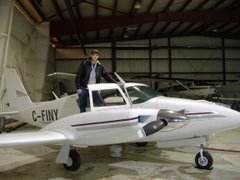
Currently I’m riding the train south. The Cherokee is finally fixed, so I’ll stay down south for the night and then fly it back in the morning. I’m looking forward to logging a few more hours in the Cherokee. Not because I need Cherokee hours, but because its just a more pleasant airplane to operate, and I have a bit of an attachment to it after 700 hrs.
Last night I had an OPP officer knock on my door at about 6 PM. It was rather unexpected, and as I answered the door I tried to quickly scroll back through my mind to try to find the reason they were at my door. I didn’t REMEMBER doing anything illegal. They were actually here for a favour. The officer had a guy with her, and she explained that he had a family emergency, and needed to get to Toronto ASAP. He was wondering if I could fly him in the Comanche. He was visibly upset, and mentioned that he had a significant amount of money on his VISA to cover the fuel costs. I told them I would if I could, but I’d have to check the weather first, and clear it with my employers, so if I got stuck somewhere they’d know where I was. It sounded like it was going to be a long night; it would have been an easy 6 hr round trip, so if I was airborne by 7, I probably wouldn’t be back until close to 2 AM.
I got some stuff together and took a good look at the weather. I’m still not Instrument rated so as always I’d have to make the trip VFR, which can be problematic this time of year for covering such a large distance, especially at night, where scud running (very low level flying) isn’t so safe. There was fog forming all across my route. Fog is still probably the single biggest thing that scares me. Strong winds can be handled, thunderstorms can be flown around or navigated through with the Stormscope, its tough to land if you can’t see the runway through fog, let alone even see the fog at night. I had to call the poor guy and let him know I couldn’t do it. I felt bad, I’m not sure what his emergency was, I didn’t ask and it was none of my business, but he seemed pretty desperate to get to Toronto.
As I went to bed I wondered if we could have at least tried the flight, but then images of being stuck in the dark cold night above a layer of fog unable to land, and I decided that I’d rather be curled up in bed like I was.
-------
Back home now, safe and sound, and one day later. I stayed the night last night, and then spent most of the day killing time waiting for the weather to clear, as I woke up with ceilings on both ends of my route at 200 ft agl. Finally as daylight was running out today the ceilings lifted JUST enough for me to give it a go. I spent a good part of the flight flogging through poor visibility, but both the ceilings and visibility got better as I got further north and the ground fell away below me.
Once again I get to sleep in my own bed.
Tuesday, November 24, 2009

Friday, November 20, 2009
Boat Hunting
I've been playing airliner service for the last couple days. I've had 3 trips so far that has involved taking a load of freight up the coast, unloading, installing the seats, taking a group of people further north, dropping them off, picking up more, heading back south to my original stop, dropping THOSE people off, and then taking more people on my final leg back south. There's been a lot of people wanting to move around lately.
Today was no exception. There was supposed to be fog this morning, but there was none out my window when I woke up. The GFA weather map was also indicating low cloud/fog all the way up the coast, however standing on the ground andn looking to the north there was no visual indication of anything. I shrugged, the weather forecast is often wrong, its so tough to make a prediction with so few weather stations.
So I took off with my load of pop and chips and 4 seats stuffed into the back and headed north. It turned out that the GFA was sort of half right, and I ran into the forecast layer of low cloud about 20 miles south of my first stop, and long story short I got the trip done, but we called it quits when I got back because we were picking up some airframe icing along most of the route.
So I went home, used the time to do some shopping and make some lunch. About an hour later my boss came by to go for a local flight. Apparently some mischievious kids untied some boats by the river, and they got carried away by the tide. We were being chartered to take a flight up and down the river to see if we could locate them. One of the locals who had lost his boat came with us, and I also took along our co-op student who's been working with us this semester as a spotter. Our co-op student and I took one truck to the airport to get the plane ready while my boss took another truck to pick up the client.
As they pulled up I turned around to greet the client, and he looked at me in disbelief and said, "How old are you?" Lol. I confidently answered that I'm 24. My answer didn't seem to put him at ease. Personally I don't think 24 is young at all to be doing this job, but the general public would seem to disagree. I take it as a compliment usually when people ask my age or mention/insinuate that I'm young to be a pilot. After we had all gotten seated and strapped in he asked me how long I've been flying. I told him I'd been flying for 8 years now, to which he relaxed and chuckled, "So you've been flying since you were 16? Heh heh, ok now I trust you.". Although I haven't been a professional pilot yet for 8 years, it wasn't a lie. I signed up for flying lessons soon after my 16th birthday. I could have told him how much flight time I had, but I find for most people uninitiated in the aviation world a total of hours doesn't mean much, since they don't really have any comparison.
It was a little warmer then up the coast, so icing wasn't an issue for the flight, but we were still stuck crusing around at 400-500 ft through misty conditions. It wasn't a great day for sightseeing, but finding boats was somewhat time-sensitive, considering the river current could potentially carry them out into the bay, where they'd be gone for good - forever consigned to roaming the vast emptyness of open water. Six boats had washed away. We found 2 right away that had floated into a small island inlet. Several trips up and down the river, and out to the bay didn't turn up the other four unfortunately. Too bad, when we took off I was fully expecting that we'd recover all of them. I guess not. I sure don't want to be those kids if they ever find out who did it, if it was my boat that got lost I'd be ready to skin them alive.
Today was no exception. There was supposed to be fog this morning, but there was none out my window when I woke up. The GFA weather map was also indicating low cloud/fog all the way up the coast, however standing on the ground andn looking to the north there was no visual indication of anything. I shrugged, the weather forecast is often wrong, its so tough to make a prediction with so few weather stations.
So I took off with my load of pop and chips and 4 seats stuffed into the back and headed north. It turned out that the GFA was sort of half right, and I ran into the forecast layer of low cloud about 20 miles south of my first stop, and long story short I got the trip done, but we called it quits when I got back because we were picking up some airframe icing along most of the route.
So I went home, used the time to do some shopping and make some lunch. About an hour later my boss came by to go for a local flight. Apparently some mischievious kids untied some boats by the river, and they got carried away by the tide. We were being chartered to take a flight up and down the river to see if we could locate them. One of the locals who had lost his boat came with us, and I also took along our co-op student who's been working with us this semester as a spotter. Our co-op student and I took one truck to the airport to get the plane ready while my boss took another truck to pick up the client.
As they pulled up I turned around to greet the client, and he looked at me in disbelief and said, "How old are you?" Lol. I confidently answered that I'm 24. My answer didn't seem to put him at ease. Personally I don't think 24 is young at all to be doing this job, but the general public would seem to disagree. I take it as a compliment usually when people ask my age or mention/insinuate that I'm young to be a pilot. After we had all gotten seated and strapped in he asked me how long I've been flying. I told him I'd been flying for 8 years now, to which he relaxed and chuckled, "So you've been flying since you were 16? Heh heh, ok now I trust you.". Although I haven't been a professional pilot yet for 8 years, it wasn't a lie. I signed up for flying lessons soon after my 16th birthday. I could have told him how much flight time I had, but I find for most people uninitiated in the aviation world a total of hours doesn't mean much, since they don't really have any comparison.
It was a little warmer then up the coast, so icing wasn't an issue for the flight, but we were still stuck crusing around at 400-500 ft through misty conditions. It wasn't a great day for sightseeing, but finding boats was somewhat time-sensitive, considering the river current could potentially carry them out into the bay, where they'd be gone for good - forever consigned to roaming the vast emptyness of open water. Six boats had washed away. We found 2 right away that had floated into a small island inlet. Several trips up and down the river, and out to the bay didn't turn up the other four unfortunately. Too bad, when we took off I was fully expecting that we'd recover all of them. I guess not. I sure don't want to be those kids if they ever find out who did it, if it was my boat that got lost I'd be ready to skin them alive.
Wednesday, November 11, 2009
Windy Days, Long-Windedness, and World Wars
Happy Remembrance Day everyone. I hope you all had time this morning and did better than me to pause for our veterans. I missed my chance at 11:00 AM to give a minute of silence, as I was loading the airplane and pre-flighting for my first flight of the day and 11 AM slipped right past me. As I taxiied out I checked my watch to record the time up and it was 11:11. I guess the 11th minute of the 11th hour of the 11th day of the 11th month will have to do. I sat at the end of the runway lined up and ready to go, the engine idling, as I gave a moment to ponder our veterans of the 2 World Wars. I could only manage 15 seconds before I had to cut it short because there was an Embraer 110 on final behind me closing fast.
It was windy today. Very windy. Gusts on the surface started out strong, and got stronger as the day went on, but I was lucky in that the wind direction was lined up within 10 degrees of the runways on both ends of the flights, so I didn't have much crosswind to wrestle with. But it did mean I had almost a direct crosswind for the cruising portion of the flights. It was quite fun actually, the upper winds were pushing 50-60 knots, which meant my wind drift was almost 30 degrees. You always have at least a few degrees of drift (the angle between the heading of the airplane and the actual path its travelling), but I don't think I've ever had as much as I did today. When flying I find it difficult to wrap my mind around pointing the airplane 30 degrees to one side of where I actually want to end up. Its unintuitive to keep where you want to go that far away from directly in front of you. Once I had the airport in sight I had to resist the urge to steer directly towards it.
Since the winds were so strong I couldn't resist the chance to see if I could slow the airplane down, and turn it into the wind to see if I could stop the airplane in midair altogether. The slowest I managed was 8 knots groundspeed on the GPS, which pretty much looks and feels like a standstill looking out the window. The 206 with its Robinson STOL kit can land and stop in an impressively short distance to begin with, but today with the winds I could have it down and stopped in under 100 ft with full flaps and a nice slow approach speed. What fun!
The high winds picked up as the day went on as a result of a low pressure system moving in from the north. I could see the weather system moving in on on the trip before, the winds were getting quite strong, and we were pretty much out of daylight, so when I taxied in I figured we call it day. Normally we would have called it quits, but the next load included some electrical supplies, which HAD to be there that night. Apparently there was an electrician that had been flown up the coast and he was leaving the next day, so I agreed to brave the winds, rain (which didn't turn out to be that bad), and darkness to get the job done. Technically we're a day only operation, but we can fly the airplane just like a private operator for repositioning flights and such when there isn't any paying passengers or freight onboard. So I had to make it up north with the load before official night-time, and the flight on the way back which would be empty would be legal to make.
It made me think about the idea of managed risk. Its the essence of commercial aviation. In one sense you always want to mitigate the risk as much as possible, but at the same time there is a job to do, and customers that are counting on you. Private pilots have the luxury of just deciding not to go flying if the weather isn't exactly how they like it, but its a bit more of a delicate balance with commercial aviation. In this case NORMALLY we wouldn't have made the flight, cause they can usually wait a day or two for more pop and chips, but today they couldn't wait on the electrical supplies - at least not without incurring a great deal more expense. So I thought about where do we draw the line? By doing the flight both the company and myself were exposing ourselves to a certain amount of MORE risk/danger than usual, but we were still charging the same amount for the trip, and the consequences would still be exactly the same if I bent up the airplane (ie. expensive repairs/possible injury). So why did we make an exception for this flight? At first it seemed like we should decide on an acceptable level of risk and never cross that line under any circumstances, regardless of the urgency. If the immediate rewards were still the same (in the form of X number of dollars paid for completing the trip), why increase the risk?
I came to the conclusion that its not always that simple. Sometimes its just good business sense to increase the acceptable level of risk in certain conditions. Like I said, the essence of commercial aviation is to manage the risk, not to cap it. In that case I was still very sure I could make the flight safely, as was my boss, so that temporary increased risk was worth the reward, intangible as it may be, of proving ourselves able to be counted on by our customers. From a business standpoint that makes the difference. If it was just another usual pop and chips run that could wait, it wouldn't make sense to expose ourselves to the increased risk, because it wouldn't make such a big impression on the customer. But when it mattered to the customer, it mattered that we came through, and as a result will be around for that customer to call on us again to use our service. Safety is always counter balanced by running a viable business. If we cancelled flights too much out of "safety", the company would go under eventually. In the other sense, running a viable business also to some extent contributes to safety. If a company crashed or bent up an airplane every week it wouldn't take long to go bankrupt. Obviously there's a threshold where it just isn't worth the risk, but that threshold can be different for every flight.
I joked once that I was going to start up a competing company to the one I work for now. My fleet would comprise of Cessna 150's cause they're cheap (I'd operate them two-crew, for safety of course). That way in addition to not doing any sort of maintenance whatsoever, and hiring extremely low time pilots at minimum wage, I'd be able to offer much lower prices than my competitors. When an engine seized up or a wing fell off out of lack of maintenance and crashed in the bush I'd just buy another Cessna 150 and hire a couple more pilots. Its the perfect business plan... right? Anyways back to the serious discussion.
Flying freight in higher-risk situations is one thing, but what about exposing passengers to increased risk? That can sometimes be a tricky situation. When I'm flying freight the only one that's exposed to that higher level of risk is me, and I have the ultimate go/no decision, and I'm well aquainted with the level of risk for that particular flight. Not so with passengers. Most passengers would have no idea of the level of risk that they're being exposed to, and generally trust 100% that they're not being put in harms way. Luckily I found however, is that MOST of the time that works itself out, simply by the fact that flying in weather that increases the the level of risk an appreciable amount, is weather that is far beyond the level where most passengers would be scared crapless. Usually when its a passenger trip with questionable weather we cancel the flight out of fear that the passengers would be airsick, or scared crapless, or otherwise be convinced we're crazy to go flying (and choose not to fly with us again) long before we'd cancel the trip out of a genuine risk to safety. So in that sense consideration for our passengers' sanity (so they DO fly with us again) generally prevents the need to asses the actual risk to safety.
I'm essentially separated from the business side of the decisions, so I never have to weigh the safety vs. the business gain. Its a good thing, I've come to realize a long time ago I'm not a very good businessman. My job is JUST being the pilot. Somebody else gets to decide whether or not it would make good business sense to try to attempt the flight. That doesn't mean my fate is left to someone else though, or that I just skip the decision making process altogether. My job IS the pilot. Its still my right and responsibility to consider whether "I" think I can do it safely or not. I don't have to consider the business ramifications however, my decision is based almost entirely on if I'm gonna come back alive or not. In practice however most of this is all just theory, because my employers are ALL pilot's themselves, so they can generally make a pretty good decision all on their own, with the exceptions that sometimes they need input from me on current weather conditions (since they can't see it for themselves from the airplane) and my particular skill-level (although by now they know my skill-level fairly well).
So that was my thought process provoked by the flight today. Writing it down may have been long-winded and far too over-analytical for the actual importance of the event, but I won't apologize. Its my blog.
It was windy today. Very windy. Gusts on the surface started out strong, and got stronger as the day went on, but I was lucky in that the wind direction was lined up within 10 degrees of the runways on both ends of the flights, so I didn't have much crosswind to wrestle with. But it did mean I had almost a direct crosswind for the cruising portion of the flights. It was quite fun actually, the upper winds were pushing 50-60 knots, which meant my wind drift was almost 30 degrees. You always have at least a few degrees of drift (the angle between the heading of the airplane and the actual path its travelling), but I don't think I've ever had as much as I did today. When flying I find it difficult to wrap my mind around pointing the airplane 30 degrees to one side of where I actually want to end up. Its unintuitive to keep where you want to go that far away from directly in front of you. Once I had the airport in sight I had to resist the urge to steer directly towards it.
Since the winds were so strong I couldn't resist the chance to see if I could slow the airplane down, and turn it into the wind to see if I could stop the airplane in midair altogether. The slowest I managed was 8 knots groundspeed on the GPS, which pretty much looks and feels like a standstill looking out the window. The 206 with its Robinson STOL kit can land and stop in an impressively short distance to begin with, but today with the winds I could have it down and stopped in under 100 ft with full flaps and a nice slow approach speed. What fun!
The high winds picked up as the day went on as a result of a low pressure system moving in from the north. I could see the weather system moving in on on the trip before, the winds were getting quite strong, and we were pretty much out of daylight, so when I taxied in I figured we call it day. Normally we would have called it quits, but the next load included some electrical supplies, which HAD to be there that night. Apparently there was an electrician that had been flown up the coast and he was leaving the next day, so I agreed to brave the winds, rain (which didn't turn out to be that bad), and darkness to get the job done. Technically we're a day only operation, but we can fly the airplane just like a private operator for repositioning flights and such when there isn't any paying passengers or freight onboard. So I had to make it up north with the load before official night-time, and the flight on the way back which would be empty would be legal to make.
It made me think about the idea of managed risk. Its the essence of commercial aviation. In one sense you always want to mitigate the risk as much as possible, but at the same time there is a job to do, and customers that are counting on you. Private pilots have the luxury of just deciding not to go flying if the weather isn't exactly how they like it, but its a bit more of a delicate balance with commercial aviation. In this case NORMALLY we wouldn't have made the flight, cause they can usually wait a day or two for more pop and chips, but today they couldn't wait on the electrical supplies - at least not without incurring a great deal more expense. So I thought about where do we draw the line? By doing the flight both the company and myself were exposing ourselves to a certain amount of MORE risk/danger than usual, but we were still charging the same amount for the trip, and the consequences would still be exactly the same if I bent up the airplane (ie. expensive repairs/possible injury). So why did we make an exception for this flight? At first it seemed like we should decide on an acceptable level of risk and never cross that line under any circumstances, regardless of the urgency. If the immediate rewards were still the same (in the form of X number of dollars paid for completing the trip), why increase the risk?
I came to the conclusion that its not always that simple. Sometimes its just good business sense to increase the acceptable level of risk in certain conditions. Like I said, the essence of commercial aviation is to manage the risk, not to cap it. In that case I was still very sure I could make the flight safely, as was my boss, so that temporary increased risk was worth the reward, intangible as it may be, of proving ourselves able to be counted on by our customers. From a business standpoint that makes the difference. If it was just another usual pop and chips run that could wait, it wouldn't make sense to expose ourselves to the increased risk, because it wouldn't make such a big impression on the customer. But when it mattered to the customer, it mattered that we came through, and as a result will be around for that customer to call on us again to use our service. Safety is always counter balanced by running a viable business. If we cancelled flights too much out of "safety", the company would go under eventually. In the other sense, running a viable business also to some extent contributes to safety. If a company crashed or bent up an airplane every week it wouldn't take long to go bankrupt. Obviously there's a threshold where it just isn't worth the risk, but that threshold can be different for every flight.
I joked once that I was going to start up a competing company to the one I work for now. My fleet would comprise of Cessna 150's cause they're cheap (I'd operate them two-crew, for safety of course). That way in addition to not doing any sort of maintenance whatsoever, and hiring extremely low time pilots at minimum wage, I'd be able to offer much lower prices than my competitors. When an engine seized up or a wing fell off out of lack of maintenance and crashed in the bush I'd just buy another Cessna 150 and hire a couple more pilots. Its the perfect business plan... right? Anyways back to the serious discussion.
Flying freight in higher-risk situations is one thing, but what about exposing passengers to increased risk? That can sometimes be a tricky situation. When I'm flying freight the only one that's exposed to that higher level of risk is me, and I have the ultimate go/no decision, and I'm well aquainted with the level of risk for that particular flight. Not so with passengers. Most passengers would have no idea of the level of risk that they're being exposed to, and generally trust 100% that they're not being put in harms way. Luckily I found however, is that MOST of the time that works itself out, simply by the fact that flying in weather that increases the the level of risk an appreciable amount, is weather that is far beyond the level where most passengers would be scared crapless. Usually when its a passenger trip with questionable weather we cancel the flight out of fear that the passengers would be airsick, or scared crapless, or otherwise be convinced we're crazy to go flying (and choose not to fly with us again) long before we'd cancel the trip out of a genuine risk to safety. So in that sense consideration for our passengers' sanity (so they DO fly with us again) generally prevents the need to asses the actual risk to safety.
I'm essentially separated from the business side of the decisions, so I never have to weigh the safety vs. the business gain. Its a good thing, I've come to realize a long time ago I'm not a very good businessman. My job is JUST being the pilot. Somebody else gets to decide whether or not it would make good business sense to try to attempt the flight. That doesn't mean my fate is left to someone else though, or that I just skip the decision making process altogether. My job IS the pilot. Its still my right and responsibility to consider whether "I" think I can do it safely or not. I don't have to consider the business ramifications however, my decision is based almost entirely on if I'm gonna come back alive or not. In practice however most of this is all just theory, because my employers are ALL pilot's themselves, so they can generally make a pretty good decision all on their own, with the exceptions that sometimes they need input from me on current weather conditions (since they can't see it for themselves from the airplane) and my particular skill-level (although by now they know my skill-level fairly well).
So that was my thought process provoked by the flight today. Writing it down may have been long-winded and far too over-analytical for the actual importance of the event, but I won't apologize. Its my blog.
Thursday, November 5, 2009
Just One of Those Days
We had 4 inches of snow last night. I had some flights I was supposed to do in the morning around 8:30, but the boss said if the weather doesn't look great when I wake up just go back to bed. Sounds good to me. Sure enough as my alarm went off this morning I got up and peaked out the window. I was surprised to see the winter wonderland out the window, but it didn't look to good for flying. Just to be sure I checked the weather reports, and they confirmed the Mark 1 Weather Observation System (aka living room window), so I crawled back under the gloriously warm blankets.
About an hour or so later the boss knocked on my door as per usual and said the weather's looking better, so to be ready in a half hour. We were supposed to have a couple freight trips, but we didn't end up getting all of the freight for one of the trips, so that's been pushed till tomorrow, so I just had the one, and then I had one pax trip after the train arrived in the afternoon.
The Cherokee is down south for maintenance, so I'm flying the C206 in the meantime. I've got almost 50 hrs in it now, and its starting to grow on me, but I think I still like the Cherokee a better. The 206 is just so awkward to climb into. You have to move the seat all the way back, then climb in by vaulting off the tire, and somehow squeeze your feet through the 6" space between the seat and the front of the door openning. Then you have to slide the seat forward, watching that you don't tangle your feet in the dangling headset wires in the process. Before you do that however you have to latch the back cargo door, which can only be done from the inside. Not a big deal if you have a full load of passengers, you can just get them to do it, but if the back of the airplane is all loaded up with freight you have to go in from the front door, somehow reach across the airplane through/over the baggage, feel for the handle, and latch it (you'll have to do that again to unlatch it). Boarding was not a top priority on the engineer's design features for Cessnas.
We got out to the airport, and thankfully it was still well below zero the snow was dry and fluffy so it was just a matter of pulling the wing covers off and then brushing off the rest of the airplane. No scraping ice. We also ended up waiting 15 min or so for the freight to be delivered out to the airplane, so I got a chance to brush the snow off the Twin Comanche as well. Better to do it now than when it warms up a few degrees and turns crusty. The first trip was uneventful. After I came back we still had a couple hours until the train came in so I had a chance to go home and get something to eat before I headed out for my second trip.
The second trip was two adults, both large people, with a baby and a small toddler, and a TON of stuff. It was awkward stuff to pack too. Things like a shovel, a baby basket and a sled as well as the usual boxes and bags. Finally we managed to pack it all in and squeeze the doors shut. The packing job was a work of art. Next came loading the passengers in from the other door. I keep my flight bag in between the two front seats, but that presents a problem for the front seat passenger in boarding since he has to climb over the pilot seat into the front right seat, so I pulled my bag out and put it on the ground beside the airplane. I'll throw it back in after my front passenger has boarded and then I'll be the last to climb in myself. The woman climbed in and got seated in the back, and I waited to host the toddler up onto her lap as she dug around for her seatbelt. She found the one strap, but couldn't locate the other one. I tried to poke my head in and help her dig around to find it, but with no luck. It must have been buried under the bags packed beside the seat. I couldn't get it with her still seated, so she had to extricate herself from the airplane so I could better dig my hands under the bags and pull it out. Still no luck, I couldn't find it. I did however find the rung that it should have been attached to, so that means it wasn't there. Dang. So I wormed my arm through the stacks of cargo to unlatch the back door, and then walked around to the other side of the airplane to see if I could dig up the seatbelt. I tried rustling around with my hand wedged under all the cargo to find it, but still had no luck, so getting quite frusterated, started UNPACKING the back of the airplane again to locate the missing seatbelt strap. I ended up unpacking the entire airplane, because the strap must have somehow come loose during the previous freight trip and been thrown by someone to the very tail end of the cabin.
In a hurried frusteration I started REPACKING the airplane again. It wasn't quite the work of art that it was the first time, but still managed to get it all in there. Time for take two. Once again I closed the door and walked back around to start the boarding process again. Somehow try to latch the back door, load the back passenger, get her belted in, hand her the toddler. Hold the baby while the front passenger climbs in. I've held so many babies this year than I ever thought I would. I used to generally avoid holding babies cause I had never really done it before, but its kind of a requirement of the job here. Apparently I'm doing something right because when the father handed him to me he was crying away, but as soon as I took him in my arms he stopped instantly, lol. Finally everyone was good to go, so I hauled myself up into the airplane. I got seated, and was just about to put my seatbelt on when the passenger in the back piped up, "What about your briefcase?" Aww frig, there it is, still sitting on the ground beside the airplane, out of arms reach. So I extricated myself from the airplane to retrieve my bag, stuffed it between the seats, and climbed back in. I'm glad she said something. I probably would have started up the airplane, then reached for my notebook to record the time, and done the 'ol slap the forehead routine. What a gong show. FINALLY everyone was aboard, the doors were closed, and we were ready to go. Just one of those days.
About an hour or so later the boss knocked on my door as per usual and said the weather's looking better, so to be ready in a half hour. We were supposed to have a couple freight trips, but we didn't end up getting all of the freight for one of the trips, so that's been pushed till tomorrow, so I just had the one, and then I had one pax trip after the train arrived in the afternoon.
The Cherokee is down south for maintenance, so I'm flying the C206 in the meantime. I've got almost 50 hrs in it now, and its starting to grow on me, but I think I still like the Cherokee a better. The 206 is just so awkward to climb into. You have to move the seat all the way back, then climb in by vaulting off the tire, and somehow squeeze your feet through the 6" space between the seat and the front of the door openning. Then you have to slide the seat forward, watching that you don't tangle your feet in the dangling headset wires in the process. Before you do that however you have to latch the back cargo door, which can only be done from the inside. Not a big deal if you have a full load of passengers, you can just get them to do it, but if the back of the airplane is all loaded up with freight you have to go in from the front door, somehow reach across the airplane through/over the baggage, feel for the handle, and latch it (you'll have to do that again to unlatch it). Boarding was not a top priority on the engineer's design features for Cessnas.
We got out to the airport, and thankfully it was still well below zero the snow was dry and fluffy so it was just a matter of pulling the wing covers off and then brushing off the rest of the airplane. No scraping ice. We also ended up waiting 15 min or so for the freight to be delivered out to the airplane, so I got a chance to brush the snow off the Twin Comanche as well. Better to do it now than when it warms up a few degrees and turns crusty. The first trip was uneventful. After I came back we still had a couple hours until the train came in so I had a chance to go home and get something to eat before I headed out for my second trip.
The second trip was two adults, both large people, with a baby and a small toddler, and a TON of stuff. It was awkward stuff to pack too. Things like a shovel, a baby basket and a sled as well as the usual boxes and bags. Finally we managed to pack it all in and squeeze the doors shut. The packing job was a work of art. Next came loading the passengers in from the other door. I keep my flight bag in between the two front seats, but that presents a problem for the front seat passenger in boarding since he has to climb over the pilot seat into the front right seat, so I pulled my bag out and put it on the ground beside the airplane. I'll throw it back in after my front passenger has boarded and then I'll be the last to climb in myself. The woman climbed in and got seated in the back, and I waited to host the toddler up onto her lap as she dug around for her seatbelt. She found the one strap, but couldn't locate the other one. I tried to poke my head in and help her dig around to find it, but with no luck. It must have been buried under the bags packed beside the seat. I couldn't get it with her still seated, so she had to extricate herself from the airplane so I could better dig my hands under the bags and pull it out. Still no luck, I couldn't find it. I did however find the rung that it should have been attached to, so that means it wasn't there. Dang. So I wormed my arm through the stacks of cargo to unlatch the back door, and then walked around to the other side of the airplane to see if I could dig up the seatbelt. I tried rustling around with my hand wedged under all the cargo to find it, but still had no luck, so getting quite frusterated, started UNPACKING the back of the airplane again to locate the missing seatbelt strap. I ended up unpacking the entire airplane, because the strap must have somehow come loose during the previous freight trip and been thrown by someone to the very tail end of the cabin.
In a hurried frusteration I started REPACKING the airplane again. It wasn't quite the work of art that it was the first time, but still managed to get it all in there. Time for take two. Once again I closed the door and walked back around to start the boarding process again. Somehow try to latch the back door, load the back passenger, get her belted in, hand her the toddler. Hold the baby while the front passenger climbs in. I've held so many babies this year than I ever thought I would. I used to generally avoid holding babies cause I had never really done it before, but its kind of a requirement of the job here. Apparently I'm doing something right because when the father handed him to me he was crying away, but as soon as I took him in my arms he stopped instantly, lol. Finally everyone was good to go, so I hauled myself up into the airplane. I got seated, and was just about to put my seatbelt on when the passenger in the back piped up, "What about your briefcase?" Aww frig, there it is, still sitting on the ground beside the airplane, out of arms reach. So I extricated myself from the airplane to retrieve my bag, stuffed it between the seats, and climbed back in. I'm glad she said something. I probably would have started up the airplane, then reached for my notebook to record the time, and done the 'ol slap the forehead routine. What a gong show. FINALLY everyone was aboard, the doors were closed, and we were ready to go. Just one of those days.
Subscribe to:
Posts (Atom)